There are days at a World Cup when the football does the talking and the footnotes write themselves. June 25, 2026 was one of those days — a final matchday across Groups A, E, and F that delivered a perfect Mexican performance, the most extraordinary upset of the group stage, an African watershed moment, a veteran goalkeeper hoisted on the shoulders of his teammates at forty years old, and a Curaçaoan chapter that deserves far more column inches than it will receive. Six matches. Dozens of decisions. And somewhere in all of it, football being precisely the enormous, ungovernable thing we love it for.
Group A: Mexico, Immortal; South Africa, Historic
Mexico 3–0 Czechia — Mexico City Stadium
There is something almost unsettling about a team that does not concede a single goal across an entire group stage. Mexico finished their three matches with six goals scored, none conceded, nine points from nine, and a defensive record that César Montes and Johan Vásquez can wear with genuine pride. Against Czechia — who conjured thirteen shots and an xG of 0.47, which is the mathematical equivalent of sustained ambition going nowhere — Javier El Vasco Aguirre’s side were unhurried, clinical when it mattered, and thoroughly in command.
Mateo Chávez opened the scoring. Julián Quiñones, growing into this tournament with his second goal in three matches, added the second. And then, in the fourth minute of added time, substitute Álvaro Fidalgo curled a finish into the top-left corner — the kind of goal that is either impudent or inevitable depending on which side of 3–0 you happen to be watching from.
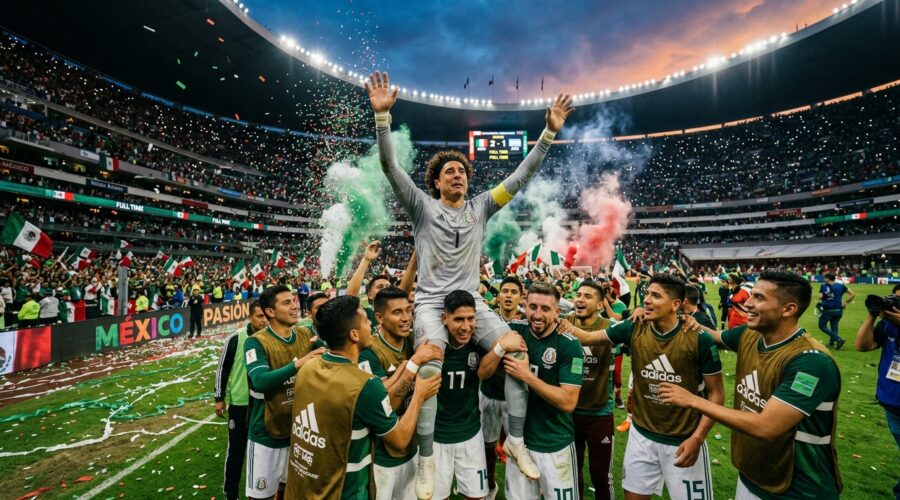
But the evening’s emotional centrepiece arrived not in goals but in a substitution. Guillermo Ochoa, aged forty, wearing the number thirteen, was brought on in the second half. The crowd at Mexico City Stadium — already invested in every touch — understood immediately what they were witnessing. This was his sixth FIFA World Cup. A record-equalling feat. A mark that, for all the talk of Messi and Ronaldo chasing the same milestone, has a goalkeeper’s particular stubbornness about it: Ochoa has spent six tournaments standing between Mexico and disaster, and the nation has not always made it easy for him.
When the final whistle blew, his teammates lifted him. There is no statistic for what that image communicated, which is perhaps why it will outlast every xG figure from the evening.
South Africa 1–0 South Korea — Estadio BBVA, Monterrey
Heung-min Son was introduced at halftime, the Korean community in Monterrey creating something close to a home atmosphere, and for forty-five minutes the Son-shaped cavalry was supposed to arrive and resolve everything. He touched the ball twenty-nine times. Once inside the penalty area. His World Cup goal drought, which had stretched back to 2018 and had already been ended by two goals earlier in this very tournament, was not extended further here — but nor did he add to his tally.
That tells you something about how South Africa set up. Hugo Broos is not a manager who invites pressure and then absorbs it romantically. His Bafana Bafana are organised, compact, and extremely difficult to play through — a shape that gave South Korea’s 68.4% possession about as much threat as driving very fast along a road that leads nowhere. Ronwen Williams in goal was as composed as his manager requires. And in the sixty-third minute, Thapelo Maseko finished with his left foot, and a nation of sixty million people breathed out.
South Africa have qualified for the World Cup knockout stage for the first time in their history. Hosting the tournament in 2010 — an occasion of almost unbearable national pride — had not delivered it. Three group stages, three group stage exits. And now, finally, after a journey that reportedly included pre-tournament visa chaos and administrative failures that left the squad uncertain whether they would even board a plane, Hugo Broos’ side are in the Round of 32. Against Canada, admittedly — nothing is simple — but in it nonetheless.
South Korea, meanwhile, wait. Their third-place standing keeps open the possibility of advancing as one of eight best third-place finishers. Myung-Bo Hong’s team were better than the result suggested, which is the consolation that changes nothing.
Group E: Ecuador Rewrites the Story; Ivory Coast Finally Arrives
Ecuador 2–1 Germany — MetLife Stadium, East Rutherford (80,663)
Before this tournament, Germany had won eleven consecutive matches. They needed one more to equal the national record set between 1979 and 1980. Julian Nagelsmann’s side had swept through the group stage looking like a team with a plan, a purpose, and the personnel to carry both. Leroy Sané put them ahead inside two minutes at MetLife Stadium — after a VAR review that examined an apparent boot to a head in the build-up and decided it could live with itself — and for a brief, misleading moment everything was proceeding as expected.
It took Ecuador seven minutes to dismantle that particular illusion. Nilson Angulo equalised with a shot from outside the box, and the eighty thousand in attendance began to sense that this was not going to be the choreographed German march they had anticipated. Sebastián Beccacece’s Ecuador played with the organised ferocity of a side that has nothing to lose, which is a genuinely dangerous quality when the other team is playing with the cautious confidence of a side that has too much to protect.
The decisive moment arrived in the seventy-seventh minute — and its choreography deserves attention. Kevin Rodríguez had been introduced in the sixty-fourth minute, a tactical intervention by Beccacece that restructured Ecuador’s attacking threat at precisely the moment Germany would have expected the contest to be managed out. Rodríguez provided the assist; Gonzalo Plata poked it past Manuel Neuer from close range. Two forty-year-olds in this group stage — Neuer and Ochoa — and only one had the evening he deserved.
Germany’s Deniz Undav, three goals and two assists in the tournament, added nothing to either column. Nico Schlotterbeck limped out of the match with an ankle injury that ends his tournament. The record of eleven wins falls one short. And Ecuador advance to the knockout stage as a third-place finisher — only the second time in their history they have reached that point, and the first since 2006. That the 2006 tournament was hosted, in part, by Germany is one of those historical coincidences that football offers with a straight face and expects you to appreciate.
Curaçao 0–2 Ivory Coast — Lincoln Financial Field, Philadelphia
Ivory Coast had appeared at three previous World Cups — 2006, 2010, 2014 — and had not once reached the knockout stage. A generation of exceptional players, including in their prime a squad that would have graced any tournament in history, had been drawn into groups of impossible difficulty and eliminated before the real business began. On June 25, 2026, in Philadelphia, that particular source of national frustration was finally addressed.
Nicolas Pépé scored in the seventh minute — the earliest goal in Ivory Coast’s World Cup history, set up by nineteen-year-old Yan Diomandé, who capitalised on Curaçao playing out from the back with a generosity their opponents did not deserve. Pépé hammered it low and first-time through Eloy Room from six yards, and the relief in the Ivory Coast dugout was not subtle. These were Pépé’s first competitive international goals since October 2024. Coach Emerse Faé had repaid faith by placing faith, and Pépé had responded in kind.
His second, in the sixty-fourth minute — assisted by Ibrahim Sangaré — ended whatever slim hope Curaçao retained. Jurien Garri had gone wide in the fourteenth minute; Sherel Florarus had lifted one high in the fifty-fifth. The margins, in the end, were stark.
A word for Dick Advocaat’s team, because they deserve more than a footnote. The seventy-eight-year-old Dutch manager — overseeing Curaçao’s campaign with the quiet authority of someone who has seen everything — guided the participation of the smallest nation by land area and population ever to appear at a FIFA World Cup. Curaçao lost to Ivory Coast in their final group game. They drew with Ecuador. They showed, throughout, that they belong in this conversation, even if the tournament ultimately proved one level beyond them. That is not failure. That is an extraordinary national achievement dressed up as a group stage exit.
Group F: The Netherlands Dominant; Japan and Sweden Both Survive
Netherlands 3–1 Tunisia — Arrowhead Stadium, Kansas City
Tunisia entered this match having lost their first two group games, with coach Sabri Lamouchi already relieved of his duties after the opening fixture and Hervé Renard brought in to steady a listing ship. The ship, it should be noted, had already sunk — Tunisia needed a constellation of results to advance — so Ronald Koeman’s Netherlands were effectively playing a side with nothing to lose and no particular reason to organise themselves around the kind of defensive structure that causes European heavyweights problems.
They did not. An own goal inside the opening five minutes and a Brian Brobbey finish in the eighth made it 2–0 almost before the Arrowhead crowd had settled. Brobbey ends the group stage with three goals in three matches — a composed, muscular presence who has outscored nearly everyone in the tournament. The Netherlands finish Group F with ten goals, seven points, and the air of a team that is yet to find its ceiling. Crysencio Summerville’s two goals and an assist, Cody Gakpo’s contributions, Frenkie de Jong’s orchestration, Tijjani Reijnders running between lines, Virgil van Dijk declining to be beaten at the back — it is a squad of serious depth, and the Round of 32 awaits Morocco.
Tunisia finish with no points, a goal difference of minus ten, and the memory of a tournament that went wrong from the first kick. Sometimes a group stage exit is a genuine injustice. This was not one of those times.
Japan 1–1 Sweden — AT&T Stadium, Arlington
When the permutations lined up, both Japan and Sweden knew a draw was almost certainly sufficient. Football being what it is, they went and produced a draw anyway — whether by design, instinct, or the simple reality that neither side could sustain the pressure required to genuinely threaten the other in the final twenty minutes after both had scored.
Daizen Maeda put Japan ahead in the fifty-sixth minute. Anthony Elanga equalised six minutes later. After that, the match settled into the kind of cautious arithmetic that final-day group stage football tends to produce when the numbers are manageable. It is not always pretty. It is, however, rational.
Japan finish second in Group F with five points and face Brazil in Houston in the Round of 32 — a fixture that carries all the romance and statistical improbability of a David and Goliath pairing, except that this particular David has a highly organised defensive block and a manager who will absolutely not be intimidated by the occasion. Sweden, third with four points, likely face France in New York. Graham Potter’s side have performed with considerable credit throughout and will not be straightforward opponents for anyone, even a Mbappé-led French team currently among the Golden Boot contenders.
The Bigger Picture: Records, Races, and What Comes Next
The Ecuador versus Germany match at MetLife Stadium drew 80,663 people, and that attendance pushed the total for the 2026 World Cup to 3,587,539 — surpassing the all-time record of 3,587,538 set by the United States in 1994, by precisely one spectator. The expanded format and the sheer scale of the North American host cities have delivered on their most basic promise, whatever reservations one might hold about the sporting logic of a forty-eight-team group stage.
The Golden Boot race, for those who track such things, has Lionel Messi leading with five goals from two matches — a rate of production that is either brilliant or faintly alarming depending on what you think the tournament can sustain. Vinicius Junior, Kylian Mbappé, and Erling Haaland each have four, with group games still to play. Deniz Undav’s three goals and two assists for Germany may ultimately be the most complete contribution of any player in the early running who now faces elimination pressure in the knockouts.
The confirmed Round of 32 matchups make for compelling reading. Mexico against Scotland. South Africa against Canada. Germany against an opponent still to be determined. Ivory Coast against whoever emerges second from Group I. Netherlands against Morocco. Brazil against Japan. Sweden, likely, against France. The remaining groups — D, G, H, I, J, K, and L — complete their final matchdays between June 26 and 28, and the full bracket will then be known.
What June 25 delivered, across six matches and three groups, was a reminder of why the World Cup remains the only sporting event that can produce a Guillermo Ochoa moment, a Bafana Bafana watershed, and an Ecuadorian upset of genuine historical weight all on the same afternoon and evening. The spreadsheet captures the scorelines. The narrative, as always, is rather more complicated — and rather more worth telling.