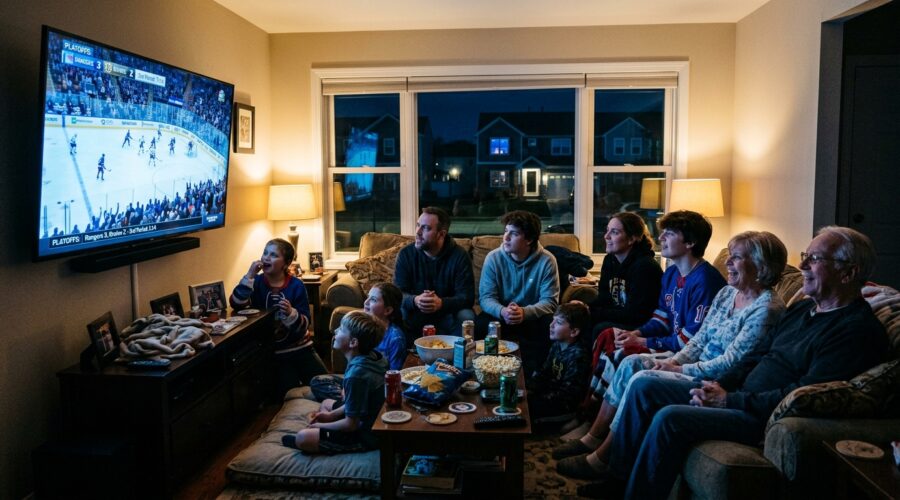
For the better part of two decades, hockey occupied a peculiar position in the American sports landscape: beloved by its existing fans with a near-religious intensity, virtually invisible to everyone else. The NHL was the league that kept producing generational talent — Crosby, Ovechkin, McDavid — and watching those talents perform for audiences that barely registered on the broader cultural radar. The sport’s ceiling in the United States felt fixed, its fanbase self-selecting and stubbornly static.
The 2026 Stanley Cup Playoffs may have just shattered that ceiling entirely. The numbers arriving out of this postseason are not incremental. They are seismic. And the story behind them is more complicated, more interesting, and more consequential for the future of American sports media than any single headline can capture.
The Numbers That Rewrote the Record Books
Start with the raw data, because it demands to be stated plainly. TNT Sports averaged 1.4 million viewers through the Conference Finals of the 2026 playoffs — a 50% increase over 2025 and the network’s best-ever NHL performance since acquiring rights in 2021. The First Round of the playoffs, combined across ESPN and TNT Sports, averaged 1.2 million viewers — up 68% year-over-year and the most-watched opening playoff round in U.S. history.
Game 1 of the Stanley Cup Final between the Vegas Golden Knights and Carolina Hurricanes, broadcast on ABC on June 2, drew 4.8 million viewers — the most-watched Stanley Cup Final opener since 2019, nearly double the 2.4 million who watched Game 1 of the 2025 Final on TNT, and 54% above the 3.1 million for Game 1 of the 2024 Final on ABC.
The regular season was no longer just a prelude to the story. The 2025–26 NHL regular season averaged 546,000 viewers per nationally televised game, a 25% year-over-year increase and the highest regular-season average in 14 years — the best since the NBC era of 2012–13. The NHL Stadium Series matchup between the Boston Bruins and Tampa Bay Lightning on February 1 drew 2.07 million viewers, the most-watched regular-season cable NHL telecast ever recorded.
Individual playoff games produced their own jaw-dropping moments. Game 7 of the Montreal Canadiens versus Tampa Bay Lightning First Round series on TNT averaged 2.3 million viewers and peaked at 3.2 million — the most-watched First Round cable game ever featuring a Canadian team. The Sabres-Canadiens Game 6 on ABC drew 2.7 million, the most-viewed individual game through the Second Round. The Eastern Conference Final between Carolina and Montreal on TNT Sports averaged 2.0 million viewers, with Game 3 on Memorial Day peaking at 2.6 million, the largest Conference Final audience in TNT Sports NHL history.
Across all rounds, the 2026 playoffs are averaging 1.4 million viewers — up 63% from 2025 and 24% above the previous all-time record set just two years prior in 2024. The sport is not merely trending. It is rewriting its own historical benchmarks in real time.
The Olympic Catalyst: America Remembers What Hockey Feels Like
To understand how we got here, you have to go back to the morning of February 22, 2026, in Milan. For the first time since Sochi 2014, NHL players suited up for their countries at the Winter Olympics. For the first time since the 1980 Miracle on Ice — 46 years — the United States men’s hockey team won Olympic gold.
Jack Hughes of the New Jersey Devils scored the overtime winner as the U.S. defeated Canada 2–1 in the men’s gold medal game. The game averaged 18.6 million live viewers on NBC and Peacock, peaking at 26 million viewers — NBC’s second-most-watched hockey game in U.S. history, behind only the 2010 Vancouver Olympics men’s gold medal game (Canada vs. USA), which averaged 27.6 million viewers. It was, per Nielsen, the most-watched sporting event on record in U.S. history with a start time before 9 a.m. Eastern. The combined North American audience at the moment Hughes’ shot crossed the goal line approached 35 million people.
The women’s gold medal game, where Team USA also defeated Canada 2–1 in overtime, drew 5.3 million viewers — the most-watched women’s hockey game in U.S. history. The overall Milano Cortina Winter Olympics averaged 23.5 million viewers, the most-watched Winter Games since 2014 and roughly double the 2022 Beijing audience.
The ripple effect was immediate and measurable. Post-Olympic TNT Sports NHL games averaged 453,000 viewers — up 47% from the same window the prior year. ESPN and ABC post-Olympic games averaged 785,000 — up 17%. NHL COO Stephen McArdle did not hesitate to connect the dots: “The Olympics were a cultural moment. We know that Olympic viewership does appeal to those demographics, to that female demographic, and so I think the Olympic bump that we saw was really in part influenced by that female Olympic audience.”
This was the spark. But unlike previous Olympic hockey moments that faded quickly from the public consciousness — the 2014 Sochi tournament produced no lasting U.S. viewership growth — the 2026 moment landed on a field of dry tinder that had been accumulating for months.
The New Hockey Fan: Young, Female, and Here to Stay
The most transformative — and most debated — story of the 2026 playoff surge is the explosion in female viewership. ESPN reported a 106% increase in women viewers. TNT Sports reported a 66% increase. The 18–34 female demographic drove a disproportionate share of that growth across both networks.
The instinct to reduce this story to a single viral streaming show is understandable. Heated Rivalry — a Canadian production based on Rachel Reid’s novel, following the relationship between two rival NHL players — logged 254 million minutes viewed in a single week in January 2026 and was drawing 8–9 million viewers per episode by late January. British Vogue named it among the best television shows of the century. The cultural footprint was undeniable.
Then, on May 13 — right as the Stanley Cup Playoffs shifted into Second Round — Amazon Prime Video premiered Off Campus, based on Elle Kennedy’s bestselling college hockey romance novel series, which has sold 25 million copies worldwide. Amazon said it instantly became the platform’s top show worldwide.
But crediting romance programming alone would be both incomplete and condescending. TNT Sports EVP and Chief Content Officer Craig Barry was careful to frame it accurately: “It’s not any one thing. It’s the collective of the planets aligning that has shown dramatic increases in the female audience.”
What those planets look like in sequence: the 4 Nations Face-Off in February 2025 — a tournament that replaced the All-Star Game and included an overtime thriller between the U.S. and Canada — introduced many casual viewers to NHL-caliber hockey in a concentrated, high-stakes format. The 2026 Olympics amplified that exposure by an order of magnitude. Fiction provided emotional entry points and parasocial relationships with hockey culture. And the NHL’s own TikTok strategy — deliberately creating content that skewed toward female audiences and building the crossover profiles of players like Quinn Hughes, Jack Hughes, and Connor Bedard — converted cultural interest into game viewership.
ESPN VP of Production Linda Schulz articulated the fundamental challenge the league has always faced: “Hockey is a particular challenge because sports fans tend to follow something that they themselves have participated in. Hockey is one that is not as commonplace for people to have actually strapped on skates.” The 2026 moment may represent the first time the NHL found a genuine answer to that challenge at scale.
The sustainability question is real. The 2014 Sochi Olympics, by most measures, did not produce lasting growth for the NHL in the United States. What makes 2026 feel different is the layering: a larger and more emotionally resonant Olympic spike, a primed audience from the 4 Nations, persistent cultural touchpoints in Heated Rivalry and Off Campus, a sustained social media presence, and a crop of young stars — Macklin Celebrini’s 115-point rookie season, Mitch Marner’s 24-point playoff performance through Game 1 of the Final — who offer the kind of compelling personalities that casual fans can follow across platforms.
The Bracket Mattered, and So Did the Production
Ratings do not exist in a vacuum. The 2026 playoff bracket delivered exactly the kind of compelling narrative architecture that television audiences reward. The Flyers versus Penguins First Round series — reviving one of the sport’s signature rivalries in a combined market of over six million people — drew 2.1 million viewers for Game 1 on ESPN, the most-watched First Round cable game ever (excluding Game 7s). Sidney Crosby in defeat was still Sidney Crosby, and casual sports fans noticed.
The Montreal Canadiens’ run to the Conference Final was perhaps the single most important viewership driver of the postseason. Montreal’s seven-game series against Tampa Bay in the First Round — featuring four overtime games — culminated in a record Game 7. Their seven-game Second Round battle with Buffalo produced the single most-watched game through Round 2. Their presence in the Eastern Conference Final on TNT Sports drove that series to record cable numbers for the network’s NHL coverage. A Canadian franchise in a non-Nielsen-rated market paradoxically became the engine of American viewership growth because the Canadiens, historically, carry a national emotional resonance in ways that few franchises anywhere in North American sports can match.
On the production side, TNT Sports made a deliberate and consequential commitment: full onsite production for every game throughout the 2026 postseason, across up to 49 total games spanning TNT, TBS, truTV, and HBO Max. Lead Game Producer Kevin Brown, Director John Tackett, Technical Director Dan Crosswait, and A1 Audio Engineer Tim Dunn were physically present at every venue throughout the run. The network expanded its use of Nucleus cameras — ultra-compact rigs that open up novel ice-level sightlines previously inaccessible to traditional broadcast equipment — giving the telecast a visual intimacy that matched the intensity of the hockey itself.
The studio team anchored by host Liam McHugh, with Wayne Gretzky, Henrik Lundqvist, Anson Carter, and Paul Bissonnette in analysis roles, brought a credibility and personality combination that attracted both hardcore fans and newcomers. The Face Off pre-game show was expanded to a full hour for high-profile games. These are not the decisions of a network treating a sports property as filler. They are the choices of a network that understood, correctly, that this was its moment.
The “You Just Have to Watch” Gamble That Paid Off
Perhaps the most structurally significant development of the 2026 postseason had nothing to do with any individual game or series. For the first time in NHL broadcasting history, ESPN and TNT Sports — competing rights holders — collaborated on a unified marketing campaign.
Developed by Arts & Letters Creative Co. and coordinated with the NHL and Canada’s Sportsnet, the “You Just Have to Watch” campaign deployed three distinct spots — Fired Up, Overtime, and Do Anything — across the first three rounds of the playoffs. The creative concept centered on new patrons walking into crowded hockey bars and discovering playoff hockey’s emotional velocity for the first time. Each spot was owned in post-production by a different network. Each one told the same story: the game will convert you if you just give it a chance.
The irony is that the campaign’s message proved to be entirely accurate. The data confirmed it round by round.
The Measurement Caveat — and Why It Does Not Explain What Happened
Any honest accounting of the 2026 surge must address Nielsen’s Big Data + Panel methodology, adopted in September 2025, which expanded out-of-home measurement across 100% of markets and produces an across-the-board lift in live sports averages. Comparable lifts for the 2025–26 season included NBA playoffs up 35%, men’s college basketball up 19%, and the NFL up 10%.
Analysts estimate the methodology adds roughly 5–10% to live sports averages. The NHL’s 68–70% playoff increases are not 5–10% numbers. Sports Media Watch analyst Jon Lewis acknowledged that the changes “generally skew comparisons to past years” while noting they would not explain a 25% year-over-year increase in regular-season averages. OutKick’s Bobby Burack was blunter: the NHL’s increases “go well beyond any measurement changes. For comparison, that is not the case for the NBA playoffs.”
The growth is real. The methodology adds context, not an explanation.
What Comes Next: A League at the Negotiating Table With All the Leverage
The 2026 ratings surge arrives at an extraordinarily consequential moment for the NHL’s business future. The current U.S. media rights deal — ESPN at approximately $400 million per year and TNT Sports at approximately $225 million per year, part of a combined $4.5 billion, seven-year agreement — expires after the 2027–28 season. Commissioner Gary Bettman has already approached both partners about early renewal. At the State of the League, he was characteristically measured and maximally clear: “The value of our rights has never been greater. And I believe our partners, both of whom we love, will treat us fairly.”
Unconfirmed industry speculation points toward a next-cycle deal potentially worth $7.2 billion over eight years — more than doubling the current annual average rights value. Whether that specific figure materializes or not, the directional logic is sound. A property that just produced the most-watched opening playoff round in U.S. history, the most-watched Stanley Cup Final Game 1 in seven years, and a 106% surge in a demographic that commands premium advertising rates has fundamentally stronger leverage than it had twelve months ago.
For TNT Sports specifically, the stakes are existential in the most literal business sense. Warner Bros. Discovery lost its domestic NBA rights to Disney, NBCUniversal, and Amazon Prime Video in a three-way, 11-year deal valued at approximately $77 billion — a transition that took effect after the 2024–25 season. The NHL is now the network’s most important live sports property. TNT Sports CEO Luis Silberwasser confirmed the network is “extremely interested” in retaining NHL rights beyond 2028 — a statement that carries the weight of institutional survival as much as editorial preference.
The proposed Paramount-WBD merger adds another dimension. Bettman has called it “potentially very good” for the NHL, with barely concealed enthusiasm about the prospect of CBS broadcast access: “I can’t wait to meet David Ellison and talk about those things. And yes, I would be very excited to see the opportunity that being with CBS would present.” The comparison between Game 1 of the 2026 Final on ABC (4.8 million) and Game 1 of the 2025 Final on cable TNT (2.4 million) makes the argument for broadcast exposure more forcefully than any executive talking point could.
Front Office Sports framed the broadcast-versus-streaming dynamic with admirable directness: “Another possible reason the TV ratings are surging? The games are actually on TV.” The linear-first, streaming-as-add-on model — with all playoff games accessible via two streaming services for under $50 per month combined — has maximized casual reach while avoiding the audience fragmentation that has undermined other properties’ growth narratives. The NHL’s next rights negotiation will be, in part, a fight over how much more broadcast exposure the league can secure. Every fraction of that fight is being funded by the 2026 numbers.
The Larger Question Behind the Numbers
The 2026 Stanley Cup Playoffs have given the NHL something it has spent three decades searching for: undeniable evidence that the American sports audience is capable of caring about hockey at scale. Not just the existing base, not just the markets where the game has always been embedded in local culture, but a genuinely new and demographically diverse audience that arrived through multiple doors simultaneously and appears, at least for now, to have decided to stay.
Bobby Burack at OutKick captured the cultural shift as plainly as anyone: “For the first time in nearly a decade, hockey feels like a real factor in the American zeitgeist. It started with the Olympics.”
What it becomes from here depends on decisions that will be made over the next 18 months — in media rights negotiations, in broadcast strategy, in league marketing, in the continued development of young stars like Macklin Celebrini and the next wave of players who can hold a casual fan’s attention across every platform simultaneously. The NHL has been in positions of momentum before and failed to convert them into lasting structural growth.
The difference in 2026 is that the evidence for momentum is not anecdotal or confined to one market or one demographic. It is everywhere in the data, simultaneously, and it is being driven by forces — cultural, technological, and competitive — that the league did not entirely manufacture and therefore cannot entirely control. That is both the promise and the uncertainty of this moment.
The game has never been better. The audiences are finally showing up to confirm it. The next question is whether the business decisions made in the next two years are worthy of what is happening on the ice.