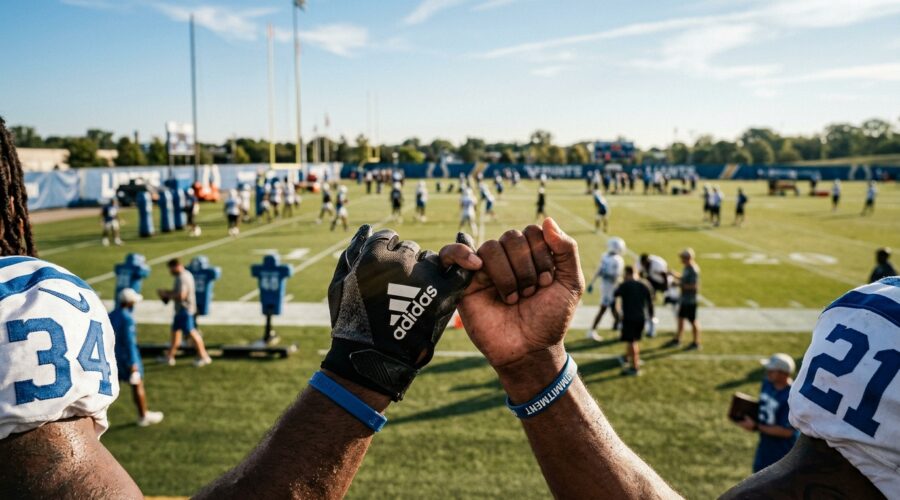
On July 31, 2026, at Broncos Park in Centennial, Colorado, a 27-year-old running back with a medical history that reads like a surgical textbook stood in front of reporters and made one of the boldest guarantees in recent NFL memory. J.K. Dobbins — a man who has torn his ACL, LCL, meniscus, and hamstring all on the same play, blown out an Achilles on the first series of a season, fractured his foot on a hip-drop tackle, and missed 47 games across six professional years — looked into the cameras and promised to lead the entire NFL in rushing yards while playing all 17 games in 2026.
He sealed the deal with a pinky promise. Then he went inside and reportedly gave double pinky promises to his head coach and general manager.
There is no way to write about this without acknowledging the comedy. And yet, when you actually sit down and run the numbers, the most surprising thing is that the argument for Dobbins is almost as strong as the argument against him. Almost.
The Case File: What We Are Actually Dealing With
Let us establish the baseline before we start arguing about anything. J.K. Dobbins has a 5.2 career yards per carry average. That figure is not a rounding error — it places him among the most efficient rushers of his era. In his breakout rookie season with Baltimore in 2020, he posted a 6.0 YPC on 134 carries, the second-best rate by a rookie in two decades at the time. In 2024 with the Chargers, he put up 905 rushing yards and nine touchdowns before suffering a Grade 2 MCL sprain in Week 12 that sent him to injured reserve — though he was activated off IR on December 27, 2024, and returned to play, finishing the season with 13 games played. In 2025 with Denver, he was ranked third to fifth in the NFL in total rushing yards before Tyree Wilson’s hip-drop tackle in Week 10 sent him to injured reserve with a Lisfranc fracture. He was on pace for approximately 1,375 scrimmage yards on the season.
The talent has never been the question. The talent is obvious, empirically established, and repeatedly confirmed. The issue is a body that has, with truly stunning consistency, found new and creative ways to fail him before he could finish a full calendar year of football. His comprehensive injury timeline looks like this:
- 2021: Torn ACL, LCL, meniscus, and hamstring — all in a single preseason play against Washington. Missed the entire season.
- 2022: Arthroscopic knee surgery. Returned in Week 14, played eight games.
- 2023: Torn Achilles on the first series of Week 1 against Houston. Played exactly 22 yards worth of football that year.
- 2024: Grade 2 MCL sprain in Week 12. Activated off injured reserve on December 27 and returned to play, finishing with 13 games played and career-high production.
- 2025: Lisfranc fracture via hip-drop tackle, Week 10. Ten games, 772 yards, 5.0 YPC.
He has never played more than 15 games in a single NFL regular season. He has never played 17. He is being asked to do something he has literally never done in six years of professional football, and he is doing so coming off a foot fracture that typically carries a six-to-twelve month recovery timeline. His career earnings through 2025 sit at approximately $10.5 million — a figure suppressed almost entirely by the fact that his body kept preventing him from reaching free agency at full health.
That is the file. Now let us get into why he might actually be right.
The Offseason Work: ‘Elasti-Boy’ and the TB12 Gambit
Dobbins did not just show up to training camp and declare himself healthy. He showed up with a theory. Specifically, he showed up referencing Tom Brady’s TB12 pliability philosophy — the idea that longer, more flexible muscles are better equipped to absorb contact without tearing — and then physically demonstrated that he had regained the ability to do the splits.
“I’m going to be like Elasti-Boy,” he told reporters, describing what would happen if someone hit him with another hip-drop tackle. “I’ll be over there bouncing back up from it. Like, if I get hip-drop tackled, I’ll just touch my head to the back of my foot and get back up.”
He also mimicked going limp like, per the Denver Post, an inflatable balloon man outside a car dealership.
It is easy to laugh at this. The TB12 method has its skeptics, and Dobbins leaning on flexibility training as a structural injury-prevention strategy is not the same as, say, surgically reinforcing his connective tissue. But here is the thing: there is a legitimate theoretical basis for pliability work reducing soft tissue injury risk, and Dobbins additionally trimmed down to his college weight to reduce mechanical stress on his joints. These are not just press conference talking points. They represent a real, intentional approach to injury prevention — one that Dobbins, to his credit, implemented before camp rather than just announcing at camp.
Whether it works is the $20 million question. Literally — that is what his max contract value is.
The Contract: Sean Payton Put His Money Where His Mouth Is
On March 10, 2026, Denver passed on Travis Etienne (who signed with New Orleans) and Kenneth Walker (who hit early free agency) to re-sign Dobbins to a two-year deal worth $16 million base and $20 million at maximum value, with $8 million fully guaranteed in Year 1. The 2026 cap hit comes to $6 million — a relatively team-friendly number given the production when healthy.
Year 2 is a non-guaranteed team option, which tells you everything you need to know about how both sides are thinking about this arrangement. Denver is betting on one season. Dobbins is betting on himself delivering one season. They are aligned.
“Getting J.K. back was a priority above all others,” Sean Payton said on July 31. “He was a big part of why we won 14 games last year, and sometimes that can get lost in the narrative.”
It should not get lost. When Dobbins was healthy in 2025, the Broncos were 8-2. Their rushing attack generated a plus-230 rushing yards over expectation in Weeks 1 through 10. Their EPA per carry was -0.01. After he went on injured reserve, the offense ran at a -0.08 EPA per carry and produced a -124 RYOE over the final eight weeks. The Broncos still advanced to the AFC Championship Game, where they lost 10-7 to the New England Patriots without both Dobbins and quarterback Bo Nix. Denver’s offensive identity is not just better with Dobbins — it is structurally different with him, and the difference is quantifiable.
The Backfield Setup: For the First Time, He Has Real Cover
One of the underappreciated parts of the 2026 setup is that Dobbins is entering the season with the deepest running back room of his Denver tenure, which also happens to be the most equipped for genuine load management. RJ Harvey — who rushed for seven touchdowns as a 2025 second-round rookie out of UCF — is the RB2. Jonah Coleman, a 2026 fourth-round pick from Washington who put up 1,053 yards and 15 touchdowns in college in 2025, profiles as a legitimate thumper and third-down option. Jaleel McLaughlin, Tyler Badie, and fullback Adam Prentice round out a group that Payton called “markedly better” than previous years.
Payton has publicly discussed load management as part of the plan. That is not nothing. Previous Dobbins seasons in Denver did not feature the same luxury. In 2025, Denver leaned on him heavily early in the season, and when he went down, the replacement options were clearly insufficient. In 2026, the intent is to pace him, protect him, and keep him fresh into December — the months he has historically never reached.
Linebacker Alex Singleton, who has watched Dobbins up close in practice, offered an assessment that cuts against the conventional narrative: “Every time he comes back, he’s better than he was the version before.” That is a strange thing to say about someone with Dobbins’ injury history, but it is also arguably true from a production standpoint. Each healthy stretch has been better than the last.
The Competition: Because This Is Not Just About Staying Healthy
Even if Dobbins plays all 17 games, winning the rushing title is a separate challenge. The field in 2026 is legitimately difficult.
Ashton Jeanty is the most dangerous rival on paper. The Raiders’ 2025 sixth-overall pick led all rookies in rushing yards with 975 in his first season — a figure made more impressive by the fact that he did it behind a porous offensive line, with multiple midseason coordinator changes, and still finished as a top-10 fantasy running back. FantasyPros projects him for 1,107 rushing yards in 2026, and with new head coach Klint Kubiak firmly committed to feeding him the football, a new quarterback in Fernando Mendoza potentially stabilizing the offense, and improved blocking personnel, Jeanty’s ceiling is substantially higher than his projection. He is 22 years old and actively improving. He is also a division rival whom Dobbins will face twice.
Omarion Hampton is the high-upside wildcard. The Chargers’ 2025 first-round pick played only nine games as a rookie due to ankle injuries but posted a 4.4 YPC and showed legitimate burst when healthy. New offensive coordinator Mike McDaniel — a Mike Shanahan disciple who spent four seasons as the head coach of the Miami Dolphins before joining the Chargers — has already compared Hampton to Terrell Davis. Hampton himself said the system is “going to be super good for us.” When Hampton’s own new coordinator is making Terrell Davis comparisons, it is appropriate to take notice. His ceiling is top-three at the position.
FantasyPros projects Dobbins for 218.2 carries, 1,020.7 rushing yards, and 6.6 touchdowns in 2026 — which ranks him RB32 overall due to the injury discount baked into his ADP of RB34. His best-case range is RB23. His worst-case range is RB42. The market, in other words, does not believe the pinky promise.
The Honest Skeptic’s Corner
Here is where we have to be direct about something. Dobbins made a version of this speech before the 2024 season with the Chargers. He said the storm was over with. He made similar health declarations before Denver’s 2025 minicamp. In each case, the injuries were different, the circumstances were different, and in each case the outcome was the same: he got hurt before Week 17.
Dobbins acknowledged this himself on July 31, noting that “a lot of people always get mad when I say the injuries are over, because I said it last year.” His defense — that the 2025 Lisfranc fracture was “pretty fluky” because it was caused by an external hit rather than a structural failure — is reasonable as far as it goes. A hip-drop tackle to the ankle is an acute, externally-caused injury. It is categorically different from an ACL tear caused by planting incorrectly. His argument has merit.
But here is the uncomfortable counterpoint: his 2021 ACL tear, his 2022 arthroscopic surgery, his 2023 Achilles, and his 2024 MCL could all be framed as “pretty fluky” too. The question is not whether each individual injury was fluky. The question is whether a player who has sustained significant injuries to virtually every major lower-body structure — knee, Achilles, MCL, foot — is operating at a biomechanical disadvantage that makes future injuries more likely. Sports medicine professionals have raised this concern specifically about Dobbins, noting that catastrophic multi-ligament injuries like his 2021 tear can permanently alter movement patterns in ways that increase susceptibility over time.
None of that means he cannot have a healthy 2026. It means the base rate argues against it, and the flexibility training, while theoretically sound, does not rewrite anatomy.
The Bigger Picture: What This Season Actually Means
Dobbins is 27 years old. This contract — with its non-guaranteed Year 2 — is functionally his final audition for a long-term deal. His career earnings of roughly $10.5 million represent a fraction of what an elite running back with his production profile would have earned had he stayed healthy. The $2 million incentive threshold tied to 1,200-plus scrimmage yards in 2026 is not just a contract clause. It is the version of the season that changes his financial trajectory.
He grew up outside Houston wanting to play for a Pee-Wee team called the Broncos and could not for financial reasons. He was not drafted by Denver. He came here as a one-year reclamation project and fell in love with the organization, calling Payton the best coach he has ever played for. He said publicly in January that he is “Born to be a Bronco” — not as a marketing slogan but as a statement of personal identity. There are two Raiders games on the schedule, one of which is a late-season trip to Las Vegas where Dobbins will face Tyree Wilson, the man whose hip-drop tackle ended his 2025. The Broncos lost the AFC Championship Game 10-7 without both him and Bo Nix. He said he would have played in a Super Bowl if Denver had advanced. He knows exactly what was left on the table.
“The storm can’t last forever,” he said. “I’m from Texas, born in Houston, and we get hurricanes. The storm can be long. It can be very dangerous. It can be dark for a long time. You don’t know when you’re going to get power. But they never last forever.”
It is a genuinely good quote. It is the kind of thing you want to believe.
The Verdict: An Informed Leap of Faith
Here is where this lands, intellectually honestly. The rushing title claim is a stretch — not because Dobbins lacks the talent, but because winning the rushing title requires approximately 1,400-plus yards in a season against competition that includes a year-two Ashton Jeanty and a potentially unleashed Omarion Hampton under one of the best run-game coordinators in football. Even a healthy Dobbins operating in a load-managed system is probably looking at 1,100-to-1,200 yards, which may not be enough.
But the health claim — 17 games — is actually not that crazy. The 2025 Lisfranc was caused by a specific type of tackle that the NFL has since been further pressured to address. The 2024 MCL was a contact injury in a pile. The 2023 Achilles is the most structurally concerning of the recent injuries, but that was three years ago, and every post-Achilles season since has produced better football than the one before it. He has one of the deepest supporting backfields of his career, a coach who is explicitly planning around protecting him, and a level of personal motivation that is not manufactured for a press conference.
The fantasy market has him as RB32 with an ADP of RB34. That is an injury discount so steep it essentially assumes he gets hurt. If you believe there is a 50-50 shot he plays 15 or more games — a completely defensible position given the above — then that discount is almost certainly too aggressive and represents genuine value for anyone willing to take the bet.
J.K. Dobbins has been one of the most productive backs in football every time he has been on the field. He has been one of the most unavailable backs in football every time he has been off it. In 2026, those two facts are colliding with a pinky promise, a set of splits, and a city that just watched an AFC Championship Game slip away without him.
The storm has been very, very long. Whether it is finally over is the only question that matters in Denver this season.