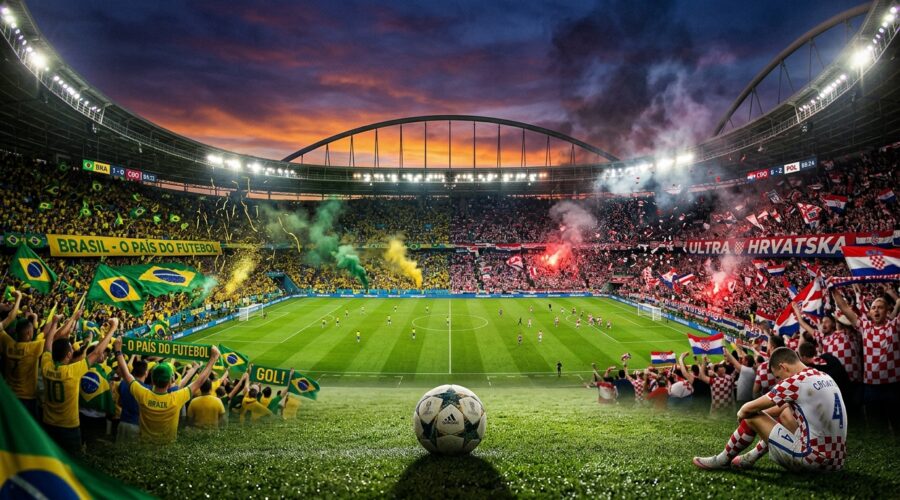
Four matches. Four groups concluded. Eight fates sealed. June 24 was the kind of footballing day that arrives fully loaded — the sort where you keep one eye on a ticker and the other on whichever match happens to be producing the most theatre at any given moment. Groups B and C completed their final matchdays simultaneously, and between them they offered everything this tournament has already shown it can deliver: clinical brilliance, arithmetical anguish, veteran farewell, and the particular cruelty of a side winning their match and still being sent home.
Settle in. There is a great deal to unpack.
Brazil 3–0 Scotland: The Samba Is No Longer a Metaphor
The most straightforward result of the day was, in truth, the most ominous. Brazil did not merely defeat Scotland. They conducted a ninety-minute education in what elite attacking football looks like when the system and the personnel are aligned with uncomfortable precision. The 3–0 scoreline flattered nobody — least of all a Scotland side that had done what no Scotland side had done in living memory simply by being present in the first place.
Vinicius Junior, by now operating in that rarefied territory where the distinction between form and genius becomes difficult to locate, continued his extraordinary tournament. Four goals and an assist from three group stage appearances. The way he moves — cutting inside, waiting for defenders to commit, then doing precisely what they were afraid he would do — carries the unmistakable quality of a man who has arrived in peak condition at peak moment. Brazil’s Carlo Ancelotti has built a structure that functions as a delivery mechanism for Vinicius’s instincts, and it is working with the kind of ruthless efficiency that should frighten every remaining side in the draw.
Matheus Cunha added to his tournament tally with multiple goals of his own across the group stage, contributing independently to a Brazil attack that has fired from multiple sources. Behind them both, at thirty-four and wearing the unmistakable expression of a man who knows this is the last chapter, Neymar orchestrated with the quiet authority of someone who no longer needs to prove anything. He is not the explosive force that tore through 2014. He does not need to be. In the role of creative orchestrator — threading, turning defenders, drawing pressure and releasing teammates — he has found a dignity that suits him rather well. Whether this is indeed his final World Cup, only he knows. But he is making certain it counts.
The defensive numbers are worth noting, even for those of us who reach instinctively for the match programme when someone starts quoting statistics. One goal conceded across three group stage matches. One. Marquinhos and Bremer, at the heart of a back four that has been asked to do relatively little but has done it without the slightest tremor of anxiety, form a partnership that looks entirely untroubled by the prospect of what lies ahead. This Brazil team has not merely qualified from a group. It has issued a statement.
As for Scotland — and this must be said with genuine warmth rather than condescension — the mere fact of their participation at a World Cup represents a watershed moment for a nation that has spent decades on the outside of these occasions. They beat Haiti on matchday one. They were outclassed by Morocco and Brazil in the matches that followed. Third in the group, with three points, and their heads held appropriately high. The romance of Scotland at a World Cup does not require a deep run to feel significant.
Morocco 4–2 Haiti: Hakimi’s Lions Put on a Show
Morocco did not need to win this match so emphatically. Second place was secure regardless. But this is a side that has absorbed Regragui’s ambition so thoroughly that throttling back is not obviously in their vocabulary, and Haiti — spirited, technically capable in patches, and utterly overmatched — were unable to contain the wave.
Ismael Saibari has been the tournament’s most compelling breakout story across these early weeks. Three goals in three matches for the Moroccan midfielder, who has graduated from clever dinked finishes to the sort of performances that make you wonder why anyone was surprised. Achraf Hakimi, captaining from right back, continues to do things that defenders are not supposed to do from that position — overlapping, arriving late, creating havoc — and Brahim Diaz behind the strikers was the kind of player Haiti’s defensive shape simply had no answer for.
Haiti scored twice, which speaks to their refusal to capitulate, and perhaps also to Morocco’s tendency to ease off when the contest appears decided. It is a minor flaw in an otherwise impressive group stage campaign. Morocco finish with four points and a goal difference of plus one, runners-up behind Brazil, and they will carry into the knockout rounds a combination of defensive organisation, attacking creativity, and the experience of having already navigated precisely this kind of tournament football four years ago in Qatar. They are not tourists here. They know exactly what this feels like.
Switzerland 2–1 Canada: The Prodigy Takes His Bow
Both sides already knew they were through. The question was only who would carry the label of group winner into the knockout bracket, and Switzerland answered it with a second-half performance shaped almost entirely by a twenty-year-old winger who arrived at this tournament as a squad option and is departing the group stage as one of its defining characters.
Johan Manzambi started a World Cup match for the first time against Canada in Vancouver, and he made the kind of impact that justifies the phrase full of himself in the most flattering sense possible. His assist for the opening goal came within seconds of the second half beginning — a cross of absolute intent, delivered before Canada had time to reset their defensive block. His second goal, slotted past the goalkeeper in the 57th minute with the composure of someone who has been doing this for years rather than weeks, extended the lead. Three goals and an assist from the group stage. He has become the first Swiss player since Shaqiri to score three or more in a single World Cup. He is twenty years old. Manzambi did not go unnoticed before this tournament, but he is leaving the group stage as a name that every Round of 16 opponent will have circled in red.
Granit Xhaka anchored the midfield with his customary authority — the grizzled general alongside the prodigy, which is perhaps a dynamic Switzerland will find useful as the stakes intensify. Gregor Kobel in goal was sharp when required, particularly in the final quarter when Canada, with nothing to lose and everything to gain in terms of group position, pushed forward with increasing urgency.
Jonathan David, with three tournament goals, departs the group stage as Canada’s standard-bearer in the Golden Boot conversation, though his nation’s advancement matters considerably more to him than any individual ledger. Canada are through. In the context of their footballing history, that remains something extraordinary enough to say without qualification.
Bosnia-Herzegovina 3–1 Qatar: The Beautiful Futility
There is a particular kind of misery in winning a match and still being eliminated, and Bosnia-Herzegovina experienced it in its purest form on June 24. They beat Qatar 3–1. Edin Džeko, the old warhorse who has spent the better part of two decades carrying Bosnian football on his considerable shoulders, spearheaded an attack that was full of purpose and rather too light on good fortune. They played with everything available to them. The mathematics had already decided their fate before kick-off.
Canada’s goal difference advantage of plus six over Bosnia’s minus three was simply too vast a chasm to bridge. Bosnia would have needed results of such cartoonish extremity — a scoreline in the double digits in their favour and an implosion of historic proportions from Canada — that the exercise was theoretical before a ball was kicked. They won anyway. You can read that as either nobility or tragedy, and Bosnia’s supporters in the stands seemed to settle on some of both.
Qatar, for their part, conceded eight goals in the group stage — a single point to show for three matches, and an exit that sits in jarring contrast to the pageantry of their 2022 hosting. The passage from tournament host to first-round departing guest in four years is not the trajectory anyone in Doha had planned. One Almoez Ali consolation against Bosnia does not alter the arithmetic of a deeply disappointing campaign.
The Golden Boot: Messi, and Then Everybody Else
While four matches completed the group stage business of two groups, one subplot continues to grow more extraordinary by the matchday. Lionel Messi leads the Golden Boot race with five goals in two matches. The specific mathematics of that sentence bear repeating. Five goals. Two matches. He turned thirty-nine years old on June 24 — and marked the occasion in the manner befitting the greatest footballer the game has produced. Earlier in the tournament, Messi surpassed Brazil’s Marta to become the outright leading scorer in World Cup history across both men’s and women’s competitions, reaching 18 World Cup goals and eclipsing a record many believed untouchable. He has done so with a group stage game still to play, and with the kind of clinical finishing that strips any romantic narrative of its necessity and replaces it with something starker: he is, at the moment, simply the best goalscorer in the building.
Mbappé has four in two matches, with one group game remaining. Haaland, finally at a World Cup, has four in two. Vinicius finishes the group stage on four, his account closed for this particular chapter. The four-way contest at the summit of the Golden Boot table is unlike anything this tournament has previously produced at this stage, and the fact that Messi is a goal clear of three generational strikers is a detail worth sitting with.
Saibari, Manzambi, David, and Matheus Cunha each sit on three. The conversation at the top will extend deep into the knockout rounds. Which is precisely where it should be held.
What We Know Now
Four teams qualified on June 24 from Groups B and C: Switzerland, Canada, Brazil, Morocco. Four were eliminated: Qatar, Bosnia-Herzegovina, Haiti, Scotland. The group stage ledger is settling, and the shape of the tournament is becoming visible.
Brazil look like a side that can go all the way, their defensive solidity and attacking firepower operating in a balance that feels sustainable rather than brittle. Morocco are experienced, organised, and dangerous. Switzerland have a twenty-year-old who is currently playing the best football of anyone at the tournament outside the established hierarchy of Messi, Mbappé, and Vinicius.
The knockout rounds begin in earnest shortly. What June 24 established — beyond the raw results, beyond the standings, beyond the Golden Boot arithmetic — is that this World Cup has the depth of quality and the abundance of narrative to sustain itself all the way to the final. The group stage has served its purpose. Now the real matches begin.