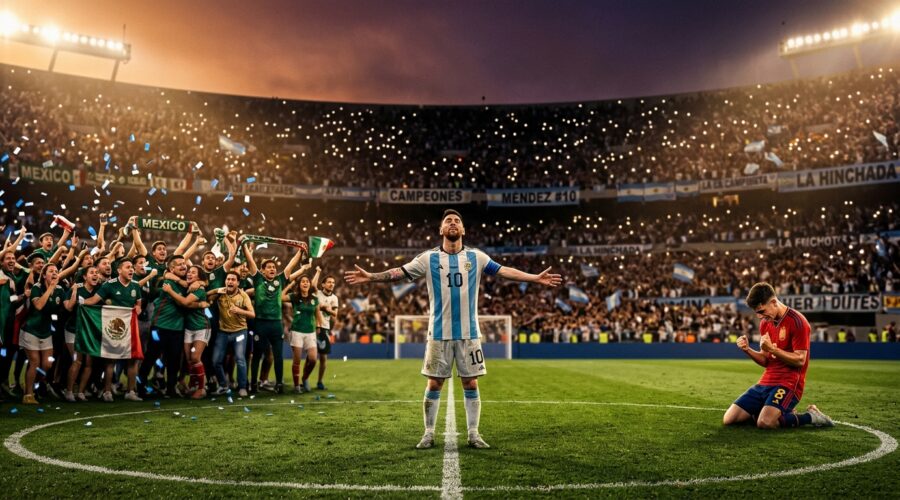
There are evenings in football where you feel the game reaching beyond itself — straining toward something that resists easy description. Saturday, June 28 was one of those evenings. Three matches, three continents of emotion, and a collective ninety minutes that will be replayed in compilation videos long after most of us have forgotten who lifted the trophy. From a sun-baked Arlington night where a thirty-eight-year-old man bent the laws of sporting time, to a Kansas City stadium that briefly threatened to resurrect the most dishonourable chapter in World Cup history before producing the exact opposite, to a Los Angeles afternoon that belonged to a midfielder who plays his club football across the city and spent ninety-two minutes waiting for his moment — June 28 delivered everything football promises and so rarely keeps.
Jordan 1–3 Argentina: The Conjurer Does It Again
Lionel Scaloni arrived at AT&T Stadium with a problem most managers would envy: his team had already won the group, Jordan were already eliminated, and he had a squad full of players who deserved minutes. His solution was ruthless in its elegance — nine changes, a near-reserve lineup, and the quiet assurance that the one man everyone had paid to see would get his thirty minutes. Football as controlled theatre.
The first half was brisk and efficient. Giovani Lo Celso, handed the kind of creative licence that rarely comes his way when the first XI is assembled, curled a free-kick of genuine quality into the top corner on nineteen minutes — the sort of strike that reminds you players are biding their time on benches that most of us would consider a career highlight. Lautaro Martínez added a penalty before half-time, his first World Cup goal, slotted with the composed authority of a striker who has been waiting for this particular moment for some time.
Jordan pulled one back midway through the second half through Musa Al-Taamari, who finished a low cross with a sliding precision that deserved a slightly larger occasion. The crowd, perhaps feeling some warmth for an outclassed side who had given the tournament nothing but honesty, gave it a generous reception. Jordan have now scored three goals at this World Cup, none of them meaningless, all of them earned.
And then, on sixty minutes, the old man walked on.
Twenty minutes. That was all Lionel Messi had. The crowd’s reception — in a stadium that holds 80,000 and felt, in that moment, like it was holding rather more — was the kind that precedes something. Scaloni knows his man. The free-kick came on eighty minutes, around twenty-two yards out, in the position Messi has owned for so long that goalkeepers barely bother preparing a different response. Low, curling, irretrievable. Yazeed Abu Layla made the correct diving motion; the ball simply went somewhere else.
The numbers that followed require a moment of stillness. His sixth goal of this tournament. His nineteenth World Cup goal in total, extending his own all-time Argentina record into territory no one will reach for generations. And, the record that will outlast all the others: the first footballer in the history of the competition to score in seven consecutive World Cup tournament appearances. His first came in 2006, in Germany, when he was eighteen years old. His latest came on a Saturday night in Texas, from a free-kick, in thirty minutes off the bench, with Argentina already qualified and the group already won. The casual brutality of greatness has always been Messi’s particular gift to the game.
Two goals ahead in the Golden Boot standings — six to the four of Vinicius Junior, Kylian Mbappé, Erling Haaland, and Ousmane Dembélé — he walks into the knockout stages with the quiet menace of someone who has not yet begun to concentrate.
Algeria 3–3 Austria: The Ghost of Gijón, Exorcised in Magnificent Style
Before a ball was kicked in Kansas City, the past was already present. Forty-four years is a long time to carry a grievance, but Algeria have carried this one with extraordinary patience. On June 25, 1982, in Gijón, Spain, West Germany and Austria played a match that was, depending on your appetite for euphemism, either a remarkable coincidence of mutual interest or a cynical and coordinated act of elimination. Horst Hrubesch scored in the 11th minute. The ball was then passed between the two sides with the urgency of men relocating furniture. Algeria, who had beaten West Germany earlier in the tournament — one of the great upsets in World Cup history — were eliminated on goal difference. The crowd in Gijón turned their backs and waved handkerchiefs in contempt. FIFA introduced simultaneous final-round kickoffs the following tournament. The Disgrace of Gijón became a fixed coordinate in the sport’s moral map.
Now, forty-four years later, Algeria and Austria found themselves in Group J — and in exactly the position of West Germany and Austria in 1982. Both teams entered on three points. A draw would send them both through and eliminate Iran. The historical symmetry was almost offensively neat: Algeria, the victims of 1982’s scandal, could now be the beneficiaries of the same arithmetic.
What happened instead was one of the most extraordinary group-stage matches in World Cup history, and a repudiation of every cynical assumption the scenario invited.
Austria went ahead through Marko Arnautovic — the oldest Austrian player to start a World Cup match at thirty-seven years and seventy days, breaking a record set by Michael Konsel in 1998, and doing so with the composed finish of a man who has decided age is largely an administrative inconvenience. Algeria equalised before half-time through Rafik Belghali, after Riyad Mahrez engineered a passage of play near the corner flag with the territorial possessiveness of a man who owns that stretch of turf. Marcel Sabitzer restored Austrian advantage with a curling strike of the highest order. Mahrez levelled again at sixty minutes, tapping in from close range after Houssem Aouar had carved open the left channel.
At that point, with the score at two-all, football’s more cynical constituency might have expected both teams to calculate their way to a handshake and a quiet half-hour of nothing in particular. They did not. Both teams kept pressing. And then, in the ninety-third minute, Mahrez — gliding behind a flat-footed Austrian backline with the effortless timing that has always been his signature — swept the ball into the bottom corner for three-two. Algeria were winning. Iran were through. The Guardian’s live reporter, evidently a person of sufficient experience to know when language was failing them, simply typed: “OMG ALGERIA ARE GOING TO WIN AND SEND IRAN THROUGH TO THE ROUND OF 32. AUSTRIA ARE OUT.”
Ninety-five minutes. Michael Gregoritsch crossed from the right. Saša Kalajdžić, a substitute, met it with a header that carried all the desperate purpose of a man who has just watched his tournament evaporate. Three-three. Austria survived. Iran did not. The same reporter offered: “I just cannot believe what I’ve seen.”
A 3–3 draw with two goals in stoppage time, no whiff of collusion, no slow-motion interlude of careful possession management — just six goals, two nations giving absolutely everything, and history rewriting itself with rather more dignity than 1982 had managed. Algeria advance as one of the eight best third-placed teams, having secured three points from their 3–3 draw with Austria. Austria face Spain in Los Angeles on July 2. Whatever criticism one might level at this tournament’s expanded format, it is difficult to argue with this particular evening’s output.
South Africa 0–1 Canada: A Volley and a Country’s History Rewritten
The first knockout match of the 2026 World Cup — played at SoFi Stadium in Inglewood, California, three hours before the evening’s other dramas — unfolded with the careful tension of two sides who understood exactly what was at stake and were determined not to give it away cheaply.
South Africa, the Bafana Bafana, arrived as the tournament’s quiet revelation — a side that had qualified for the knockout stages of the World Cup for the first time in their history, having beaten South Korea in the final group game with the straightforward conviction of people who had decided they belonged here. They play with a structural discipline and a collective defensive organisation that turns games into attritional examinations, and for eighty-nine minutes and fifty-eight seconds, they passed that examination with honours.
Alphonso Davies, fit again after the hamstring injury that had kept Canada’s captain from the group stage, was back in the starting XI — his mere presence changing the shape of Canadian possibility down the left. And Canada were the better side across large portions of the match, building pressure without quite finding the decisive touch. Jesse Marsch’s side was composed, technically sound, and increasingly anxious as the clock moved toward what looked like extra time.
Around the eighty-fifth minute, Ronwen Williams — South Africa’s goalkeeper and, quietly, one of the performances of the tournament — produced the moment that almost preserved his side’s passage. A Canada corner, a powerful header from Moise Bombito that was somehow hooked off the line by Aubrey Modiba, and then the loose ball fell to Tajon Buchanan for what seemed a certain goal. Williams, already committed from the first save, recovered his position with the reflexive brilliance of a man operating entirely on instinct, and blocked with his body. It was the kind of double save that earns standing ovations in stadiums on other continents, the kind that, in a different story, would have been the defining image of the afternoon.
But football does not always reward the extraordinary save. In the ninety-second minute, with South Africa organised and resolute and apparently ready to see the match into extra time, the ball arrived at the feet of Stephen Eustáquio just outside the penalty area. He plays for Los Angeles FC, whose training ground sits some seventeen miles across the city from the stadium where he now stood. He took one touch and hit a dipping volley — low, precise, technically flawless — into the bottom corner. Ronwen Williams dived the right way. The ball went past him anyway. One-nil. Full time.
Canada’s first-ever knockout victory in men’s World Cup history. Eustáquio, who had started on the substitutes’ bench against Switzerland in the group stage and spent most of this match in the moderate periphery of events, had chosen the precise correct moment to become the protagonist. He joins a growing tradition in this tournament of goals that nobody will have forgotten by the time the next one comes around.
South Africa exit with genuine credit. Their first Round of 32 appearance in history, a goalkeeper who deserved a better ending, and the sort of tournament performance that builds something. There is a generation of South African footballers for whom June 2026 in Los Angeles will mean something permanent.
Canada, meanwhile, will face the winner of Netherlands versus Morocco in Houston on July 4 in the Round of 16 — uncharted territory, secured by this very victory. Davies fit, Eustáquio with a goal in his legs and the crowd noise still in his ears, and a country that has been waiting for this specific footballing moment with the patience of the very faithful.
The Bigger Picture
Three matches, three quite different stories, and a collective evening that demonstrated — not for the first time and certainly not for the last — that the game rewards those who refuse to calculate it into submission. Mahrez went for the win in the ninety-third minute when a draw would have been sufficient; Eustáquio hit the volley when composure might have suggested laying it off; Messi walked on for thirty minutes and bent a free-kick past a goalkeeper in a match that was already decided, because that is apparently just what he does now.
The Golden Boot standings sit at Messi with six, a clutch of the tournament’s other luminaries on four. The knockout stage is beginning to take shape. The really serious conversations — the ones about defensive shape and pressing triggers and what Scaloni does when the first XI is fully assembled — are just around the corner.
But for now, June 28 can stand alone. A night when history was made at least three times over, when the ghost of 1982 was finally laid to rest in the most emphatic fashion imaginable, and when a local boy from Los Angeles FC wrote his name into Canadian football mythology with a single dipping volley into the bottom corner. There are worse ways to spend a Saturday in the first summer of a forty-eight-team World Cup.