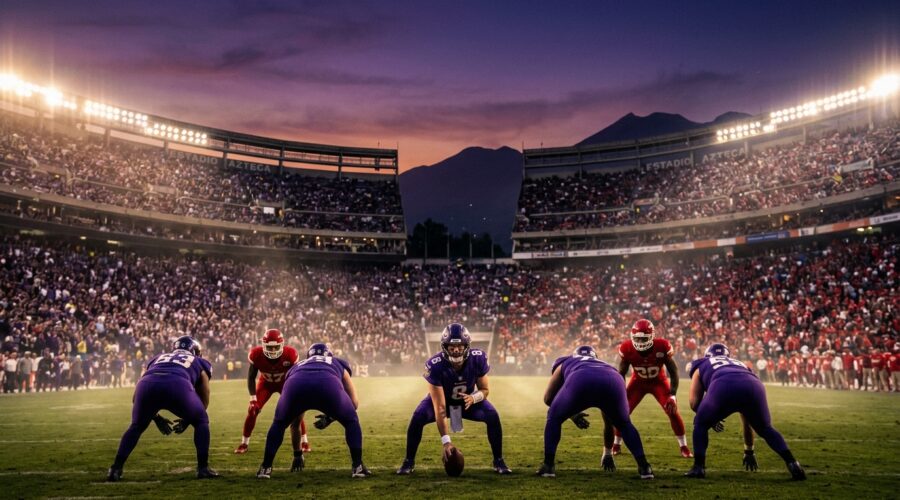
On Sunday night, 80,000-plus fans will pack a renovated stadium at 7,352 feet above sea level in Mexico City, Mexico, to watch two of the NFC’s best teams settle a question that the standings alone cannot answer. The San Francisco 49ers (8-1) and the Minnesota Vikings (7-2) are meeting at Estadio Banorte — the venue formerly, and in every person’s heart still, known as the Azteca — in the NFL’s sixth regular-season game ever played in Mexico. The NFC’s No. 1 seed is functionally on the line. The game is on primetime Sunday Night Football. And somehow, none of that is even the best storyline.
The best storyline is a 38-year-old quarterback who, two weeks ago, was losing 38-17 to the San Francisco 49ers while wearing a Las Vegas Raiders uniform, got traded two days later, and is now starting against those same 49ers on a Sunday night in Mexico City. If a Hollywood screenwriter pitched this, they would be told it was too convenient. The NFL does not care about your skepticism.
This is Kirk Cousins’ revenge game. It just so happens to be one of the most analytically fascinating games of the 2026 season at the same time.
The Standings Picture: Why This Game Actually Matters
Let us start with the stakes because they are significant enough to warrant actual attention before we get lost in the narrative catnip.
The 49ers sit at 8-1 with a +88 point differential that leads the NFL. They are a full game ahead of a three-team 7-2 logjam in the NFC North — the Lions, Vikings, and Bears are all sitting there with identical records, squinting at each other through the standings like contestants on a game show nobody quite knows the rules of. The NFC’s No. 1 seed, and the home-field advantage that comes with it throughout the postseason, is the prize.
The math here is clean: a Vikings win closes the gap to half a game and vaults Minnesota into legitimate NFC title contention with eight weeks remaining. A 49ers win effectively turns that gap into two full games and nearly cements San Francisco as the NFC’s top dog. CBS Sports has already priced SF’s playoff probability at 97.2%. A loss Sunday does not eliminate Minnesota from the seed race, but it makes the math considerably less fun for Kevin O’Connell’s whiteboard.
The all-time series between these teams stands at exactly 25-25-1. A perfectly tied rivalry, now playing its most consequential regular-season game in years, in a soccer cathedral in Mexico. The NFL is very good at scheduling, whatever else you want to say about it.
Kirk Cousins: The Most Absurd Subplot of the 2026 Season
To fully appreciate what is happening here, you need to understand the timeline, because the timeline is genuinely unhinged.
Kirk Cousins spent six seasons (2018-2023) as a Minnesota Viking before tearing his Achilles in 2023. He left for two seasons in Atlanta, then signed a one-year, $11.3 million deal with the Las Vegas Raiders in 2026 — where he was coached by Klint Kubiak, the son of the offensive coordinator he now plays for in Minnesota. He went 4-5 as a Raider. His final start came on November 8, 2026, in a 38-17 loss to the San Francisco 49ers.
Two days later, the Vikings — desperate after Kyler Murray went down with a Grade 2 hamstring strain and Carson Wentz posted an 8.9 passer rating in a Monday Night Football disaster against Buffalo — sent a 2027 third-round pick to Las Vegas and brought Cousins home. His debut was Week 10 at Lambeau Field: 207 yards, two touchdowns, a 30-10 dismantling of Green Bay, and an NFL historical footnote — the first quarterback since at least 1950 to start games for two different teams in consecutive weeks.
His first road game back as a Viking is a Sunday Night Football matchup against the San Francisco 49ers. In Mexico City. The same team that beat him by 21 points two weeks prior, now seeing him in a different uniform, on a bigger stage, with a full week to stew over the narrative.
Cousins has a complicated history with San Francisco. His career stat line against the 49ers reads 92.9 passer rating across five games, which is perfectly respectable and also buries the most important data point: the January 2020 NFC Divisional Round, when the 49ers sacked him six times, held him to 172 yards, and ended his season in a 27-10 loss. That is a game that tends to come up whenever Kirk Cousins’ playoff credentials are discussed, which is frequently and not always charitably.
So the question Sunday night is not just whether Cousins can win a football game. It is whether he can exorcise several layers of historical baggage against a 49ers defense that, on paper, should be able to do to him roughly what it did to him in Week 9 — except this time Cousins knows the opponent, knows the system he is playing in, and has Justin Jefferson back as his legitimate WR1.
The Defining Chess Match: NFL’s Most Extreme Scheme Collision
Every good football game has a central conflict that determines the outcome. The chess match inside this one is the most extreme version of its type that the 2026 NFL season has produced.
Brian Flores’ Minnesota defense blitzes on 71.8% of opponent dropbacks. That number requires a moment of quiet contemplation. The NFL average is roughly 29%. No other team in the league is within 30 percentage points of Minnesota’s rate. Flores does not blitz frequently in the way that a team blitzes frequently — he blitzes with a frequency that makes you wonder if he has simply re-categorized what defense means. The Vikings lead the NFL in points allowed (14.0 per game), sacks, and defensive EPA per play — a figure of +0.195 that would rank among only three defenses recorded since 2011, in the same conversation as the 2019 Patriots and 2020 Rams.
Andrew Van Ginkel has 8.5 sacks, tied for second in the NFL. Dallas Turner has 8, tied for fourth. These are two of the top-five sack leaders in professional football playing on the same defense. Flores pairs all of this with zone coverage 77% of the time behind the blitz, which confounds pre-snap reads and makes it structurally difficult for even elite quarterbacks to process what they are seeing before the pressure arrives.
Brock Purdy leads the NFL in passer rating against the blitz at 135.2, with a +25.0 EPA and 11 touchdown passes against extra rushers this season. His overall line is 70.1% completions, 20 touchdowns, 5 interceptions, 12.1 yards per attempt when blitzed (NFL leader), and an overall passer rating of approximately 109.8-115.2 that ranks third in the league behind Joe Burrow and Trevor Lawrence. Kyle Shanahan reportedly compared his confidence in Purdy to his confidence in Matt Ryan during the 2016 season, which is either a compelling endorsement or a subtle harbinger depending on how you remember Super Bowl LI. Probably best not to dwell on that.
The point is: the NFL’s most aggressive blitzing defense is meeting the NFL’s most effective anti-blitz quarterback. One of those numbers has to move. Klay Kubiak will design motion, pre-snap shifts, and quick-decision concepts to attack Minnesota’s defense and account for Van Ginkel — who, playing opposite Dallas Turner, gives the Vikings one of the most dangerous pass-rush tandems in football. Van Ginkel and Turner need to win individual battles fast enough to disrupt Purdy’s timing anyway. This is not a matchup that gets resolved with one play — it is a 60-minute game of adjustment and counter-adjustment that will likely determine which quarterback has the better night.
The Red Zone Paradox
If the blitz-versus-anti-blitz matchup is the game’s headline collision, the red zone battle is where the final score actually gets decided — and both teams are carrying historically extreme numbers into it.
The 49ers have converted 24 of their 29 red-zone drives into touchdowns this season. That is an 82.8% conversion rate and the best mark in the NFL. Christian McCaffrey, playing on only 42.6% of snaps — a career-low rate designed to keep him fresh — has accumulated 13 total touchdowns and is tied for the NFL lead. His dual-threat ability as a receiving back and power runner makes single-coverage matchups in the red zone functionally untenable for opposing defenses.
Minnesota, on the other side of this, has allowed touchdowns on only five of twenty red-zone drives this season. That 25% allowance rate is reportedly the best by any team since at least 1993. The Vikings are not just good in the red zone on defense — they are historically good, the kind of number that gets pulled out in future discussions about all-time defensive performances.
So: the NFL’s best red-zone offense versus the NFL’s best red-zone defense. One of these numbers will yield on Sunday night. If the 49ers convert at anything close to their season rate, they almost certainly win. If the Vikings hold San Francisco to field goals even two or three times, the door opens for a game Minnesota can win with 20-21 points — which, against anyone else’s defense, would be a low total and a loss waiting to happen.
The Injury Situation: Notably Not Equal
Both teams are dealing with injuries, and in the interest of honest analysis, San Francisco’s situation is more troubling.
Mike Evans (Achilles, questionable) and Deebo Samuel (hamstring, questionable) are both limited. The 49ers’ wider receiver corps already has Ricky Pearsall, De’Zhaun Stribling, and Christian Kirk all on injured reserve. If Evans and Samuel cannot go or are severely limited, Kyle Shanahan is working with Keenan Allen as effectively his only healthy, experienced wide receiver option, with George Kittle as the security blanket and McCaffrey in his usual role as the check-down safety valve who somehow turns five-yard routes into 15-yard gains.
Nick Bosa, returning from a torn ACL suffered in 2025, has zero sacks in four games since his comeback and offered a quote that is not exactly designed to strike fear into opponents: “I don’t think I’m playing my best football right now.” Bosa is the kind of player who can round into form in one game and completely change a matchup. He is also, right now, a player who has not demonstrated that he has yet.
Minnesota’s most significant injury is the confirmed absence of Jordan Addison (thumb surgery). That loss elevates Jauan Jennings — formerly a 49er for six seasons (2020-2025), including a Super Bowl appearance, who turned down a trade back to San Francisco before the deadline — into the WR2 role. Jennings spent much of his first year on the practice squad and reserve/injured list before becoming a fully active player in 2021, but his accumulated knowledge of the franchise runs deep. He has six catches for 54 yards in six games this season and missed Week 10. He is not what Addison is. What he is, however, is a player who intimately knows San Francisco’s coverages, tendencies, and schematic patterns, who declined the chance to return to his former team, and who will face them Sunday night in a game that matters enormously. Fred Warner, San Francisco’s linebacker anchor who has Mexican heritage through his mother, said of Jennings: “I know he’ll be fired up.” That is the most ominous pre-game scouting report a defender can offer about a receiver who has combined for 54 yards all season.
Justin Jefferson: The Variable That Changes Everything
The most important number on Minnesota’s offensive side of the ball is not Cousins’ passer rating or Aaron Jones’ carry total. It is the differential in Justin Jefferson’s performance with and without Kirk Cousins throwing him the football.
Without Cousins in 2026, Jefferson averaged 56.1 receiving yards per game. With Cousins as his quarterback in prior seasons together, that number sat between 90 and 118 yards per game depending on the year. That is not a marginal difference in quarterback play — that is a statistical transformation of Jefferson’s entire production profile. Jefferson, who is expected to play Sunday despite lingering ankle concerns, had nine catches for 74 yards in Cousins’ Week 10 debut. That is a sample size of one game, but it tracks with everything we know about their chemistry.
The 49ers’ cornerback situation is complicated by the injury report. Nate Hobbs (adductor) is questionable. Upton Stout (shoulder and neck) is questionable. Renardo Green, who has four interceptions on the season and is tied for seventh in the NFL, is expected to play and will be a critical piece of containing Jefferson. Deommodore Lenoir and Ephesians Prysock round out the coverage group. If Jefferson gets clean matchups — and against an injury-depleted secondary, he might — the question becomes whether Cousins trusts his ankle enough to push the ball downfield consistently.
The Altitude Angle: This Is More Important Than You Think
Estadio Banorte sits at 7,352 feet above sea level. For comparison, Denver’s Mile High altitude is approximately 5,280 feet. Mexico City is 2,000 feet higher than the city the NFL uses as its baseline reference for altitude-related scheduling conversations. This is not a trivial variable.
The 49ers, after their Week 10 win at Dallas, flew directly to Colorado Springs and spent the entire week training at the U.S. Air Force Academy, which sits above 6,500 feet. The Vikings practiced in Eagan, Minnesota, used altitude simulation chambers, and flew in Saturday. Kyle Shanahan described altitude adaptation as making a team “a couple percent better” — which sounds modest until you consider that in a game projected to be decided by four points, a couple of percent is a field goal.
Dr. Laura Lewis of the U.S. Anti-Doping Agency has noted that the ideal acclimatization window is two full weeks, and neither team will be fully adapted. But the sustained, week-long physical exposure that San Francisco has undertaken is meaningfully different from chamber simulation. The 49ers have done this before — they flew to Melbourne a week early for their international opener and crushed the Rams 27-7. This level of logistical preparation is a Shanahan organizational signature. It matters, particularly for offensive linemen who will feel the thin air first.
The Scene: Estadio Banorte and What It Does to a Football Game
It is worth pausing to note where this is happening, because the venue itself is not simply a backdrop. Estadio Banorte — renamed in 2025 from the Azteca under a naming-rights deal that received “overwhelming negative reception” according to Wikipedia, which is about as democratic a cultural verdict as you can get — was inaugurated in 1966, hosted the FIFA World Cup Finals in 1970 and 1986, and once held 132,247 people for a boxing match. Pelé and Diego Maradona both performed here at the peak of their powers.
The stadium has been fully renovated for the 2026 FIFA World Cup, reopened in March with new seating, hospitality zones, and a sustainable roofing system, and now holds approximately 87,000 seats. It will be sold out Sunday. George Kittle described the Mexico City atmosphere as unlike anything in the NFL, which is a remarkable statement from a player who has experienced 65,000 screaming people at Levi’s Stadium. Fred Warner’s Mexican heritage through his mother will likely earn him a reception that goes beyond the standard NFL crowd appreciation for linebackers.
The NFL is playing its sixth regular-season game ever in Mexico on Sunday, and the first since San Francisco beat Arizona 38-10 in 2022. The 49ers are 2-1 in Mexico and 8-1 in international regular-season play overall. They have won eight international games while losing exactly one, to the Falcons in Atlanta in Week 7 of this very season. That loss remains their only blemish on the entire year.
The Betting Market’s Honest Assessment
The market has San Francisco as a three-point favorite at -110 on both sides of the spread, with a moneyline of -162 (49ers) and +136 (Vikings). The total is 46.5, with the under priced at -112 — which tracks, given that Minnesota’s games have gone under in eight of their last nine contests. When Brian Flores is your defensive coordinator, most games feel like they should have an under tag attached by default.
FanDuel’s numberFire model gives San Francisco a 68.2% win probability. ESPN’s forecast has the 49ers at 63%. Dimers projects the final score at SF 24, MIN 20 — a margin that tells you the market believes this is a 49ers game but respects the Vikings enough to keep it close. The Arizona Republic picked Minnesota, 27-24, which is worth noting as the clearest dissenting voice among major outlets.
The 49ers have covered the spread in six of nine games this season against a 5-4 ATS record for Minnesota. They are as small a favorite here as they have been since their Week 4 win over Denver (also -3, also a cover). The market is essentially saying: San Francisco is better, but not three-score better, and in a game this defensively loaded, that gap can evaporate with two plays.
How This Game Gets Decided
Three questions will determine the outcome:
Can Flores’ blitz package slow Purdy? This has not happened in 2026. Purdy has lit up blitz-heavy defenses all season to the tune of a 135.2 passer rating against extra rushers. But altitude compounds the difficulty for offensive linemen, Van Ginkel and Turner are real, and no quarterback has faced a blitz package this extreme this season. If Minnesota gets sustained pressure — not occasional pressure, but drive-wrecking, rhythm-destroying pressure — this is a different game.
Can Cousins execute with enough discipline to keep Minnesota competitive? His Week 10 performance showed he can operate O’Connell’s system, he knows the personnel, and he genuinely elevates Jefferson’s game in ways that the previous nine weeks of Vikings quarterback play did not. He does not need to be spectacular. He needs to be steady, avoid the interceptions that plagued him early in his Raider tenure (eight through nine games), and give his defense a chance. If he turns the ball over twice, this is a 49ers victory. If he turns it over zero times and finds Jefferson four times, Minnesota can win.
Who wins the red-zone standoff? This is ultimately the game within the game. If Minnesota holds San Francisco to two field goals instead of two touchdowns across four red-zone trips, that is a 14-point swing and a Vikings victory. If the 49ers convert at anything approaching their 82.8% season rate, they will post more points than Minnesota’s offense can realistically generate against a secondary that is not entirely healthy but still managed to hold multiple opponents under 20 this year.
The Prediction
The 49ers are the better team. They are healthier at the positions that most matter for high-leverage plays, they have prepared more rigorously for the altitude, they are playing what functionally amounts to a home game given their history in Mexico, and they have the NFL’s most accurate quarterback against the exact coverage type they will face all night.
But the Vikings’ defense is not a background detail. It is historically good. And Kirk Cousins, whatever the narrative tax on his legacy, is a quarterback who has averaged 281 yards per game against this 49ers franchise across five career meetings. He has Jefferson. He has Hockenson. He has Aaron Jones. He has a Flores defense that is fully capable of winning this game on its own.
The most likely outcome is San Francisco 24, Minnesota 21 — a fourth-quarter game decided by a single possession, a red-zone stop that matters, and a moment where either Purdy or Cousins makes the decisive throw. If Flores’ defense stifles Purdy for the first time in 2026 and Cousins finds Jefferson twice in the fourth quarter, the Vikings are capable of one of the best international upsets in NFL history. If Purdy posts his 11th consecutive efficient game and McCaffrey punches in two touchdowns in the red zone, the 49ers extend their NFC lead and the revenge tour stalls at 7,352 feet.
Either way, the Azteca — Estadio Banorte — Estadio Ciudad de México — whatever you want to call it — will be full, loud, and operating at an altitude that makes every play slightly harder than it looks on the stat sheet. The NFL’s sixth game in Mexico deserves to be its best. On paper, it has every ingredient to be exactly that.
Prediction: San Francisco 49ers 24, Minnesota Vikings 21.
Sunday Night Football. NBC and Peacock. 8:20 PM ET. Estadio Banorte, Mexico City. Watch it.