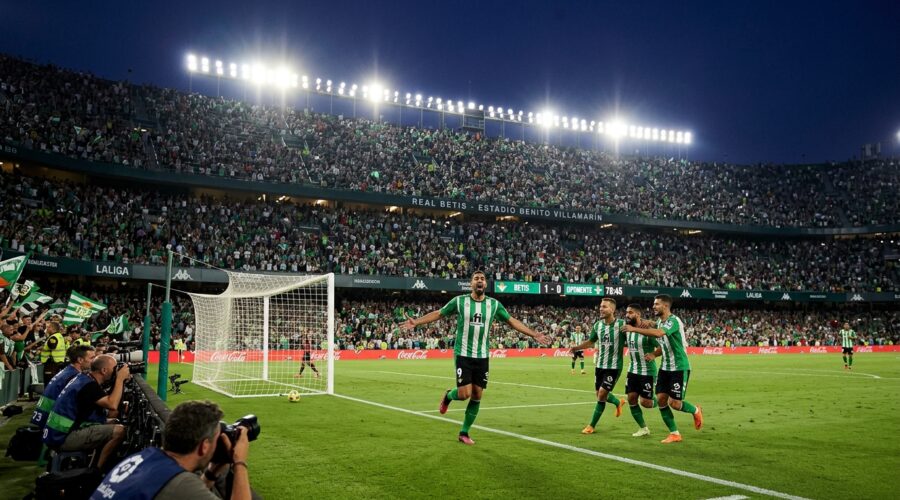
There is a particular pleasure in watching La Liga open its doors while its most powerful residents are still unpacking their suitcases. On a warm August Friday evening at the Estadio de La Cartuja, Real Betis defeated Real Sociedad 1–0 in what served as both a purposeful declaration of intent and a reminder that Spanish football’s new season is unlike any that has preceded it. Rodrigo Riquelme’s 63rd-minute volley separated two clubs with legitimate European ambitions, and for ninety minutes at least, the great reshuffling that defines this season was visible in microcosm: a club reaching for history on one side, another still trying to reconcile a glorious spring with an uncertain autumn.
Elsewhere, of course, the heavyweights are coming. José Mourinho’s reconstituted Real Madrid, half a billion euros of summer transfers barely unpacked, make their league bow on Saturday. Hansi Flick’s Barcelona — world-champion-laden, Camp Nou-restored, quietly terrifying — begin Sunday. But first, the stage belongs to others. And in Seville, Betis have made the most of it.
A Staggered Start, Explained
To understand why the 96th edition of La Liga kicks off with such deliberate asymmetry, one must go back to July 19, 2026, when the final whistle blew in North America and Spain were crowned world champions for the second time. The 2026 FIFA World Cup, hosted across the United States, Canada, and Mexico, had concluded with Rodri claiming the Golden Ball as Player of the Tournament — while Ferran Torres, who had scored the decisive goal in the final against Argentina, boarded a plane home alongside eight Barcelona teammates, among them a nineteen-year-old Lamine Yamal, as kings of the world.
La Liga president Javier Tebas, a man not always celebrated for flexibility but occasionally capable of pragmatic wisdom, enforced a mandatory 21-day rest period followed by a full three-week pre-season for all clubs whose players had reached the World Cup semi-finals or beyond. The consequence is a season that launches in waves: some clubs have already played twice, others have yet to kick a competitive ball. Barcelona, Real Madrid, and Atlético Madrid — whose players featured prominently in both the Spanish triumph and the French near-miss — begin their league campaigns this weekend, with rescheduled Matchday 1 fixtures to follow days later. It is, in short, the footballing equivalent of a staggered start in a cross-country race, and the field has already spread.
Real Betis 1–0 Real Sociedad: Pellegrini’s Fortress Holds
What Manuel Pellegrini has built at Real Betis over seven extraordinary consecutive seasons defies most reasonable sporting logic. He arrived in August 2020 to find a club emerging from a dismal 15th-place finish, a fractured institution with romantic bones and structural rot. By May 2026, he had guided them to fifth in La Liga, 60 points, and the Champions League for only the third time in the club’s 118-year history — the first since 2005–06. The Chilean is 73 years old and does not appear to find any of this particularly surprising.
On Friday evening, his team looked precisely like a Pellegrini side: organised, purposeful, physically aggressive in the press but patient enough to wait for the right moment to strike. Real Sociedad had possession — just over half of it, technically — but Betis controlled the game’s emotional temperature, and that is a different thing entirely.
The decisive moment came from a man who had nearly provided it in the second minute. Rodrigo Riquelme, Betis’s elegant, goal-hungry creator, had already rattled Sociedad’s composure with an early attempt that fell agonisingly wide. On 63 minutes, he found himself at the far post to meet a cross from Juan Cucho Hernández — the Colombian striker who had swapped the MLS and Columbus Crew for Real Betis’s green and white — and the volley was clean, certain, and well-deserved. It was the kind of goal that looks simple only because the player who scored it knew exactly where to be.
Pablo Fornals was the architect of much of what was compelling in Betis’s play, and his Man of the Match award was not an argument anyone rushed to contest. Behind him, the defensive line held with the composure of a team that has spent the summer growing into its new European identity. Álvaro Vallés — who arrived on a free transfer from Las Palmas — made a sensational late save to deny Orri Óskarsson and preserve the clean sheet, which, given the framing of Betis’s Champions League ambitions, felt entirely appropriate.
The supporting cast of summer arrivals acquitted themselves well. Facundo Bernal, the 22-year-old defensive midfielder plucked from Fluminense for €10.5m, provided the kind of composed, positional intelligence that Pellegrini tends to prize above almost all else in that zone. Fran García, the left-back who joined from Real Madrid for a thoroughly sensible €4m, looked immediately at home. Antony, finally on a permanent deal after his loan spell, was lively and direct.
For Betis, then, three points and a clean sheet in their opening home European-qualifying season is as good a statement as a Friday night fixture allows. Their head-to-head record against Sociedad at home — three consecutive wins, including a 3–1 last September and a 3–0 the February before that — has extended to four.
A Word for the Vanquished
Real Sociedad arrive in this season with a peculiar duality: Copa del Rey winners, and a club that finished 10th in La Liga. The cup triumph — a 4–3 penalty win over Atlético Madrid at the Estadio de La Cartuja on April 18 — was one of the genuinely uplifting stories of last season, not least because it was delivered by Pellegrino Matarazzo, the New Jersey-born coach who had taken over in December 2025 when the club sat 16th, two points above the relegation zone. In four months, Matarazzo had turned them into cup winners and made history as the first American manager to lift a major trophy in a top-five European league. The football world quietly applauded and then promptly wondered what came next.
What comes next, it seems, involves Sociedad managing the transition from romantic cup heroes to a Europa League campaign alongside a renewed La Liga push, while carrying an away record that reads seven games without a win. On Friday evening, Luka Sučić struck the post, Remiro made sharp saves to deny Cucho Hernández’s driven effort, and the performance — if not the result — suggested a team that is functional and occasionally dangerous. But Matarazzo will know that this level of territory-into-nothing conversion rate will not sustain a meaningful season in two competitions. The system was right; the cutting edge was blunt when it mattered.
The Giants Stir: Mourinho Returns to La Liga
On Saturday evening, José Mourinho takes his reconstructed Real Madrid to the RCDE Stadium to face Espanyol. It is his first competitive La Liga match since 2013 — thirteen years in the wilderness of Chelsea, Manchester United, Tottenham, Roma, Fenerbahçe, and Benfica, each chapter feeling, as one assessment memorably put it, slightly smaller than the last. And yet here he is, appointed on June 11, 2026 by a Florentino Pérez who has always preferred the company of familiar faces, having previously rehired both Carlo Ancelotti and Zinedine Zidane for second spells.
The project Mourinho has inherited is both richly appointed and genuinely complicated. Two seasons without a major trophy had rendered the Bernabéu restless — “unacceptable by Madrid standards” is the polite formulation — and Pérez’s response was to sanction nearly €500m in summer transfers. The defensive unit has been entirely overhauled: Marc Cucurella arrived from Chelsea for €55m to play left-back; Ibrahima Konaté came on a free from Liverpool to partner Antonio Rüdiger in central defence; Denzel Dumfries cost €20m from Inter Milan to cover the right; and Dani Carvajal, finally, retired after his 451st and final appearance, the last guardian of a different era walking quietly into history.
The headline figure is Yan Diomande, the wide forward who cost €125m from RB Leipzig and breaks Real Madrid’s club transfer record, installed on the right of an attack that already contains Kylian Mbappé through the centre and Vinícius Jr. on the left. Bernardo Silva arrived on a free from Manchester City to add intelligence and craft to the midfield. Endrick has returned from a loan spell at Lyon. The squad has the depth of a side that expects to compete across multiple fronts.
Whether Mourinho can orchestrate all of this is the season’s most genuinely unpredictable question. His tactical instincts remain sharp, his man-management more combustible than it once was. The 4-3-3 he has lined up — Tchouaméni as the anchor, Valverde and Bellingham ahead of him, the electric front three above — is recognisable and formidable. Getting Mbappé, Vinícius Jr., and a €125m new signing to coexist, however, is less a tactical exercise than a diplomatic one. Mourinho has always been rather better at the tactics.
The Defending Champions Return
On Sunday, Barcelona begin their title defence at Elche — a fixture that presents no obvious danger to a club that has not lost to their opponents in La Liga since 2014. The real story is not the result but the atmosphere: Hansi Flick’s side returning to a fully renovated Spotify Camp Nou after more than two seasons housed at Estadi Lluís Companys on Montjuïc, and doing so as back-to-back champions, World Cup winners, and the possessors of perhaps the most thrilling young core in European football.
Lamine Yamal is nineteen years old and a world champion. Pedri, Pau Cubarsí, Alejandro Balde, and Marc Bernal are all under 24. Robert Lewandowski — 120 goals in 194 appearances — has departed for Chicago Fire in one of those transfers that makes perfect sense at both ends while still feeling faintly surreal. In his place, Anthony Gordon arrived from Newcastle for roughly £69m and Karim Adeyemi came from Dortmund for £18m, both adding to the directness and energy that Flick has made his signature in three seasons at the club. And Rodri Hernández — unveiled at the Trofeo Gamper on August 19 to a crowd that greeted him with the kind of noise usually reserved for the return of something lost — adds an entirely new dimension to the midfield.
Flick’s Barcelona are the title favourites, and they wear that status with the ease of a team that has spent two seasons making the hard things look ordinary. Their pre-season was unbeaten in all full-length friendlies, twelve goals scored, six conceded. Yamal scored in a 5–2 demolition of Basel. The machine runs cleanly. Flick’s task in Year 3 is to prove that was not beginner’s luck.
A Season That Already Has a Shape
After Matchday 2 is completed, Deportivo Alavés lead the table with four points from two games — the kind of statistic that will be referenced nowhere in May. Espanyol, Atlético Madrid, Sevilla, and now Betis sit on three. Real Sociedad and the three newly promoted clubs — Málaga CF, RC Deportivo de La Coruña, and Racing Santander, the latter having already drawn 2–2 with Villarreal — are finding their feet. And at positions 12 through 15 in the table, Barcelona, Athletic Club, Celta Vigo, and Real Madrid sit on zero points, not because they have failed, but because they have not yet been asked.
They will be asked, very shortly.
For now, though, this is Pellegrini’s moment. Seven seasons building toward a Champions League return, a 70,000-capacity stadium filled in Seville’s late summer heat, a group of players who understand the weight of what they are carrying. Rodrigo Riquelme’s volley on 63 minutes was not merely a winning goal — it was an opening statement in what promises to be Betis’s most significant season in two decades. The big clubs will come, and they will bring their hundreds of millions with them. Pellegrini has seen it all before. He managed Real Madrid once. He is not frightened of them.
He will need that nerve. But then, he always has.