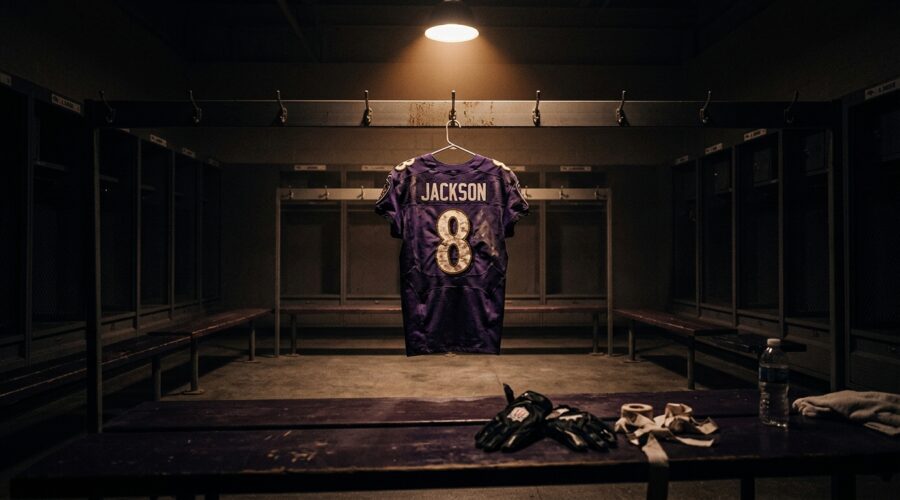
On November 1, 2026, Lamar Jackson took a shotgun snap, targeted Zay Flowers on a quick out, and watched Greg Rousseau’s hand find his throwing thumb mid-release. One incomplete pass. One play-by-play notation — “BAL-8-L.Jackson was injured during the play” — and suddenly the entire Baltimore Ravens organization was staring down the barrel of a franchise-defining crisis that had been quietly loaded for three years.
It was his first offensive snap back from a high ankle sprain that had already cost him three weeks. One play. That’s it. The most efficient stretch of Lamar Jackson’s career — 118.4 passer rating, 70.8% completion rate, 10.1 yards per attempt across four games — ended with a fractured and dislocated right thumb, a 6-to-9-week recovery timeline, and a Ravens team that now has to survive the NFL’s toughest late-season division gauntlet with Jacoby Brissett at quarterback.
So let’s break all of it down: the injury, the quarterback carousel of sadness Baltimore has running right now, the trade that bought them a lifeline, and the $84.34 million nuclear warhead sitting in the middle of their 2027 salary cap. Because this isn’t just a football story. This is a franchise at a genuine crossroads — the kind they don’t usually let you walk back from.
The Injury That Shouldn’t Have Happened (And Yet Always Seemed Inevitable)
To understand why the Ravens are sitting at 4-4 and last in the AFC North, you have to appreciate the almost comedic precision of Jackson’s injury timing. He missed Weeks 5 through 7 with a high ankle sprain. He returned in Week 8 at Buffalo. His first snap back ended his season.
CBS Sports has tracked that Jackson has appeared in only 18 of a possible 34 regular season games across the 2025 and 2026 seasons combined. That is a 52.9% availability rate from the two-time MVP and the man signed to a 5-year, $260 million contract. For context, that’s roughly the dependability of a used car you bought off a Facebook Marketplace listing in December. The car is spectacular when it runs. It just doesn’t run very often.
What makes this particular injury especially brutal is what it interrupted. Through four healthy games in 2026 — before suffering an ankle injury in Week 4 — Jackson was putting together the most statistically pristine stretch of his career: a 70.8% completion rate, six touchdowns against one interception, and a 10.1 yards-per-attempt figure that belongs in a video game. The Ravens went 3-1 in those games. The offense, with Jesse Minter’s first-year fingerprints and a healthy Derrick Henry, looked like a legitimate Super Bowl contender.
Then one Greg Rousseau hand ended that conversation.
What followed was a three-game, franchise-history-making collapse. Baltimore lost to Buffalo 36-10 in Week 8 — the game where the injury occurred. Tyler Huntley came in, then promptly suffered turf toe significant enough to end his season. The Ravens used three quarterbacks in a single game. In Week 9 on Thursday Night Football, they handed the keys to undrafted rookie Joe Fagnano, who responded with a line of 10-for-18, 60 net passing yards, and 2 interceptions in a 33-10 home loss to Jacksonville. The Ravens lost by 20-plus points in three consecutive games for the first time in their 31-year franchise history. Even the weather during those games probably felt embarrassed to be there.
Without Jackson, Baltimore’s offense averaged 4.6 yards per play. That figure would rank 30th in the NFL. The team went 1-4 in games without him. The defense — which is absorbing $170.9 million in total cap charges — held Jacksonville to 2.6 yards per carry in Week 9, which qualifies as a bright spot only because everything else was so thoroughly gray.
Jacoby Brissett: The Most Reasonable Answer to an Unreasonable Problem
Two days after the Fagnano disaster, the Ravens traded a 2027 fourth-round pick and a 2028 seventh-round pick to the Arizona Cardinals for Jacoby Brissett and a 2027 fifth-round pick. Arizona also covered more than half of Brissett’s remaining 2026 salary, leaving Baltimore holding approximately $2.43 million.
Yahoo Sports’ Frank Schwab graded the acquisition a B-minus. That is, to be clear, a grade that accurately reflects the situation. This is not a “we fixed it” trade. This is a “we stopped the bleeding” trade. Brissett is the fourth-best solution to a problem that has only three solutions, one of which involves an undrafted rookie who just threw two picks against a Jacksonville defense that had not exactly been terrorizing offenses this season.
But here’s the thing about Brissett that gets lost in the narrative of “journeyman QB on his seventh team”: the actual statistics across his last 20 games are genuinely good. First in dropbacks. First in completions. Third in passing first downs. Fourth in completion percentage over expected. Fifth in passing yards. That is not a backup quarterback profile. That is a quarterback who gets benched on bad teams and praised on good ones — which is, coincidentally, exactly the situation he’s walking into in Baltimore.
The 2025 season in Arizona — 3,366 yards, 23 touchdowns, 8 interceptions, 94.1 passer rating across 12 starts on a team that went 1-11 in those games — tells you everything. Brissett is not a problem creator. He is a function-the-offense-correctly machine who needs competent supporting infrastructure to thrive. With Derrick Henry still carrying the football (687 rushing yards, 8 rushing touchdowns through Week 9), Zay Flowers healthy, and Mark Andrews running routes, Brissett has a better supporting cast than he’s had at any point in his career.
The one statistical alarm worth flagging: in those same last 20 games where Brissett ranked in the top five in every positive passing category, he also took 62 sacks — a figure that trails only Deshaun Watson and Joe Theismann, who lead all quarterbacks in that span with 74 sacks each. That is the number of a quarterback who needs his offensive line to hold up. Given that Danny Pinter is on IR and Ronnie Stanley’s health has been a recurring question mark, this detail deserves a seat at the table when projecting Brissett’s upcoming weeks.
The schedule, however, sets him up well. Week 10 against Los Angeles, then at Carolina (3-5), then at Houston (3-5), then a bye in Week 13. If Brissett can’t stabilize this offense over those four weeks, the Ravens have bigger problems than their cap situation. That favorable window is precisely why Baltimore didn’t trade Derrick Henry at the deadline — the Ravens told him directly that he isn’t going anywhere. They are still competing.
Jackson’s Contract: A Masterclass in Short-Term Relief and Long-Term Terror
Now we arrive at the number that makes Ravens front office personnel wake up at 3 a.m. in a cold sweat: $84.34 million.
That is Lamar Jackson’s 2027 cap hit. It represents approximately 25.8% of the projected 2027 NFL salary cap. For reference, while teams like the Kansas City Chiefs (Patrick Mahomes at 22.7%), Cincinnati Bengals (Joe Burrow at 24.5%), and Jacksonville Jaguars (Trevor Lawrence at 21.5%) have sustained single players above 20% of the cap and remained competitive, none have done so while simultaneously facing the broader roster cost crunch Baltimore is staring down. The Ravens would be doing it while also paying Roquan Smith $32.7 million, Nnamdi Madubuike $29.9 million, and carrying significant commitments to Kyle Hamilton and Ronnie Stanley.
As of November 2026, the Ravens are already $45.94 million over the projected 2027 cap — the worst position in the entire NFL. Spotrac actually projects the number as high as $53.2 million over cap, depending on the final cap figure. Either way, they are not just in cap trouble. They are in the kind of cap trouble where the financial advisors are using words like “unprecedented” in a tone that suggests they do not mean it as a compliment.
How did this happen? In March 2026, with Jackson’s extension negotiations stalled and the team unable to reach a new deal, Baltimore restructured his existing contract. They converted approximately $39.96 million of his 2026 base salary into a signing bonus, which reduced his 2026 cap hit to a manageable $34.39 million and gave the team roughly $39.96 million in additional cap space for the current season. The side effect was pushing charges forward through voiding years stretching from 2028 to 2030.
This was the Ravens’ second restructure of Jackson’s deal. They are now contemplating whether a third is even viable. The math on that option is brutal: a maximum restructure of base salary could create approximately $37.4 million of 2027 cap room, but would generate a reported $79.9 million in 2028 dead money if Jackson then signs elsewhere. They would be restructuring their way into a financial crater and hoping Jackson decides to stay in it with them.
The dead money picture if Jackson departs after 2027 is legitimately staggering: $32.34 million in 2027, $42.47 million in 2028, totaling $74.81 million. The cap savings versus simply keeping him at his current contract terms? Approximately $9.53 million. For the numerically oriented, they would absorb three-quarters of a billion cents in dead money penalties to save roughly the annual salary of a mid-tier backup linebacker.
The Clause That Changes Everything
The contract architecture matters as much as the numbers, and Jackson’s deal contains two clauses that are quietly the most consequential in modern NFL history.
First: a full no-trade clause. Baltimore cannot move Jackson without his explicit consent. He submits a list of acceptable destinations. If a team is not on that list, the deal does not happen. The Ravens do not hold leverage in this negotiation — Jackson does, completely and totally.
Second: a no-franchise-tag clause. When Jackson’s contract expires after 2027, Baltimore cannot use the franchise tag to retain him. He walks to free agency at age 31 as an unrestricted free agent. The Ravens have no mechanism to prevent it. Zero. The only tool they have is making him an offer compelling enough that he chooses to stay.
Owner Steve Bisciotti has publicly stated he wants Jackson to be the highest-paid player in NFL history — reportedly the NFL’s first $70 million-per-year quarterback, per Ian Rapoport and James Palmer. Jackson, who represents himself without an agent and has consistently declined to engage in extension discussions during the season, has said he wants to focus on football first. The negotiations, if they happen at all in a meaningful way, will occur in the March-to-April 2027 offseason window.
The market context coming into that window is critical. Caleb Williams, Drake Maye, Jayden Daniels, and Bo Nix are all eligible for extensions this offseason. When one or more of those deals lands — and they will, because that is how the NFL works — the market floor will reset above $63 million per year, which is Patrick Mahomes’ current mark. At that point, Jackson’s $70 million ask stops looking like an opening negotiating position and starts looking like a reasonable number for a two-time MVP who, when healthy, is the most uniquely dangerous offensive player in the history of professional football.
The complication, obviously, is the “when healthy” qualifier that keeps showing up in every sentence about him.
Jesse Minter, John Harbaugh’s Ghost, and the Weight of Year One
None of this narrative is happening in a vacuum. Jesse Minter was hired on January 22, 2026, at age 43, on a 5-year deal to replace John Harbaugh after 18 seasons. Harbaugh was fired on January 6th — the best regular-season record in Ravens coaching history, a Super Bowl championship, and a postseason narrative that his critics had been writing for years. Jackson’s playoff record was central to that conversation, which makes the entire situation recursively complicated in ways that fill sports radio hours but rarely generate useful conclusions.
Minter is a defensive coordinator by background — he worked under both Harbaugh brothers, earned a CFP championship at Michigan in the 2023-24 season (a 34-13 victory over Washington in January 2024), and spent 2024-2025 as the Chargers’ DC. He is 43 years old, described by team sources as a “legitimate genius,” and is currently coaching his first NFL season at 4-4 without his franchise quarterback for half the year. If you wanted to design a stress test for a first-year head coach, you could not engineer a more comprehensive one.
His post-Week 9 press conference was notably direct. Results not acceptable. Pre-snap penalties very frustrating. The tone was of a man who understands exactly what is happening and is not interested in managing perceptions about it. That kind of candor is worth something, even when the wins column is not cooperating.
The situation Jackson described to his teammates — “just stay alive” — was characterized by locker room sources as “energizing” and “exciting.” Jackson is still the emotional center of this organization even while sitting in street clothes watching Fagnano throw interceptions to a middling Jacksonville defense. That cultural hold matters when calculating the probability of an extension versus a departure.
The Late-Season Math and What It Actually Means
Jackson’s recovery timeline is 6 to 9 weeks from surgery on or around November 2nd. The earliest realistic return places him back for Week 15 at Pittsburgh. The latest puts him in the postseason — if Baltimore gets there.
Getting there requires the following: Brissett must navigate the three-game soft stretch and emerge at 7-5 or 6-6. Henry must continue operating as the first option in an offense that cannot ask Brissett to carry it alone. The defense — with Trey Hendrickson (2 sacks in 9 games, somehow), Roquan Smith, Kyle Hamilton, and what has been a quietly elite run-stopping unit — must become the primary identity of this football team for the next six weeks.
The final four games of the schedule — at Pittsburgh, versus Cleveland, at Cincinnati, versus Pittsburgh again — are as brutal a closing gauntlet as exists in the NFL, playing entirely within the AFC North. If Jackson is healthy for Weeks 15 through 18 and Baltimore is still alive in the wild card race, those games become appointment television of the highest order.
The AFC North standings as of Week 9 show Pittsburgh at 6-2, with Baltimore at 4-4 and 0-2 in the division. The Ravens are behind but not eliminated. The wild card picture includes enough teams with enough inconsistency that eight wins likely makes the postseason in 2026. That means Baltimore needs to go 5-3 or better in their final eight games. With a soft schedule through Week 12 and Jackson potentially returning for the stretch run, it is not an unreasonable target. It is, however, a narrow one.
The Fork in the Road Baltimore Has to Name Out Loud
Rex Ryan made an impassioned argument that Jackson belongs in Baltimore forever, invoking Ray Lewis’s legacy and statue in a way that was emotionally resonant and strategically irrelevant to a cap conversation. The statues argument, while compelling television, does not create $50 million in cap space.
The actual trade market conversation, per Bleacher Report and Fansided, centers on the New York Jets, Miami Dolphins, Las Vegas Raiders, Atlanta Falcons, Minnesota Vikings, and Carolina Panthers as potential destinations. Based on their available draft capital, analysts have identified the Jets as a team theoretically capable of offering three 2027 first-round picks — though no such offer has been formally reported by team executives or insiders. One league executive cut to it cleanly: “There’s no doubt he’s worth two first-round picks. It’s more about the rest of it.” The “rest of it” is the dead money, the no-trade clause, and the fact that Jackson — per Ian Rapoport — would prefer to remain in Baltimore.
Ian Rapoport’s reporting on Jackson’s preference to stay is probably the single most important piece of information in this entire situation, and it gets underweighted in the trade destination conversation. Jackson is not pushing for an exit. He is pushing for a contract that reflects his value. Those are different things, and conflating them leads to bad analysis.
The Ravens, for their part, are navigating a situation where every available path has real costs. Keep Jackson at $84.34 million in 2027 and absorb a cap year of organizational paralysis. Extend him at $70 million per year and hope the defense can be rebuilt around a smaller budget. Trade him and collect draft capital while absorbing $74.81 million in dead money for two years. Release him after a June 1 designation and save $52 million while watching him sign with the Jets on national television and win three postseason games.
None of these are good options. All of them are live options. The Ravens and Jackson both have leverage. The Ravens need him. Jackson needs them to validate his market value. The 2027 offseason will be a negotiation unlike any the NFL has seen in years — conducted between an owner who has publicly promised the moon, a quarterback who represents himself and negotiates on his own timetable, and a cap situation so compromised that the team’s flexibility is essentially theoretical.
The Thumbnail Version of Where This Is All Going
Here is what we know, stated plainly: Lamar Jackson is the best quarterback Baltimore has ever had. He may be the most uniquely talented player at the position in NFL history when accounting for the full scope of what he does. He is also 29 years old, has played in 52.9% of possible games over the last two seasons, and is under contract terms that give him every structural advantage in any negotiation with his current team.
The Ravens are $45 to $53 million over the 2027 projected cap. They have a defense worth $170.9 million. They have an $84.34 million quarterback cap hit that makes their financial situation mathematically untenable without either an extension, a trade, or creative restructuring that simply defers the pain further into the future — which, to be clear, is what every previous restructure has done.
Jacoby Brissett will give them a chance to stay competitive while Jackson recovers. The soft November schedule gives them a chance to build toward a playoff push. Derrick Henry — who is not going anywhere — gives them a chance to win ugly in an offense that does not need to be spectacular to function. And somewhere in a recovery program working on grip strength and throwing mechanics, Lamar Jackson is telling himself — and presumably anyone who will listen — to just stay alive.
That is advice that applies equally well to the entire Baltimore Ravens organization right now. Stay alive through the injury. Stay alive through the cap. Stay alive long enough to get to the negotiating table in March 2027, when the most important conversation in Ravens history will determine whether that statue Rex Ryan mentioned gets built outside M&T Bank Stadium or somewhere else entirely.
The thumb will heal. The contract will not solve itself. And the clock that really matters in Baltimore has nothing to do with the injury timeline.