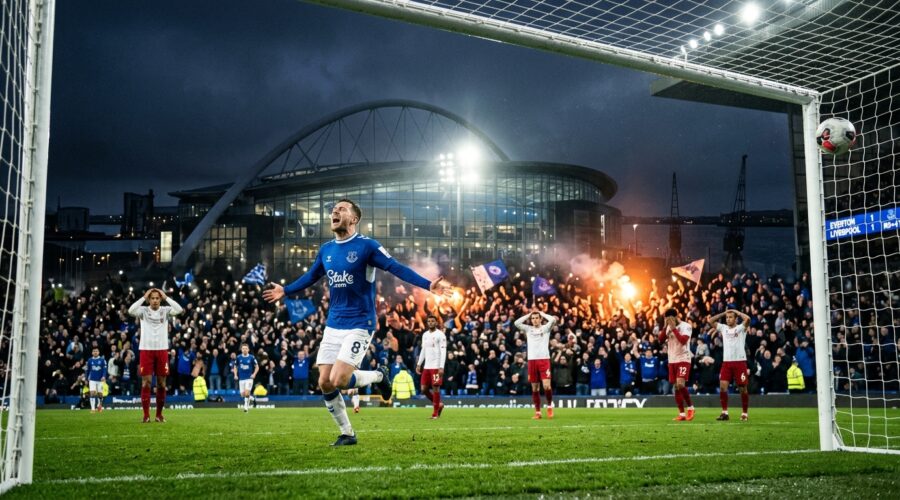
There is a particular cruelty to conceding in the ninety-sixth minute of a game you have led twice. Michael Carrick will have known that cruelty intimately by the time Ainsley Maitland-Niles — five days an Everton player, a £4.2 million deadline-day punt who had scored just one Premier League goal for his previous clubs before joining Everton — sent a first-time strike arcing into the top corner of the net at Hill Dickinson Stadium. The goalkeeper barely twitched. The crowd lost its collective mind. And Manchester United, who had looked so composed just eight minutes earlier when Benjamin Sesko had powered home what seemed the winner, trudged back to Manchester with one point from a match they had spent most of the evening believing they had won.
Football is rarely kind. On this Sunday evening on the Bramley-Moore waterfront, it was openly sadistic.
A Stadium Still Finding Its Voice — And Then Finding All of It
The Hill Dickinson Stadium, Everton’s magnificent new home on the Liverpool waterfront, opened in the 2025/26 season as the Premier League’s 62nd ground. With a capacity of 52,769 — sixth largest in the top flight — it has spent its early months accumulating the folklore that old grounds acquire over decades. Sunday night handed it a story worth telling for years. The atmosphere in the first half was vigorous but measured, the kind of noise that announces intent without committing to anything dramatic. By the ninety-sixth minute, it was something else entirely.
The match itself took a while to offer anything worth the ticket price. Both sides moved with care early on. Bruno Fernandes struck the crossbar from distance and Jordan Pickford scrambled to smother a blistering run-and-shot from Matheus Cunha — James Tarkowski completing the defensive set piece with a superb last-ditch tackle when Cunha found a second opening moments later. Thierno Barry headed wide from a Merlin Röhl cross. The first half ended goalless, which felt about right.
Mbeumo Opens the Lock
The second half had barely drawn breath when Manchester United broke the deadlock in the manner that only Bryan Mbeumo can. Kobbie Mainoo fed him on the right channel — a tidy, unhurried pass from a player who conducts himself in the middle of the park as though the game is operating at roughly seventy percent of the speed everyone else experiences it at — and Mbeumo did the rest. He cut inside, shifted the ball to his left, and curled a precise finish into the far bottom corner. A classic Mbeumo goal: technically immaculate, spatially intelligent, and made to look slightly unfair given how little he had to think about it.
United looked settled after that. Rashford and Luke Shaw were causing genuine problems down the left flank, the kind of instinctive partnership built on years of reading each other’s positioning — overlapping runs, darting touches, the shorthand of two players who know exactly where the other will be. Fernandes hit the woodwork again. Cunha blazed over. The expected goals were moving in United’s direction, if not quite in the way the numbers ended up suggesting.
The Rashford Question
Then, on seventy minutes, Rashford gestured to the bench. Something had felt wrong. Carrick, sensibly given the week ahead, did not hesitate — Patrick Dorgu came on and Rashford walked slowly to the dugout, the kind of slow walk that immediately triggers the word hamstring in the minds of every supporter watching.
Carrick was characteristically understated about it afterwards. “He felt a little bit of something, so we had to change him,” he said, with the studied neutrality of a man delivering information he would rather not be delivering. “Just had an issue, so nothing major.” The qualifier — nothing major — did its job without being entirely convincing.
The timing matters because Manchester United host Sabah FK of Azerbaijan in their Champions League group stage opener at Old Trafford on Thursday, before the small matter of the Manchester Derby six days after that. Rashford, who spent the 2025/26 season on loan at Barcelona under Hansi Flick — twenty La Liga appearances, seven goals, ten assists, a league title medal — carries a specific importance in European competition. His record in the Champions League for Barcelona alone stands at five goals and three assists in eleven appearances. That Barcelona held a thirty million euro buy option and ultimately allowed the deadline to pass without activating it tells its own quiet story about squad priorities — a decision that had already been made before their subsequent move for Anthony Gordon — though it does nothing to diminish what Rashford brought during his time there.
What was plain after he departed the pitch was how much United’s attacking threat diminished. Three shots registered after the seventieth minute. Three. The system that had functioned with such fluency through the Shaw-Rashford left axis looked structurally compromised without him, as if someone had removed a supporting wall and everyone was suddenly aware of the building’s vulnerability.
George, Grealish, and Everton’s Turning Point
David Moyes had introduced Jack Grealish four minutes before Rashford went off — a reminder that Everton’s own bench had something to offer, even if their deadline week had fallen well short of ambitions. The collapse of the Folarin Balogun deal — forty million pounds and a failed medical — had left Moyes working with the kind of squad that makes every substitution feel slightly consequential. Grealish, on his second loan spell from Manchester City, changed the texture of Everton’s play almost immediately. The game opened up. Everton began to breathe.
And then, on eighty-three minutes, Tyrique George reminded everyone why Everton had fought to make his move from Chelsea permanent in a deal worth up to £24 million. Hayden Hackney found him wide. George created a half-yard of space with the kind of disguised movement that suggests someone has been thinking about it since before they touched the ball, and fired a ferocious strike across goal into the near post. The Everton goalkeeper Stefan Lammens — this was Lammens across the dressing room, in United’s net — never moved. The Hill Dickinson Stadium erupted.
Still only twenty years of age, George has the temperament of someone older. The goal was stunning, the composure around it more impressive still.
The Sesko Sucker Punch
United’s response was swift and ruthless. Benjamin Sesko, introduced from the bench with the game balanced, needs only one invitation. Luke Shaw clipped a cross from the left flank — impeccable delivery is too mild a word for it; it was the kind of ball that does half the goalscorer’s work — and Sesko rose with power and intent to head past Pickford from seven yards. United led again, 2-1, with two minutes of normal time remaining.
It was Sesko’s second decisive contribution from the bench in the opening weeks of the season, which speaks well of United’s attacking depth even if it raises questions about why such a player finds himself starting on the substitutes’ bench in the first place. Carrick punched the air. The away end celebrated with the intensity of people who believe the game is settled.
It was not settled.
Maitland-Niles, 90+6
Ainsley Maitland-Niles arrived at Everton on the first of September, a deadline-day addition from Lyon, a club that had faced significant financial difficulties and had to come through the Champions League qualifying rounds rather than entering the league phase directly. He was not the first choice. Kenny Tete of Fulham had been the primary target until the deal stalled. Maitland-Niles — twenty-eight years old, a man whose career has involved more loan moves than most people have away trips, a player of genuine quality who had never quite found the sustained environment to prove it across a full season — was the pivot. Lyon, amid their financial difficulties, were motivated to sell.
He came on against Manchester United with five days in Everton colours behind him.
In the ninety-sixth minute, after United cleared an Everton attack, the ball dropped to him on the edge of the penalty area, twenty-five to thirty yards from goal. There was no time for deliberation. He struck it first time, inside right foot, and the ball arced viciously into the top corner of the net. The goalkeeper did not move because there was nothing he could do. Maitland-Niles had scored just one Premier League goal with his previous clubs before this one. He will not score a more important one in his life.
The ground did not so much erupt as detonate. Moyes, a man not given to public displays of emotional excess, showed something on the touchline. Maitland-Niles was buried under teammates before he had fully processed what had happened.
“It felt like a win,” he said afterwards, still slightly dazed by the whole thing. “The ball fell to me on the edge of the box, I put my foot through it and it ended up in the top corner which I’m happy about.” The understatement of an evening, and perhaps of a career.
Moyes, when asked about the goal, cut to the technical heart of it with the precision of someone who has watched a great deal of football: “The technique. The goalkeeper hardly moved.”
What the Numbers Said
The statistics, which usually arrive to confirm what the eye has already judged, told an interesting story here. Everton edged the expected goals — 1.01 to 0.72 — despite controlling only 45 percent of possession. They had eighteen shots to United’s fourteen, and six on target to United’s three. In pure territorial terms, United had more of the ball. In terms of dangerous moments, Everton created more of them.
This is the arithmetic of transition football done competently: invite your opponent into positions where their shape must extend, then exploit the space behind it. Grealish’s introduction accelerated exactly this tendency. The back-end statistics — touches in the opposition box, shots on target, xG — all tilted Everton’s way as the game wore on, which suggests that Moyes’s system was working in the second half even when the scoreline wasn’t reflecting it.
Carrick’s Persistent Late-Goal Vulnerability
For all the romance of Maitland-Niles’s equaliser, there is a structural question that Carrick must now answer seriously. This is not the first time United have conceded the decisive late goal this season. The opening weekend brought a 2-0 defeat to Hull City that was quietly alarming for a club re-entering European football. The 5-2 win over Ipswich in Gameweek 2 smoothed some nerves, but Everton have reopened them.
Three shots after the seventy-third minute. A defensive shape that became porous in stoppage time. A late goal from a set-piece situation that amounted to a clearance falling to a substitute who had been on the pitch for a matter of moments. These are patterns, not flukes, and Carrick will know that Sabah FK — romantic story though they undoubtedly are, the youngest club ever to reach the Champions League league phase, founded in 2017 and having survived four qualifying rounds to get there — do not need many such invitations to cause an embarrassment that the Old Trafford crowd would not quickly forget.
Where Both Clubs Stand
Everton sit seventh with four points from two matches, unbeaten, and are beginning to look like a side with genuine solidity at the back — Tarkowski commanding, Pickford sharp when tested, George and Grealish offering creative threat in the final third. The defeat of the Balogun deal stings, but a squad that can pull a result from 1-2 down in the ninety-sixth minute against a team of United’s quality is a squad that believes in itself. Moyes was honest about his own targets: “I need to win my home games.” That he didn’t, despite two equalisers, told you everything about how he assessed the evening.
Manchester United are eleventh, four points from three games, and head into a punishing week carrying questions about Rashford’s fitness, their defensive resilience in the closing minutes, and whether the attacking coherence they showed in the first hour against Everton is sustainable without the Shaw-Rashford axis functioning at full capacity. The Champions League return is exciting. The scheduling is not entirely merciful.
On Thursday evening at Old Trafford, the youngest club in the history of the Champions League league phase will arrive from Baku, having survived four qualifying rounds on sheer nerve and organisation. On Sunday, the Manchester Derby follows. It is a week that will define large portions of Carrick’s early narrative at this level.
And somewhere in the Everton dressing room, a thirty-million-pound goalkeeper watched a four-million-pound substitute score what may yet be the goal of the season. Football, as David Moyes might have told you after the final whistle, sometimes works out like that.