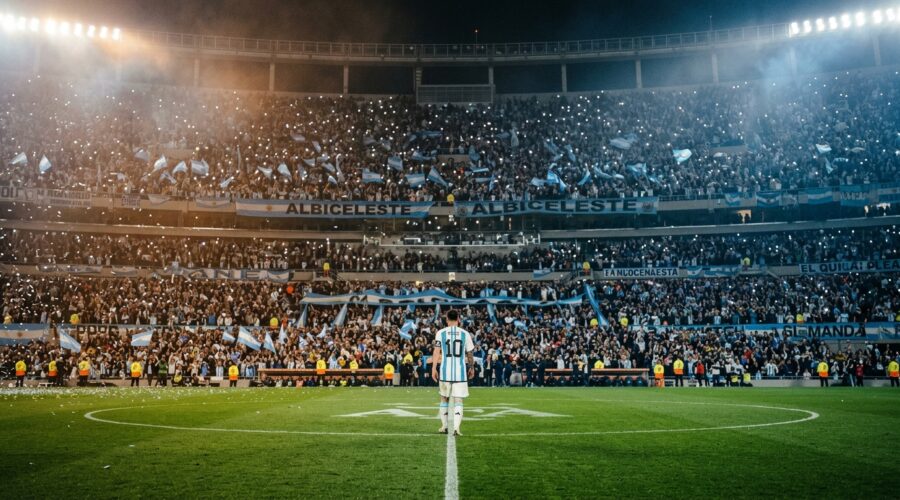
There is a particular kind of silence that descends on a stadium in the minutes before something irreversible happens. Not the silence of a goalless half, not the restless hush before a penalty — something deeper and more permanent than either of those. Buenos Aires will know that silence on the evening of October 6, 2026, when Lionel Andrés Messi Cuccittini walks out onto the Estadio Monumental pitch for the two hundred and seventh and final time in the colours of Argentina. Then, almost immediately, 85,000 people will make sure that silence doesn’t last very long at all.
This is what the end of an era looks like: a farewell friendly against Benin, a nation ranked ninety-third in the world, in a ground that sold out in four minutes. Lionel Scaloni, a man not given to hyperbole, put it as plainly as anyone could: “If there had been five Monumental stadiums, they would all have been packed.” That is not the language of football management. That is the language of national reckoning.
Written Two Days After the Final, Released After a Funeral
The story of how Messi’s retirement letter came to be published on August 31, 2026 is, in itself, a study in grief compounding grief. He wrote it on July 21 — forty-eight hours after sitting on the MetLife Stadium turf in East Rutherford, New Jersey, staring at the scoreboard that read Spain 1–0 Argentina (AET) — and then he set it aside. His father, Jorge, was ill in Rosario. The letter could wait.
Jorge Messi died on August 8, aged 68. He had been present at every meaningful juncture of his son’s life: the childhood escort to training sessions on the banks of the Paraná, the man who relocated an entire family to Barcelona so that a thirteen-year-old boy with a growth hormone deficiency could train at La Masia, the long-time agent, the closest confidant. The 2026 World Cup was the first he missed in person. He did not see the final. Three weeks after his death, Messi posted three handwritten pages to Instagram.
“I wrote these words on July 21, two days after the final,” he explained at the letter’s close. “Today, after what happened with my dad, I am more convinced than ever.” The final public line of the letter — “Thank you, God, for making me Argentine” — was received by the Argentine press with the kind of reverence normally reserved for papal encyclicals. It deserved it.
The World Cup That Was Almost Enough
Before any of that, there was the tournament itself — and Messi’s 2026 World Cup performance was, by any measure that does not involve lifting the trophy, the finest individual campaign the competition has seen in more than half a century. Eight goals. Four assists. Twelve goal contributions across eight matches — the most by any player in a single World Cup since Gerd Müller’s thirteen in 1970, when the tournament was a rather different proposition and opponents did not have sports science departments.
He was named Man of the Match in six of Argentina’s games. He scored a hat-trick against Algeria on June 16 — at thirty-eight years of age, the oldest man ever to do so in World Cup history. He started a third World Cup final, something no other player has done. He accumulated thirty-four World Cup appearances in total, an absolute record for any player in the history of the competition. The Silver Ball — second-best player of the tournament — felt, in the circumstances, faintly like being given a consolation prize for inventing fire.
Because the final itself was an aberration so complete it borders on the surreal. Argentina recorded zero shots on goal in ninety minutes against Spain — a historic low for any World Cup final. Spain completed 763 passes. La Albiceleste touched the ball eight times inside Spain’s penalty area across the entire match. In extra time, Enzo Fernández received a red card and ten-man Argentina’s already fading hopes evaporated entirely. Ferran Torres, in the hundred and sixth minute, thumped a shot past Emiliano Martínez at MetLife Stadium in East Rutherford, New Jersey, and that was that. Messi sat on the pitch afterwards, taking it in. The camera lingered, as cameras always do on him at moments like these. You could see the whole career in his face if you looked carefully enough.
The dedication to Diego Maradona’s memory, offered after the semi-final victory over England, felt prescient with hindsight. “Diego was truly great. He’ll be happy up there, enjoying all of this.” Maradona got his perfect ending in 1986. Messi, who got his in 2022, was asking too much of fate to deliver another.
207 Caps. 125 Goals. One Unresolvable Argument.
The numbers, assembled in full, have the quality of something made up by a child who has been told there are no limits. Two hundred and seven caps, the Argentine record. A hundred and twenty-five goals, the most in Argentine history and across all of South America’s international football. Sixty-eight assists — an international record by a margin that makes the second-placed man look like he was playing a different sport. Twenty-one World Cup goals. Twenty-seven appearances as World Cup captain. Five Copa América finals reached, two won (2021, 2024), alongside the 2022 World Cup in Qatar, the 2022 Finalissima against Italy, and an Olympic gold from Beijing in 2008 — the one piece of silverware that the Maradona comparison cannot complicate, since Diego never won it.
And yet the Maradona comparison will never be resolved, because it was never really a statistical argument in the first place. It is a theological one. Maradona took Argentina — a country still raw from military dictatorship and the Falklands War — and in seven games in Mexico in 1986 handed them something close to transcendence. The Hand of God goal was an act of national mischief directed at England; the Goal of the Century was sixty metres of pure athletic poetry. Maradona, as the most lucid summary of the debate puts it, gave Argentina immortality. Messi gave them something arguably harder to sustain: continued greatness, across six World Cups, against stronger defences, under more forensic scrutiny, without a single year in which the expectation relented.
Jorge Valdano said it with characteristic economy in 2013: “Messi is Maradona every day.” César Menotti, who managed Argentina to the 1978 title, placed Messi “at the level of the best Maradona.” That these are the most generous terms in which the comparison can be framed — not superiority, merely equivalence — tells you everything about the weight Messi carried for two decades, and about why the 2022 World Cup triumph in Qatar was experienced not just as sporting success but as collective emotional release. When Gonzalo Montiel struck that final penalty against France in the Lusail Stadium, a country did not celebrate. It exhaled.
The 2022 Resolution and the Drama That Preceded It
It is worth remembering, before the valedictory warmth of this week sets in completely, just how hostile the relationship between Messi and the Argentine public once was. He was perceived, for much of his early international career, as too quiet, too European — a genius for hire rather than a son of the soil. Chants of “Diego, Diego” rang out at national team games he was playing in. The accusation crystallised around the first four World Cups: not enough goals in the tournaments themselves, too much reliance on the broader squad’s limitations, a sense that he played like a man whose real home was the Camp Nou.
The 2016 Copa América Centenario final defeat on penalties — Argentina’s second consecutive major final loss in a shootout, following the 2015 Copa América — drove him to announce international retirement at thirty-one. “I’ve done all I can. It hurts not to be a champion.” He reversed the decision six weeks later. “I love my country and this jersey so much.” And that reversal, in retrospect, set the terms for everything that followed. Without it, there is no 2021 Copa América victory, no 2022 World Cup final. Without it, the story ends in bitterness and incompletion.
That Messi returned and then won — that the narrative arc bent, against all reasonable expectation, toward resolution — is why Rosario’s La Bajada neighbourhood is now a global pilgrimage site, with a 534-square-metre mural unveiled in July 2026 and guided “Messi tours” drawing visitors from Colombia, China, Japan, France and the United States. The University of Buenos Aires has produced academic papers on his impact on national identity. Muralists have painted him in poses that echo religious iconography. All of this is, on one level, rather excessive, and on another level entirely understandable — because Argentine football is not merely sport. It is the vessel through which a complicated national story has been told, and Messi became the medium through which that story, eventually, found a happy ending.
The Shirt That Nobody Would Wear
For Argentina’s preparatory friendlies against Bolivia (4–0, September 30) and Burkina Faso (7–0, October 3), Scaloni left the number ten shirt unassigned. No player wore it. “Until Leo Messi’s match, nobody will wear the 10,” he said, with the quiet authority of a man who understood exactly what he was doing. He was not simply reserving a squad number. He was performing an act of cultural demarcation — drawing a clean line between two eras, and insisting that the closing ceremony of the first be allowed its proper dignity before the second begins.
The AFA is deliberating whether to retire the number entirely, though that decision remains unmade. The shirt’s lineage is not lightly extended: Mario Kempes wore it in the 1978 World Cup triumph at this very stadium; Maradona wore it in 1986; Messi has worn it for twenty-one years. The crown, as one Reddit thread put it with unintentional elegance, “is a heavy one.” Franco Mastantuono, who made his international debut at seventeen and has since announced himself on the world stage with his first international goal at nineteen, and Nicolás Paz, twenty-one and left-footed with the vision of a senior playmaker, are the names most frequently mentioned as its prospective heirs. Both are outstanding. Neither should be given the shirt in a hurry.
The Farewell Kit and the Opponent Who Travelled 23 Hours in Economy
The special-edition Adidas jersey designed for October 6 is a handsome thing, if you are prepared to forgive its occasional drift toward the commemorative-plate aesthetic. Argentina’s blue-and-white stripes remain intact, adorned with gold accents on the nameplate, crest and number. The Adidas logo on the chest has been replaced — an extraordinary commercial concession — by Messi’s personal “M” emblem. The Sun of May appears on both front and back. Gold laurel leaves frame the number ten on the back. Messi’s name is stamped in a sunburst behind the collar. He teased it on Instagram with a line that became one of the most shared posts in football history: “One last match. A jersey for a lifetime.”
At the other end of the production values, Benin — Les Guépards, The Cheetahs, ranked ninety-third in the world — arrived in Buenos Aires after a twenty-three-hour economy class flight, discovered their hotel had no hot water and a non-functional sauna, watched their video analyst Jonas Bidé suffer a blackout from exhaustion, and endured staff illness throughout the build-up. Coach Gernot Rohr, a German-French football nomad who once faced Messi at the 2018 World Cup as Nigeria’s manager, described the fixture as “a truly grand moment” and noted, correctly, that his side would be permanently etched into football history as a result of participating. For most of his players, who have never played in front of a crowd exceeding 30,000, the Estadio Monumental will represent an experience that defies ordinary professional categories.
There is something quietly important about the identity of Messi’s final international opponent. It is not Germany, not Brazil, not France. It is a narrow coastal West African nation competing at their first international match against a team from outside their continent. That football’s greatest player takes his final bow in the company of Les Guépards rather than European aristocracy says something about the sport that no marketing campaign has ever quite managed to articulate. Even Benin gets its night in the light.
The World Watches. The Story Continues.
Screening events are organised in Kochi, India, at four in the morning local time. Usain Bolt’s Tracks and Records bar in Kingston, Jamaica will show it live. In the United Kingdom the broadcast runs at midnight, heading into the small hours of October 7. Across Spain — where the celebrations of the 2026 World Cup triumph have barely subsided — there is something close to reverence. Spanish players consoled Messi on the MetLife Stadium pitch before they began celebrating their own victory. That gesture was noted. It spoke to the particular status Messi occupies in the game: even his opponents understand that they are dealing with something that transcends the result.
FIFA president Gianni Infantino called it “an extraordinary international career that has inspired millions of people and redefined our sport.” Argentine President Javier Milei offered the most succinct tribute of anyone: “Thank you, impossible man.” Antonela Roccuzzo, who has watched all of this from closer than anyone, wrote: “I saw you keep going when things didn’t work out and always try again. And after so many years, I was also lucky enough to see you fulfill your dreams. You deserved this story and so much more.”
The notable absences — Paulo Dybala and Nahuel Molina, blocked by AS Roma in a piece of institutional gracelessness that will be remembered poorly — cast only a minor shadow. Ángel Di María, who retired from international football in 2024 and was there for the Qatar triumph, will be in the stands. Rodrigo De Paul and Giovani Lo Celso have been specifically invited to play. Nicolás Otamendi, thirty-eight, bids his own farewell to the international game alongside Messi. The dressing room will contain both the men who shared the journey and the young players — Mastantuono, Paz, Enzo Fernández, Julián Álvarez — who will be asked to chart what comes next.
What comes next is, of course, the genuinely difficult question. The creative void left by Messi’s departure is not a minor structural problem. For twenty-one years, the answer to “where does the chance come from?” has been “Messi.” Every system Scaloni built, however sophisticated and however collectively organised, carried within it a fundamental assumption: that one man would do something extraordinary at some point. He always did. The post-Messi Argentina — talented, energetic, and at the 2026 World Cup final, frankly exposed when required to produce invention without him — will have to become a different kind of team. Whether it becomes a lesser one remains to be seen.
Thank You, God, for Making Me Argentine
Messi’s club career continues. He remains under contract with Inter Miami through 2028, with a possible extension to 2030 being discussed. He scored four goals in a single MLS match against CF Montréal shortly before announcing his international retirement. The body, defying every actuarial prediction, continues to function at levels that embarrass men a decade younger. At thirty-eight, he led the Golden Boot race at a World Cup.
But at 8:00 PM Argentina time on October 6, the blue-and-white stripes come off for the last time. The special edition boots — white and gold, designed specifically for this evening — take their final steps on the Monumental turf. Three sons watch from the stands. Eighty-five thousand people who paid for their tickets in the time it takes to make a cup of coffee sing everything they know. And a man who arrived at La Masia at thirteen with a growth hormone condition and left it as the most complete footballer the sport has produced walks across the grass of the stadium where Argentina first became world champions, in the city that will claim him forever regardless of the fact that he was born two hundred miles north in Rosario.
The Maradona debate will continue. The statistics will be updated and challenged and contextualised until there is no living person left who watched both of them. The number ten shirt will eventually go to someone — Mastantuono, perhaps, or Paz — who will carry it with whatever mixture of pride and terror the occasion demands. Argentina will find ways to win without him, because football teams always do, and they will find ways to lose too.
But on October 6, none of that applies yet. On October 6, there is only the man and the shirt and the stadium and the country that, after twenty-one years of devotion and doubt and ecstasy and near-misses, finally learned how to love him without condition. He told them, in three handwritten pages, that he had nothing left to give.
They will spend the entire evening disagreeing.