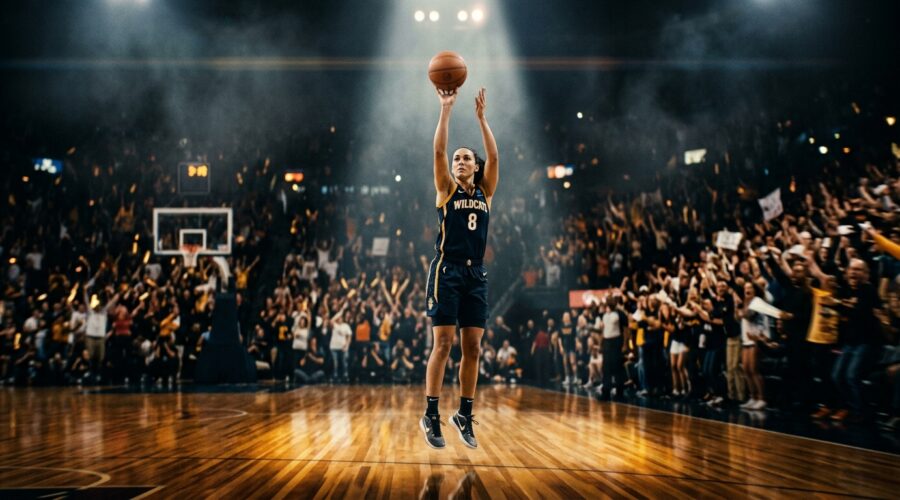
Twenty-four days. That is how long it took Azzi Fudd to go from the most quietly embarrassing debut in the history of WNBA number-one overall picks to the most electrifying third quarter a rookie has produced in nearly a decade. Twenty-four days from three points on two field goal attempts to a takeover at Barclays Center so complete that her head coach walked out of the building and told reporters, “Now everyone knows why we took her No. 1.”
The Azzi Fudd story in Dallas is not a redemption arc. Redemption implies something was lost. What this is — what it has always been, if you watched her at UConn long enough — is a shooter finding her footing. Methodically. On her own terms. In front of the whole country.
The Most Expensive Bench Player in WNBA History
When the Dallas Wings selected Fudd with the first overall pick in the 2026 WNBA Draft on April 13 at The Shed at Hudson Yards in New York City, she became the most financially valued rookie in league history. Under the new collective bargaining agreement ratified just weeks earlier, Fudd signed a $500,000 rookie contract — nearly seven times what her UConn teammate and current Dallas Wings backcourt partner Paige Bueckers earned as the 2025 number-one pick. The WNBA had, in financial terms, loudly announced that this was a franchise-altering selection.
Then head coach Jose Fernandez put her on the bench.
Fudd became only the second number-one overall pick in WNBA history to debut off the bench, joining Kelsey Plum in 2017. And she did not just come off the bench quietly. In her professional debut on May 9 against the Indiana Fever — a game that featured all four of the most recent number-one overall picks on the same floor simultaneously — Fudd scored three points. Three points set the all-time record for the lowest-scoring professional debut by a number-one overall pick in WNBA history, surpassing even Kelsey Plum’s four-point bench debut in 2017.
The jokes wrote themselves. The takes followed immediately. A half-billion dollar press release, and she scored three points.
But Fernandez was measured and deliberate in his reasoning. Dallas already had one of the most formidable backcourts in the league: Bueckers, coming off her 2025 Rookie of the Year award and averaging 19.3 points per game in 2026; Arike Ogunbowale, a franchise cornerstone and All-Star caliber veteran; and Odyssey Sims, a battle-tested guard who had been in the league for over a decade. There was no obvious roster vacancy. Fernandez’s rationale was simply: “It’s her first year in the league. We got five really talented backcourt players.”
He was right about the roster. He was also, it would turn out, right to be patient with his timeline.
The Quiet Climb: Five Games Nobody Talked About
Between her debut and her breakout, Fudd played five games off the bench and averaged 8.4 points per game on 51.4 percent shooting from the field. She was efficient, occasionally brilliant in stretches, and almost entirely overlooked in the national conversation. She had back-to-back 12-point games against Washington and Chicago, made some plays that raised eyebrows among those paying attention, and said very little publicly.
What she did do publicly was seek out Odyssey Sims.
After a game in which Fudd struggled with defending screens — a known vulnerability for younger guards transitioning to the WNBA’s pace and physicality — she asked Sims, the veteran whose starting job she would eventually take, for private defensive tutoring. The image of a number-one overall pick, the highest-paid rookie in league history, going hat in hand to the player she was positioned to replace and asking for help on the weakest part of her game, that is not a gesture you manufacture for a press conference. It is either who you are or it is not. For Fudd, it appears to be exactly who she is.
The “People’s Princess” nickname has followed Fudd since her high school days, when she became the first sophomore in history to win the Gatorade National Player of the Year Award. It seemed like marketing then. Watching her through those first six games in Dallas, it reads more like a personality diagnosis.
Barclays Center, Third Quarter: The Arrival
On May 24, 2026, the Wings were 3-3 and three games into a brutal road trip — Chicago, then Atlanta, then New York in five nights. Sabrina Ionescu was returning from a left ankle injury that had kept her out of the Liberty’s first five games. It was a national television broadcast. The setting was as high-profile as the WNBA offers in May.
Dallas trailed by one at halftime. Fernandez made two lineup changes to open the second half: he inserted Awak Kuier for Alanna Smith, and he inserted Azzi Fudd for Odyssey Sims.
It was the first time in Fudd’s professional career that she had started a half.
She missed her first three-point attempt of the third quarter. Then she made five consecutive three-pointers, capping the run by banking one in from the corner that gave Dallas a 66-53 lead with 3:15 remaining in the period. She also stripped the ball from Breanna Stewart, held Ionescu scoreless in the second half, and finished the quarter with 17 points on 5-of-6 shooting from beyond the arc.
Per ESPN’s Alexa Philippou, Fudd’s 17 points in a single quarter tied for second-most points in any quarter by a WNBA rookie since the league moved to the quarter format in 2006, trailing only Shoni Schimmel’s 20-point quarter — the sixth-highest single-quarter total in WNBA history regardless of experience level. Fudd’s final line: 24 points, 6 three-pointers, 3 steals, 2 blocks, 3 assists, 2 rebounds in 32 minutes. The Wings won 91-76.
Paige Bueckers also scored 24. Two former UConn teammates, now partners on and off the court, each dropping 24 points in the same road win. If someone wrote it as fiction you would call it too neat.
A Correction That Matters
In the immediate aftermath of Fudd’s performance, NBC Sports reported that her six three-pointers in a single game set a WNBA-wide record for the most by a rookie. That claim is incorrect, and it is worth being precise here.
Fudd’s six threes in the Liberty game set the Dallas Wings franchise record for most three-pointers by a rookie in a single game. It does not hold as a league-wide rookie record. The all-time WNBA single-game record for three-pointers made by a rookie belongs to Caitlin Clark, who knocked down seven in a game against the Washington Mystics during her 2024 rookie season.
This distinction generated genuine frustration among fans of Clark and accurate record-keeping alike, and it deserves correction. What Fudd did in Brooklyn was remarkable. It does not require inflation to be impressive.
The Numbers Underneath the Numbers
Strip away the Liberty breakout and look at what Fudd produced over her first six professional games — all off the bench, in a crowded rotation, averaging under 24 minutes per night — and the efficiency profile is startling.
Through those six games: 11.0 points per game, 56.3 percent from the field, 43.5 percent from three on 3.8 attempts per game, 100 percent from the free throw line, and a team-best plus-54 net differential. Her effective field goal percentage of .667 placed her among the most efficient offensive players in the entire league regardless of role or experience level. Her player efficiency rating of 18.4 would project as solid starter production in a full season. Her win shares per 48 minutes at .162 suggested genuine impact, not just counting stats.
At her pace of 10 three-pointers made in six games, a linear projection over a 34-game season would put Fudd somewhere around 57 made threes. That pace, if sustained with expanded minutes and attempts, would put league rookie records within realistic range. Caitlin Clark’s 2024 rookie record of 122 three-pointers made is not in immediate danger, but it is no longer an abstract landmark either.
The defensive numbers quietly tell a similar story. Through the same six games, Fudd had already posted five steals and five blocks — a combination that, per the research at the time, she shared with only one other player in the entire 2026 WNBA season. For a player being discussed almost exclusively as a perimeter shooter, this is the kind of data point that changes how you watch her.
Meanwhile, during those same 52 minutes where Dallas opened games without Fudd in the starting lineup, the Wings’ first unit posted a net rating of minus-22.5. In the second half of the Liberty game, with Fudd on the floor alongside Bueckers and Ogunbowale, Dallas outscored New York 46-32, a 14-point swing that turned a one-point deficit into a comfortable victory.
The Road Here Was Not Straight
What makes Fudd’s current trajectory even more striking is the length and difficulty of the path that produced it. Her five years at UConn were not a smooth ascent. She missed 11 games her freshman year with a foot injury. A knee injury cut her sophomore season to 15 games. Her junior year, she played two games before tearing her ACL and missing the rest of the season.
She came back, won a national championship in 2024-25 as the Final Four Most Outstanding Player — scoring 24 points and grabbing 5 rebounds in the title game — and then in her senior season led the nation with 117 three-pointers made while shooting 44.7 percent from beyond the arc and 95.5 percent from the free throw line. She holds the all-time UConn record for career free throw percentage at 92.5 percent. She was named First Team All-American by the Associated Press and USBWA.
She also became the seventh UConn player drafted first overall in WNBA history, joining Sue Bird, Diana Taurasi, Tina Charles, Maya Moore, Breanna Stewart, and Paige Bueckers. She and Bueckers mark the first time two former college teammates who were both number-one overall picks have shared the same professional roster simultaneously. Dallas is a franchise whose backcourt depth chart reads like a historical referendum on UConn’s program.
Coach Fernandez, Patience, and a Pivot
The decision to bench Fudd to open the season was not popular in every corner of the basketball internet, but it appears, in hindsight, to have been the right call for reasons beyond simple rotation management. Fudd herself, describing her mindset heading into the Liberty game, offered the most honest self-assessment of those first weeks in the league:
“My goal was to just play a little bit slower. I felt like I was rushing a little bit every time I caught the ball, not reading. I’m just putting the ball down and going too fast. So my goal was just to slow down.”
That quote is doing a great deal of work. It describes not a player held back by circumstance but a player who recognized a mechanical and mental adjustment she needed to make, made it, and then executed in the highest-leverage moment she had been given. The bench role gave her six games to watch, calibrate, and recalibrate before Fernandez handed her the second half of a nationally televised road game against a fully stocked New York Liberty roster.
She did not waste it.
What Comes Next
On May 29, five days after her Barclays Center breakout, Azzi Fudd made her first official career start against the Las Vegas Aces and scored 22 points in a 95-87 Dallas victory. The Wings improved to 5-3, tied for third in the Western Conference. A’ja Wilson, averaging 24.8 points per game in 2026 and arguably the most dominant player in the league, was on the other side of the floor that night. Fudd started anyway.
Twenty-four days separated her three-point debut from a game that made a head coach say everyone now understands the draft pick. Another five days produced her first official start. The arc is moving quickly now.
The three-point shooting will draw the most attention, and it should — 43.5 percent from deep on meaningful volume as a rookie is legitimately rare. But the steal in the third quarter against the Liberty, the block on the drive, the way she tracked Ionescu in pick-and-roll coverage in the second half, those are the details that will determine whether Fudd becomes a very good shooter in the WNBA or something more difficult to stop. The early evidence suggests she is intent on being harder to define than a label.
She sought out the veteran she was replacing for defensive instruction. She scored three points in her debut and did not spiral. She sat on the bench for six games with a $500,000 contract and the historical weight of seven UConn number-one picks before her and said her goal was simply to slow down.
Then, in a third quarter at Barclays Center, she did exactly that — and the WNBA caught up to who she already was.