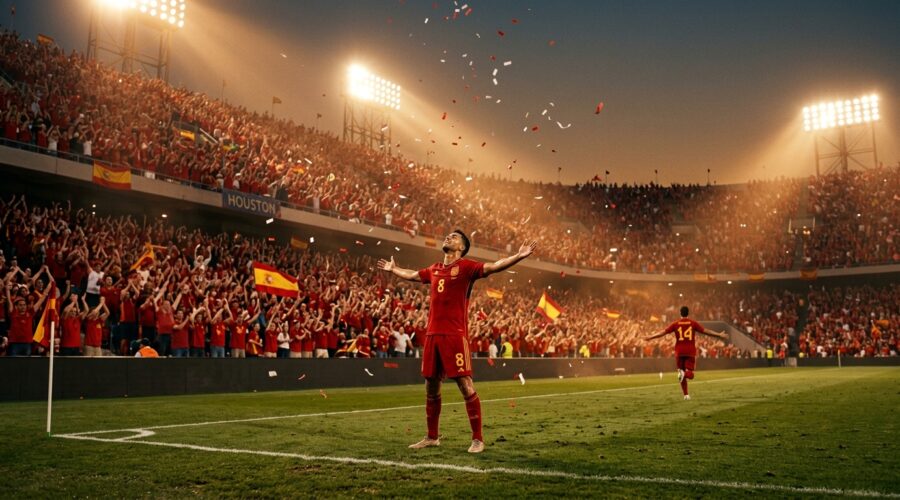
There is a particular cruelty in being good at football and having absolutely nothing to show for it. On a fierce July afternoon in Arlington, Texas, France were not merely beaten — they were rendered spectral, a team going through the motions of threatening without ever actually doing so. Spain won 2–0 and the scoreline, for once, was not harsh on the losers. It was, if anything, rather generous.
This is now three consecutive summers that Spain have knocked France out of a major tournament semi-final. Three. In 2024, Lamine Yamal scored a screamer against them in Munich on the eve of his 17th birthday. In 2025, the Nations League delivered a baroque 5–4 thriller that France still probably feel they should have won. And now this — a controlled, suffocating demolition at Dallas Stadium that never once felt in doubt after the 22nd minute. At some point it stops being a coincidence and becomes a motif.
A Birthday Boy and a Penalty
The match turned on a moment of Lamine Yamal being Lamine Yamal. He had turned 19 the day before — July 13 — and had offered pre-match the kind of line that only truly exceptional footballers can deliver without sounding absurd: “I don’t feel the pressure.” He did not look like he felt it either.
In the 22nd minute, Yamal drove into the French penalty area with the unhurried menace that has become his signature — a teenager who dribbles as though the concept of being dispossessed has simply never occurred to him. Lucas Digne, attempting a clearance, caught Yamal’s elbow with his boot. It was a clear penalty. Iván Arcides Barton Cisneros, the referee, had no hesitation.
Up stepped Mikel Oyarzabal. If there is a player in world football you want standing over a penalty in a World Cup semi-final, it is the man who scored the winner against England in the Euro 2024 final — someone whose big-game metabolism appears to run at an entirely different temperature to the rest of humanity. He sent Mike Maignan the wrong way, bottom corner, with the serene confidence of someone who has done this a thousand times in training and sees no meaningful difference between that and a global semi-final.
It was Oyarzabal’s fifth goal of the tournament and, more significantly, his 29th in international football for Spain — a tally that draws him level with Fernando Hierro and places him in the company of some of the nation’s most distinguished scorers. He has scored 18 goals in his last 20 games for La Roja, which is the sort of statistic that, if you offered it to someone without context, they would assume you had misread it. They haven’t. He is simply that good right now.
Porro: The Defender Who Destroyed France
The first goal settled Spain. The second, just before the hour, finished France as a competitive proposition.
Pedro Porro — Tottenham Hotspur right-back, a man whose primary job description is stopping things rather than starting them — combined with Dani Olmo in a one-two of such neat, instinctive precision that it deserved to be in a coaching manual. Olmo’s flicked return pass found Porro arriving in the box with the timing of a centre-forward and the conviction of someone who had been imagining this moment. First-time, bottom corner past Maignan. Clinical is the right word, but it barely covers it.
The Guardian’s headline was apt: “Pedro Porro turns from defender to destroyer as Spain outwit France once more.” It was the kind of goal that makes you reconsider the boundaries between positions — or, more accurately, that reminds you Spain under Luis de la Fuente have quietly dissolved those boundaries altogether. The full-backs press, the midfielders ghost into the final third, the centre-forwards drop and link. Everyone does everything. The system breathes.
What France Didn’t Do
It is worth pausing here, because France’s attacking output on this particular afternoon was not merely disappointing. It was historically poor.
Their expected goals figure for the full match: 0.30. Spain’s: 0.99. That is not a differential. It is a chasm. ESPN described France’s total xG as the worst attacking output from any team in over 60 years of World Cup football, which is the kind of statistic that forces you to reach for a moment of quiet reflection before continuing.
France managed two shots on target across ninety minutes. Both came from outside the penalty area. In the entire tournament, up to and including this semi-final, this had been the first time they had trailed at any point. That tells you something — not just about Spain’s suffocating defensive organisation, but about how completely and utterly the French attacking machine was dismantled.
Kylian Mbappé, who arrived in Texas with eight goals to his name and the carriage of a man who fully expects to be deciding matches of this magnitude, completed zero dribbles. Zero. Yamal, by comparison, completed six. Pau Cubarsí — nineteen years old, Barcelona-forged, apparently constitutionally incapable of panic — handled Mbappé with the brisk authority of a nightclub bouncer turning away someone not on the list. Rodri, earning a rating of 10 from ESPN’s player grades in what was described simply as “phenomenal,” cut off every passing angle before France’s attack could even build a head of steam.
By the 85th minute, Mbappé’s frustration had curdled into a cynical foul that earned him a yellow card — the surest sign that a great player has exhausted every other option. It was, in its way, the most telling moment of his afternoon. Adrien Rabiot lasted until the 46th minute before being hauled off — replaced by Manu Koné — having contributed to the match in roughly the way a traffic cone contributes to a Formula One race. He had picked up a yellow card as early as the 9th minute, and with France already trailing, Didier Deschamps was unwilling to risk being reduced to ten men.
William Saliba’s injury in the 29th minute — and his subsequent substitution in the 30th, replaced by Maxence Lacroix — was unfortunate for France and disrupted whatever defensive cohesion they had managed to assemble. But let’s not overstate it. By that point, Lucas Digne had already conceded the penalty and already been comprehensively shredded by Yamal. The structural problems preceded the injury.
The Machine That Concedes Nothing
Spain are through to their second World Cup Final, 16 years after Andrés Iniesta struck that extra-time winner against the Netherlands in Johannesburg to send an entire nation into delirium. Seven matches played in this tournament. One goal conceded. Unbeaten.
Their route to the final has a certain satisfying logic to it — no flattering draws against soft opposition, no fortunate escapes. They beat Saudi Arabia 4–0 to open the tournament, navigated Uruguay 1–0, and played out a goalless draw against Cape Verde that was the only blot on an otherwise relentless campaign. Austria went down 3–0. Portugal — always a test — fell 1–0, Mikel Merino providing a late winner. Belgium were seen off 2–1 in the quarter-final, again via a Merino goal, this time in the 88th minute. And now France.
Luis de la Fuente, asked to account for the performance afterwards, reached for the collective rather than the individual: “We did everything we knew we needed to do today to get through. This is all down to the team. We knew that to counter their strengths was key. And we did that.” He is not wrong. The tactical blueprint — high line, aggressive pressing triggers, positional fluidity in the final third, and an almost contemptuous tolerance for pressure — was executed with the precision of a side that has been doing this, in various iterations, for several years now.
The Generational Duel That Went Only One Way
Much had been made in the days before kick-off of the Yamal–Mbappé subplot. The teenager versus the 27-year-old superstar. The inheritor versus the incumbent. In the end it was not a duel. It was a verdict.
Yamal drew the penalty, completed his six dribbles, had a goal disallowed for a tight offside call in the 65th minute that VAR upheld with the pedantic precision these systems specialise in, and was named Player of the Match. He did this on a day when he was technically 19 years and one day old — a child, by most sporting measures, dismantling one of the most decorated tournament squads in the world.
The backstory by now is well-rehearsed but still dizzying: two years ago, also the day after his birthday, also against France, also in a major tournament semi-final, the then-16-year-old Yamal curled a 25-yard thunderbolt into the top corner in Munich to become the youngest goalscorer in European Championship history. France have now become, somewhat inadvertently, the recurring villain in the Yamal origin story. He keeps doing milestone things against them. It is unclear whether they have noticed.
Golden Boot, Final Arithmetic, and What Comes Next
With France eliminated, Mbappé’s tournament finishes at eight goals — a fine haul by any normal measure, rendered somewhat bittersweet by the manner of his final appearance. He shares the Golden Boot lead with Lionel Messi, whose Argentina play England in Atlanta on July 15 for the right to meet Spain in the final at MetLife Stadium. Messi, still competing, is now the sole contender with a live opportunity to move clear of the frozen Mbappé. That arithmetic alone gives tomorrow’s semi-final the shape of a story within a story.
Erling Haaland, Norway’s thunderous presence throughout the tournament, sits third with seven goals but his team are long gone. Harry Kane and Jude Bellingham, both on six, will be alive to add to their tallies should England progress. And Oyarzabal, on five, will have his chance in the final itself — a final, it should be noted, in which he already has strong form for arriving late and scoring winners.
France, meanwhile, face the Third-Place Play-Off on July 18 in Miami Gardens against whoever loses in Atlanta. It is not the stage they wanted, and given what they showed in Dallas, one wonders what Didier Deschamps — or whoever occupies the French dugout — will make of the next four days. The 0.30 xG will require some explaining.
Spain, Sixteen Years On
The last time Spain were in a World Cup Final, Xavi and Iniesta were at the peak of their powers, tiki-taka was the most discussed tactical concept in football, and a teenage Lamine Yamal was approximately two or three years old. Now Spain return to the final stage of the sport’s biggest tournament with a different vocabulary — more vertical, more athletic, more varied in its threat — but with the same fundamental conviction that the ball is theirs by right and that possession is not an end in itself but a weapon to be wielded with intent.
In five days, at MetLife Stadium in New Jersey, Spain will discover whether it is Messi’s Argentina or Bellingham and Kane’s England who await them. Both present entirely different problems. Both would constitute an extraordinary final. The draw of the bracket has a sense of dramatic occasion about it that even the most jaded football observer would struggle to resist.
What we know is this: Spain are seven matches unbeaten, have conceded once in the entire tournament, have a Player of the Match whose best football almost certainly still lies ahead of him, and have now beaten France in three consecutive major tournament semi-finals without, apparently, breaking much of a sweat. They are not a team built on luck or fleeting form. They are a team built on structure, clarity of purpose, and — in Yamal, Oyarzabal, Rodri, and Cubarsí — on players who seem to treat the biggest occasions as invitations rather than ordeals.
Iniesta’s goal in Johannesburg in 2010 was, in the moment, the definitive statement of a golden generation. What this Spain side is building in 2026 feels like something altogether different — and, perhaps, even more durable. The final awaits. They do not look remotely afraid of it.