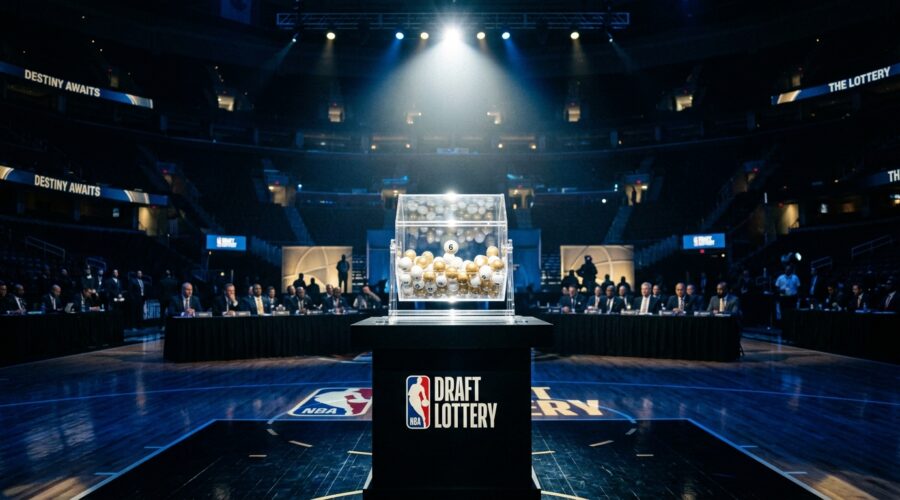
On Sunday, May 10, at 3:00 PM ET, fourteen NBA front offices will collectively hold their breath inside McCormick Place in Chicago as a set of bouncing lottery balls determines who gets to draft AJ Dybantsa. But this is not just another lottery. The 2026 edition arrives at a crossroads — a genuinely historic draft class, a tangle of traded picks with franchise-altering implications, and a looming structural overhaul that will make this the final lottery played under the current rules. Everything is on the table. And for some teams, everything is literally at stake.
The Setup: Three Teams, the Same Odds, One Transformational Pick
For the first time since the NBA flattened its lottery odds before the 2019 draft, three teams share the top slot heading into lottery night. The Washington Wizards (17–65), Indiana Pacers (19–63), and Brooklyn Nets (20–62) each carry a 14.0% chance at the No. 1 overall pick and a 52.1% probability of landing in the top four. Just behind them, the Utah Jazz and Sacramento Kings are locked at 11.5% after the Jazz beat the Kings in a coin flip — a coin flip that had enormous downstream consequences we will get to shortly.
The reason every front office in the building will be laser-focused on that No. 1 spot comes down to one name: AJ Dybantsa.
The 6’9″ BYU freshman from Utah Prep is not just the consensus top prospect in this class — he is a generational outlier. Dybantsa led all of Division I basketball in scoring as a true freshman, averaging 25.5 points, 6.8 rebounds, and 3.7 assists per game on 51.0% shooting across 35 games. He is only the second Division I freshman in history to lead the nation in scoring, joining Trey Young, who did it for Oklahoma in 2018. His 894 total points rank third all-time for a Division I freshman season. He is 19 years old.
With a 7’0″ wingspan, elite footwork, the ability to score at all three levels, and legitimate defensive switchability, Dybantsa draws pro comparisons to Paul George and Tracy McGrady. One Western Conference GM, when asked about his concerns, cut right to it: “I guess you’d rather fail with him and his upside, than not. He could just be a monster.” That is about as ringing an endorsement as the draft world offers.
The Big Four: A Draft Class That Actually Delivers on the Hype
What makes 2026 genuinely special is that the conversation does not end with Dybantsa. This is a draft with four prospects capable of anchoring a franchise rebuild, and each brings something distinct to the table.
Darryn Peterson, PG/SG, Kansas
Peterson is the most divisive player in the top four, and that is partly a compliment. The 6’6″ guard averaged 20.2 points, 4.2 rebounds, and 1.4 steals per game on 43.8% shooting and 38.2% from three — elite numbers that some evaluators believe make him the most talented player in the entire class. One Eastern Conference executive was blunt: “I think Peterson is the most talented guy, but the injury stuff is a real question.”
That injury question is real. Peterson missed 11 of Kansas’s 35 games due to a hamstring strain, a rolled ankle, cramping that required hospitalization, and illness. He played in only 24 games. For a player being considered as a franchise cornerstone, that kind of availability record at 18 years old is a legitimate red flag — not a disqualifier, but a serious due-diligence item for every medical staff in the lottery.
Cameron Boozer, PF, Duke
If pure production wins the argument, Boozer is the answer. The son of NBA veteran Carlos Boozer put together one of the most statistically complete freshman seasons in college basketball history: 22.5 points, 10.2 rebounds, and 4.1 assists per game on a remarkable 55.6% from the field — and 39.1% from three on 3.6 attempts per game. He was the only player in the nation to finish in the top 12 in both points and rebounds, and the Associated Press named him National Player of the Year.
His post finishing percentage was 62.1%. His basketball IQ reads several possessions ahead. He has the highest floor in the class and a skill set that translates immediately. The debate around Boozer is not about what he is — it is about how high his ceiling goes against elite NBA athleticism. Teams selecting in the top five will have to decide whether they want the safest bet or the highest upside.
Caleb Wilson, PF, UNC
Wilson is the most underrated name in the Big Four and the one most likely to dramatically outperform his draft position relative to expectations. The 6’10” North Carolina forward led all top prospects in combined stocks — 67 combined steals and blocks — and has been described by some evaluators as a genuine defensive unicorn: a player with the length, instincts, and positional versatility to alter games without the ball in his hands. Some boards have him as high as No. 2 overall. A late-season hand injury clouds his combine profile slightly, but the film does not lie about what he can do on that end of the floor.
The Pick Complications That Could Change Everything
If you think the lottery is just about who gets Dybantsa, you are missing the most operationally dramatic subplot of the night. Several traded picks have turned this lottery into a multi-franchise chess match with outcomes that ripple far beyond May 10.
The Indiana Pacers’ Existential Moment
No team has more on the line than Indiana. The Pacers hold a 14.0% shot at the No. 1 pick — but here is the catch: if their pick lands anywhere between positions 5 and 9, it conveys to the Los Angeles Clippers as part of the Ivica Zubac trade, and then flows to the Oklahoma City Thunder via the 2019 Paul George deal. Indiana has a 52.1% chance to keep their pick (top four) and a 47.9% chance to lose it entirely. There is no middle ground. This is not a bad lottery result — this is potentially losing your best young asset to the team with the best record in basketball. For a Pacers franchise already navigating a rebuild complicated by Tyrese Haliburton’s injury-riddled season, losing this pick would be a body blow.
The Jazz-Kings Coin Flip and Its Hidden Stakes
The Utah Jazz and Sacramento Kings finished the season with identical 22–60 records, forcing a coin flip to break the tie for the No. 4 lottery seed. Utah won — and that one coin flip mattered enormously. The Jazz’s pick carried top-8 protection for Oklahoma City. By winning the coin flip and securing the No. 4 seed rather than No. 5, Utah guaranteed their pick stays at home regardless of the lottery outcome. Had they lost, a bad lottery night could have sent their pick to OKC.
OKC’s 1.5% Ticket and the Atlanta Hawks Windfall
The Oklahoma City Thunder, who went 68–14 this past season — the best record in the NBA — hold a 1.5% lottery ticket via the Clippers’ pick from the 2019 Paul George trade. Their dynasty-level roster could theoretically add a dynasty-level prospect. History says not to dismiss it: Dallas won the 2025 lottery at exactly 1.8% odds to draft Cooper Flagg. Atlanta won in 2024 at 3.0% to take Zaccharie Risacher. New Orleans won in 2019 at 6.0% to select Zion Williamson.
Meanwhile, the Atlanta Hawks are quietly positioned as one of the night’s biggest potential winners without even being in the lottery themselves. The New Orleans Pelicans owe Atlanta their unprotected first-round pick from a 2025 draft-night trade. The Pelicans hold the No. 7 seed with 6.8% odds and a very real shot at a top-four pick. Atlanta did not tank. Atlanta did not rebuild. Atlanta could walk away with a top-seven pick in one of the deepest drafts in a decade — and they are barely part of the conversation.
The Team That Won It Last Year Is Back
The Dallas Mavericks are back in the lottery just twelve months after pulling off the most improbable draft heist in recent memory, winning the 2025 lottery at 1.8% odds to select Cooper Flagg. Now, following the seismic Luka Doncic trade to the Los Angeles Lakers, Dallas has returned to the lottery with 6.7% odds. Back-to-back lottery wins would be statistically absurd — but the lottery does not keep score. Every team gets a fresh draw on May 10.
The Cruelest Streak in Modern Lottery History
Here is a fact that should haunt every team sitting at the top of the odds board: under the post-2019 lottery reform system, the team with the worst record has never won the No. 1 overall pick. Not once.
The New York Knicks had the worst record in 2019 and fell to third. The Golden State Warriors had the worst record in 2020 and fell to second. The Houston Rockets had the worst record in both 2021 and 2022, finishing second and third, respectively. The Detroit Pistons were worst in 2023 and 2024, falling to fifth both times. The Utah Jazz, who held the top seed last year, also fell to fifth. Seven consecutive years. Seven consecutive misses.
Washington, Indiana, and Brooklyn each have a 52.1% chance at a top-four pick — which sounds reassuring until you remember that 47.9% is not small, and history has not been kind to the teams most deserving of good fortune.
The Last Lottery of Its Kind
When the balls drop on May 10, they will do so under a system that may never be used again at the NBA level. The league has disclosed to its 30 general managers a sweeping overhaul called the “3-2-1 Lottery”, with a Board of Governors vote scheduled for May 28 — just 18 days after this lottery concludes. If passed, the new system would take effect beginning with the 2027 draft.
The changes are dramatic. The lottery would expand from 14 to 16 teams, incorporating play-in losers. All 16 picks — not just the top four — would be determined by lottery draw. And crucially, the worst-team odds would collapse from 14% all the way down to 5.4%. Teams ranked 4th through 10th in the lottery standings would actually receive higher odds than the bottom three, at 8.1% each. Play-in losers would receive 2.7%.
The proposal would also ban back-to-back No. 1 picks for any single franchise, prohibit teams from landing top-five picks in three consecutive years, and grant the commissioner expanded authority to penalize franchises found to be actively tanking — including the ability to reduce their lottery odds or modify their draft positions outright.
The intellectual logic of the reform is sound. The current system has produced seven consecutive years of the worst team failing to win the top pick, suggesting the odds flattening in 2019 partially worked — but not enough to stop multi-year tanking projects that drag down competitive integrity across entire divisions. The 3-2-1 system takes the incentive structure further, making middle-of-the-pack positioning the most strategically optimal lottery approach rather than racing to the bottom.
Critics will note that flattening odds this aggressively may not actually stop tanking so much as redistribute it — and that the proposed system’s complexity introduces new competitive distortions. But sources indicate the proposal has majority support among GMs, and the sunset provision through 2029 gives the league an off-ramp if the system underperforms.
What Happens Next
After the lottery determines the draft order on May 10, the AWS NBA Draft Combine runs through May 17 in Chicago, giving teams an intensive week of measurements, interviews, and on-court evaluation to finalize their boards. The early entry withdrawal deadline is June 13 for prospects who want to preserve college eligibility. And on June 23–24, the draft itself takes place at Barclays Center in Brooklyn — the same arena that witnessed the Kevin Durant and Kyrie Irving era that buried the Nets under years of stripped picks, several of which are still rippling through this very lottery.
The Bottom Line
The 2026 NBA Draft Lottery is the intersection of everything that makes the NBA offseason compelling: a genuinely elite prospect at the top of the board, a draft class deep enough to reshape multiple franchises, traded-pick entanglements that create winners and losers beyond the obvious, and a structural inflection point that will define how the league is built for the next generation.
Someone in that room on May 10 is going to walk away with the right to select AJ Dybantsa — a 19-year-old who led the entire nation in scoring and may be the best prospect to enter the draft since Victor Wembanyama. Fourteen franchises will be watching. History suggests the favorite will not win. And in 18 days, the rules will likely change forever.
May 10. 3 PM ET. ABC. McCormick Place, Chicago. Do not look away.