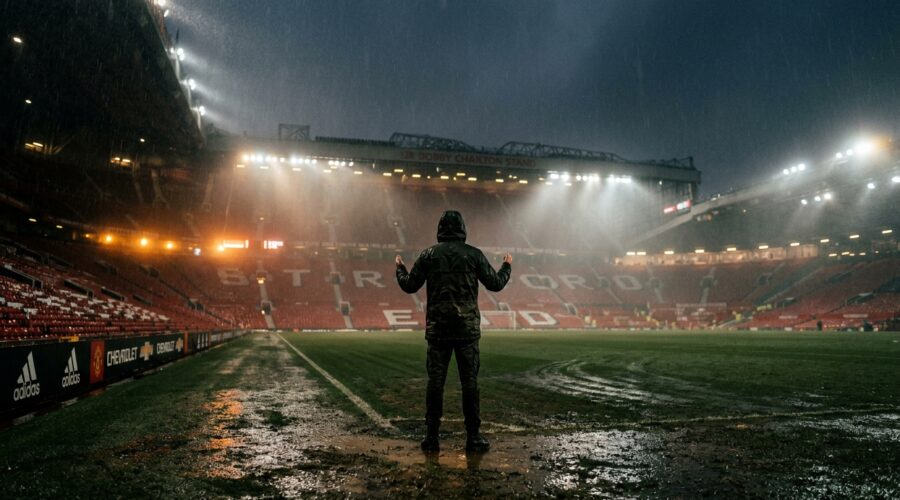
There is a particular kind of footballing chaos that only Manchester United can produce — the kind that is simultaneously farcical and genuinely compelling, a club so constitutionally incapable of quiet that even its managerial appointments arrive wrapped in international incident. On November 12, 2026, two press conferences took place on different sides of the Atlantic. At Old Trafford, Manchester United confirmed they had sacked Michael Carrick after fewer than five months of his permanent contract. Near Atlanta, Mauricio Pochettino stood before a room of American journalists, visibly emotional, and confirmed he was leaving the United States men’s national team — a job he had agreed to continue just three months earlier — to manage the most combustible club in English football.
It was, by any reasonable measure, a remarkable day. It was also, if you have been paying any attention at all to Pochettino’s career, a completely inevitable one.
The Clause That Always Pointed to Old Trafford
In August 2026, with the World Cup barely in the rearview mirror, Pochettino signed a contract extension with U.S. Soccer through the 2030 World Cup cycle. The soccer world offered polite applause. The federation, understandably wary of losing their man mid-cycle, proposed building a release clause that would only apply to a named list of specific clubs — a reasonable precaution by any administrative standard.
Pochettino refused.
“I’ll reveal something to you,” he later told Fútbol de Primera. “The federation did want to include some clubs. But I said, ‘No.’ Because you never, ever know. If they had forced me to put down the name of a club, Manchester United would have been there.”
Instead, the clause was left open — available to any club, any league, any offer. The price: $10 million. When United CEO Omar Berrada placed his call to U.S. Soccer on Wednesday, November 11 — before Carrick had even been formally dismissed — the architecture was already in place. Total compensation, including the buyout of assistant Jesús Pérez and the rest of the backroom staff, came to approximately $12 million. It is, all things considered, a tidy sum for a federation to receive for a manager who had been free to leave just months earlier. But the symmetry of the situation carries its own quiet accusation.
Sports Illustrated put it plainly: the growing perception that Pochettino was never truly committed to the USMNT project “will only be strengthened by his self-confessed revelation that he rejected the federation’s proposal of a club-specific release clause.” He acknowledged, with the kind of honesty that tends to precede the closing of a chapter, that only three months into a four-year deal he simply could not turn down what United were offering.
Two months before the appointment, Pochettino had been sitting with Pep Guardiola at an MLS derby in New York — New York City against Red Bull, the kind of occasion that tends to make a European football mind wander. Guardiola, apparently in a playful mood, asked whether Pochettino missed the Premier League. “A little bit, yes,” he admitted. “We are animals of the grass,” he would later say at his first press conference at Carrington. “We like to feel the grass. We need to smell the grass.”
The grass at Carrington had, it turned out, been calling for some time.
What Pochettino Leaves Behind
It would be dishonest to summarise Pochettino’s USMNT tenure as a failure. His final record — 23 wins, 2 draws, 12 losses across 37 matches — represents the most competitive stretch the program has enjoyed in a generation. At the 2026 World Cup on home soil, the United States won three matches, equalling the combined total of the previous four World Cup campaigns, and Pochettino became the most successful USMNT coach in World Cup history by that measure.
The tournament’s elimination, however, stings in proportion to the expectations the home advantage had generated. Belgium, in Seattle in the Round of 16, dismantled the Americans 4-1 in what Fox Sports described as “one of the low points in USMNT history.” The team looked, in the blunt assessment of observers, timid and overawed — a damaging verdict for a side that had been built, ostensibly, on the high-press conviction and mental fortitude Pochettino had spent two years installing. The quarterfinal target, long identified as the benchmark for meaningful progress, went unmet.
Folarin Balogun described a staff and squad who were “really connected.” Tyler Adams spoke of Pochettino having to “calm himself when it got too emotional” during his final team talk. The affection was genuine. So, it appears, was the ceiling. And a manager who had already admitted to missing club football, who had negotiated himself a clause wide enough to drive a Premier League bus through, was always going to find that ceiling more limiting than the one at a club capable of offering him a Champions League campaign, a historic rivalry, and the Premier League title he has not yet won.
Steve Cherundolo will take charge of the December camp. Within days of Pochettino’s departure, conversations had reportedly already begun circulating around Pep Guardiola as a potential successor — the same Pep Guardiola who, over a glass of something presumably fine in New York, may have inadvertently nudged the whole sequence of events into motion.
The Wreckage Pochettino Inherits
To understand what Manchester United have handed Pochettino, it helps to appreciate the particular arc of Michael Carrick’s tenure — a story that begins in improbable heroism and ends in something approaching tragedy.
Carrick arrived in January 2026, inheriting the smouldering aftermath of Ruben Amorim’s chaotic fourteen months, and proceeded to do something remarkable. He won 12 of his 17 Premier League games in charge, accumulated the highest points-per-game average in the division over that stretch, and dragged Manchester United to a third-place finish and a return to Champions League football. It was the kind of managerial performance that generates premature comparisons and irrational contract extensions. United gave him a deal until 2028. The summer transfer window arrived, and something went quietly wrong.
The 2026-27 season began in the manner of a slow puncture — gradual, almost invisible, until the pressure became impossible to ignore. One win in ten Premier League matches. A goal difference of minus five. A 3-0 home defeat to Bournemouth that briefly convinced the club to hold its nerve. Then a 4-4 draw against Aston Villa from a position of 4-2, which turned out to be both the moment United’s hierarchy made contact with Pochettino and the moment Carrick’s tenure was effectively over. He was formally dismissed on November 12.
Manchester United sat 18th in the Premier League — their worst start to a top-flight season since 1972-73, and their first relegation zone position after nine or more matches since November 1986, when Ron Atkinson was relieved of his duties and a certain Alex Ferguson arrived from Aberdeen. The parallel is noted by everyone and comforts almost nobody. Pochettino is the latest in a long line of permanent managers at Old Trafford since Ferguson retired in May 2013 — the full list of permanent appointments being Moyes, Van Gaal, Mourinho, Solskjær, Ten Hag, Amorim, and Carrick before him. None of his predecessors have won the Premier League title. That list reads less like a managerial succession and more like a support group.
Omar Berrada, to his credit, accepted shared institutional responsibility at the announcement: “Three managerial changes in less than three seasons represented a failure to create stability. When it doesn’t work out with a coach or a manager, we’re all responsible.” It is the kind of honest self-assessment that United’s hierarchy has not always been capable of, and it may represent the first genuinely mature moment in the club’s post-Ferguson era. Whether the humility lasts beyond the next run of results is a separate question.
The Blueprint, the Belief, and the Injury List
Pochettino arrives with a philosophy that has been consistent since his first days at Espanyol: high press, vertical intensity, constant coordinated pressure out of possession, and a demand that his players be protagonists rather than passengers. He is, as the BBC rightly notes, a disciple of Marcelo Bielsa, shaped as a player at Newell’s Old Boys under the Argentine mastermind, and he has carried that intellectual inheritance through every appointment. The 4-2-3-1 is his preferred canvas. Bruno Fernandes, confirmed as club captain at the first press conference, is his designated architect.
The points-per-game figures across his career bear examination: 1.78 or above at Southampton, Tottenham, PSG, and Chelsea. Even in the difficult circumstances of PSG — where managing Messi, Mbappé, and Neymar simultaneously would test the patience of a saint — he won Ligue 1. At Chelsea, he improved a 12th-place outfit to 6th, reached a League Cup final, and left by mutual consent after one season before he could consolidate. The pattern at every club, without exception, has been an immediate upswing. The question is whether a squad 18th in the table and haemorrhaging goals can respond quickly enough to avoid a relegation conversation becoming a relegation reality.
The injury list, presented to him on arrival, is the kind of document that makes a manager briefly reconsider the whole venture. Manuel Ugarte — the defensive midfielder who was supposed to provide the structural spine of the press — is out for the season with a knee ligament injury sustained at the World Cup. Benjamin Šeško, whose goalscoring was meant to solve one of United’s most persistent problems, is not expected back until January at the earliest. Marcus Rashford is a major doubt with a hip problem. Carlos Baleba has a hamstring injury. Patrick Dorgu, the left-back cover who would at least have brought genuine athleticism to that position, pulled out of the Denmark international squad and is a fitness concern for Sunday. Luke Shaw, in news that is itself a kind of grim running joke at this point, remains doubtful with an ongoing muscle issue.
The expected lineup at Anfield — Lammens; Mazraoui, Yoro, Maguire, Dalot; Andrey Santos, Mainoo; Fernandes; Amad, Mbeumo, Cunha — will ask Diogo Dalot, a natural right-back, to operate on the left flank, a compromise that has been, as Yahoo Sports diplomatically notes, “visible in the results.” Bryan Mbeumo (four goals) and Bruno Fernandes (four goals, two assists) provide the most reliable form in an otherwise deeply uncertain attacking unit.
The Opposition: Iraola’s Liverpool and the Puzzle of Anfield
Liverpool enter this fixture as the statistical and contextual favourites in almost every conceivable respect. Under Andoni Iraola — the Basque manager who cut his coaching teeth at Mirandés and Rayo Vallecano before transforming Bournemouth into one of the most watchable sides in the Premier League — Liverpool sit fourth with 18 points from 10 matches. Iraola, it is worth noting, operates from the same Bielsa intellectual tradition as Pochettino, which makes Sunday’s tactical contest something of an Argentine coaching philosophy in miniature: two disciples of the same master, meeting in the red half of a city that has heard more than its share of significant occasions.
Alexander Isak, signed from Newcastle in the summer, has seven Premier League goals and represents by some distance the most potent individual attacking threat in this fixture. Florian Wirtz orchestrates from deep pockets of space with the kind of ease that tends to expose a disorganised midfield. Bradley Barcola provides the explosive directness on the left that Pochettino’s patched-up backline will find extremely uncomfortable.
And yet — and this is the detail that makes this fixture considerably more interesting than the odds suggest — Liverpool have been curiously, almost inexplicably, poor at Anfield. In their first five Premier League home games, they won just once, a 2-0 victory over Brighton. Nottingham Forest, Fulham, Manchester City, and Arsenal all took points from a ground that has historically functioned as one of English football’s most inhospitable venues. Iraola himself has acknowledged the problem. The exceptional away form — 13 points from their first five away games, equalling the club record — only deepens the paradox.
Dominik Szoboszlai, the €70 million Hungarian who is meant to control tempo, is carrying a knee concern. Ryan Gravenberch has missed recent matches with a heel problem. Neither absentee would be trivial. The fitness status of both remains uncertain, and a midfield built around Kobbie Mainoo and Andrey Santos might — might — find more room than the conditions suggest.
Pochettino’s Anfield Curriculum Vitae
It is worth pausing on the fact that the man making his Manchester United managerial debut on Sunday has managed at Anfield before — with Tottenham, with PSG in pre-season contexts, and with Chelsea. He knows the noise, the compressed geography of the stadium, the way it funnels pressure onto the away technical area. He will not flinch from the occasion, whatever else happens. His opening press conference at Carrington was notably direct on the subject: “We are going to go there, to Anfield, with the idea to win and be brave and to be Manchester United. We need to make sure that we are brave and we are protagonists, and go there with no fears and challenge a very good team like Liverpool.”
The language of protagonism — we press, we attack, we do not park the bus and hope for a mistake — is the language of a man whose footballing identity is constitutionally opposed to any other approach. Whether that instinct survives contact with an Anfield crowd when Liverpool score an early goal is what Sunday will actually test.
The bookmakers, for their part, make Liverpool the firm favourites at 1.70 against United’s 4.33. Sports Mole predict a 2-1 Liverpool win. Sportskeeda go further — 3-1. The underlying data, per Statz.ai, suggests United’s situation is not quite as catastrophic as the results alone imply, though the caveat that “it doesn’t promise a climb” is doing a lot of heavy lifting in that sentence.
What the data cannot quantify — and what makes the new manager bounce so genuinely difficult to dismiss — is that United have won the last two meetings between these clubs, including a 2-1 at Anfield last October under Carrick. The head-to-head, across 218 meetings, favours United overall at 85 wins to Liverpool’s 72. And a squad that has been directionless, mismanaged, and drained of confidence for the better part of four months will, at the very least, be lacing their boots on Sunday with something approaching belief in a new idea.
The Weight of History, the Hope of Now
Pochettino addressed the drone footage incident at his first press conference with the wry composure of a man who understands that some weeks simply arrive with their own absurd soundtrack. Twelve minutes of aerial footage taken over Carrington had accumulated more than eight million views by the time he sat down in front of the media. He laughed it off. It is, in a way, the perfect metaphor for where he finds himself: a club so scrutinised, so simultaneously beloved and exasperating, that even its training ground generates viral content during an international break.
He is the latest man to attempt what Ferguson made look straightforward for 27 years. None of his permanent predecessors managed the Premier League title. Some were technically accomplished, some were temperamentally unsuited, some were structurally undermined before they started. Pochettino, to his considerable credit, arrives having actually been wanted — genuinely, persistently, over the course of several managerial cycles — by the club itself. United famously bypassed him in favour of Mourinho in 2016, and again for Ten Hag in 2022. The old joke was that United would eventually get there. They have, eventually, got there.
What they have got there to manage is a club in the relegation zone in November, with a skeleton squad, a ruined defensive record, and a fixture list that opens at Anfield. The timing, in the particular brand of cosmic comedy that follows Manchester United around, could not be more deliberately cruel. Pochettino, one suspects, would not have it any other way. The animal needs the grass. The harder the grass, the better.
Sunday will not resolve the question of whether Pochettino can rescue Manchester United from the Premier League’s lower reaches, let alone deliver the title that has eluded the club since 2013. It will, however, tell us whether a squad that has forgotten what it feels like to be brave remembers on the most unforgiving of stages. That, at least, feels worth watching.