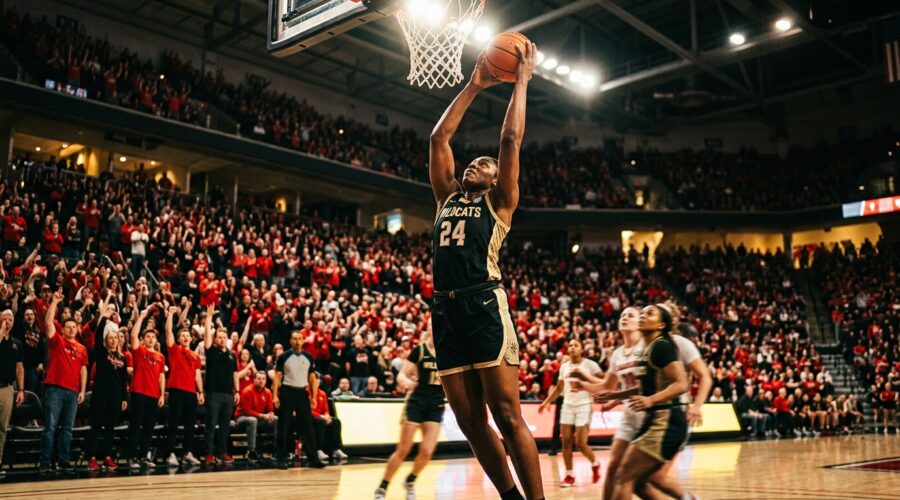
There is a moment in every great season when individual brilliance stops being a storyline and starts being a weapon. For the Atlanta Dream, that moment did not arrive on September 27, 2026 — it had been arriving, week after week, glass after glass, all summer long. But Game 1 of their first-round playoff series against the Washington Mystics was the first time the rest of the league had to sit down, watch, and reckon with what Atlanta has quietly assembled into something genuinely dangerous.
The Dream defeated the Mystics 92-77 at State Farm Arena, and while the final score tells one story, the way they won it tells a far more important one. This is a franchise built on defense, fueled by historic individual performances, and entering the postseason as a team that no one — not even the projections giving them 16% title odds — should sleep on.
Angel Reese Just Had the Greatest Rebounding Season in WNBA History. Full Stop.
Let us be precise about what Angel Reese accomplished in 2026, because imprecision would be an insult to the scope of it.
She finished the regular season with 521 total rebounds — the first player in the 30-year history of the WNBA to reach 500 in a single season. The previous record, set just two years ago by A’ja Wilson at 451, lasted all of two seasons before Reese didn’t just break it — she lapped it by 70 boards. To put that in perspective, the margin between Reese’s record and Wilson’s is larger than the margin between Wilson’s record and fifth place on the all-time single-season list.
That is not incremental progress. That is a seismic redefinition of what a single player can do.
The records did not stop there. On August 24, 2026, in a win over the Los Angeles Sparks, Reese pulled down 26 rebounds in a single game — shattering Chamique Holdsclaw’s 23-year-old mark of 24. The moment came with Reese’s characteristic self-awareness: she had been struggling offensively all night, and rather than let it unravel her, she turned missed shots into fuel. “Anything that goes up is mine,” she said afterward. “Last time I was here, I didn’t miss any shots. Tonight I couldn’t hit s—, so I knew I was going to be able to get them on the rebounding side.” That is not the mindset of a player who is racking up stats. That is the mindset of a winner who has learned to manufacture value out of adversity.
She also broke the WNBA single-season double-double record, finishing with 32 — surpassing Alyssa Thomas’s previous mark of 28. She set a new record for single-season offensive rebounds, averaging 5.1 per game. She reached 900 career rebounds in just 71 games, the fastest in league history. And on September 19, in a 106-81 dismantling of her former team, the Chicago Sky, she became the first player ever to simultaneously hold 1,000 career points and 1,000 career rebounds.
State Farm Arena gave her a standing ovation. She responded the only way she knows how: “Not satisfied. I want to do it all in Atlanta.”
On September 28, the Associated Press named Reese the 2026 WNBA Defensive Player of the Year — the first player in Atlanta Dream franchise history to receive the honor. Head coach Karl Smesko had seen it coming for months. “She should be on All-Defensive team, Defensive Player of the Year,” he said in September. “She’s having the best season of her career.” He was right on every count.
Rhyne Howard Is Breaking Records Too — Just From the Other End of the Court
It would be easy, given the historic weight of Reese’s season, to overlook what Rhyne Howard has done in 2026. That would be a mistake.
Howard finished the regular season with 129 three-pointers made — a new WNBA single-season record, surpassing Sabrina Ionescu’s previous mark of 128. She did it while also tying the WNBA single-season steals record at 100. That combination — record-level shooting and record-level defending in the same season — is essentially unprecedented. She is simultaneously the most dangerous perimeter scorer and one of the most disruptive perimeter defenders the league has ever seen, and she is doing both in the same 40-minute window.
In Game 1 against Washington, Howard posted 26 points with five steals, going a perfect 10-for-10 from the free throw line. She was everywhere, in the way that only a player who has internalized winning can be. “Making sure that we’re playing our defense for a full 40 minutes is gonna be key,” she said after the win. “You want to take their confidence early.”
Howard has also become the fastest player in WNBA history to reach 3,000 career points, 600 assists, and 300 steals, and the youngest player ever to reach 500 career three-pointers. At 26 years old, she is not approaching her prime. She is in it.
The Eastern Conference Race That Came Down to One Game
Before the playoffs began, there was the matter of the East’s final seeding to resolve — and it was resolved in dramatic fashion.
The Atlanta Dream locked up the Eastern Conference’s top spot and the overall #4 seed at 30-14 (.682), riding a 9-1 finish in their final ten games that included a 103-59 demolition of Connecticut, a 106-81 win over Chicago, and back-to-back blowouts of the New York Liberty (95-84 and 83-65). Atlanta was not just good at the end of the season. They were dominant. They were a team arriving at the right time, with a net rating of +6.8 and all five of their primary contributors playing the best basketball of the year when it mattered most.
Behind them, Washington and Indiana were knotted at 28-16 entering the final day of the regular season. The Mystics handled Chicago 101-93 on September 24. Indiana fell to Minnesota 86-66, never leading and scoring one of the fewest points of their season. The Mystics claimed the East’s #2 spot. Indiana dropped to third. The implications were enormous: Washington drew Atlanta in the first round instead of facing an easier path, while Indiana drew Las Vegas — a matchup they would go on to lose.
Caitlin Clark, whose Indiana Fever averaged 96.0 points per game — the highest in the Eastern Conference — was philosophical in defeat. “Sometimes, that’s just how the game of basketball goes,” she said. “It feels like we just couldn’t throw it in the water. But at the same time, that might happen in the playoffs. So, figure it out. Find a way to win.” It was a candid acknowledgment that regular season dominance does not always translate when one game can define everything.
Game 1: Atlanta Flips the Script in the Third Quarter
Washington entered the playoffs as a 24-year-old team with something to prove and nothing to fear. With one of the youngest rosters in WNBA history, the Mystics had finished 28-16, won 4 of their final 5 games, and built one of the league’s most intriguing young cores around three players — Sonia Citron (16.8 PPG), Kiki Iriafen (15.3 PPG, 9.6 RPG), and Shakira Austin (17.0 PPG, 9.5 RPG) — none of them yet 27 years old.
Then Austin was ruled out before Game 1 with an undisclosed injury, and the series calculus shifted immediately.
Washington played hard and played well enough to lead by 14 points in the first quarter and by 5 at halftime. Sonia Citron, in her first WNBA season and first career playoff game, posted 25 points with 3 assists, 6 rebounds, and 2 blocks — a performance that announced, even in defeat, that she is ready for this stage. Kiki Iriafen and the Mystics’ frontcourt stepped into Austin’s absence admirably, finishing with 50 team rebounds to Atlanta’s 31. Washington controlled the glass. They made the game uncomfortable. They showed they belong.
But then came the third quarter.
DeWanna Bonner, signed by Atlanta in late August in a move that raised eyebrows at the time, scored 11 of her 13 game points in a 29-12 Atlanta third quarter that turned a 5-point halftime deficit into a 14-point lead. Bonner did not just provide points. She provided momentum, experience, and a quality that cannot be quantified in a box score — the calm that comes from having already been through every version of a high-stakes game. Coach Smesko recognized it immediately. “She made so many big plays for us. And the enthusiasm she played with — it’s not just the playoff experience she has, it’s the joy of playing basketball. And that was contagious for everyone.”
Atlanta also recorded 16 steals — a franchise playoff record, two shy of the WNBA postseason record — and forced 23 Washington turnovers, turning those miscues into 27 points. They shot 25-of-26 from the free throw line. They did not win Game 1 by being lucky. They won it by being better, harder, and — even without Austin — better prepared for what the Mystics had to offer.
Angel Reese, for her part, delivered a 13-point, 12-rebound double-double in her first career playoff game, doing so while shooting just 4-of-15 from the field. That shooting line would be alarming for most players. For Reese, it is almost beside the point. She found a way to impact the game regardless.
A Young Washington Team That Is Not Done Learning
Head coach Sydney Johnson was measured and honest after the loss, and his words deserve more than a passing mention. “I’m sitting beside Kiki and Sonia. It’s their first playoff game. There’s a lot of good stuff out there. So it’s just exciting. We’re disappointed about the loss, but I’m excited to take this first step forward with them.”
That is not the language of a coach making excuses. That is the language of a coach playing a long game, building something that is meant to last. Washington’s roster averaged just 24.11 years old — among the youngest in WNBA history. Their Big Three have all improved in scoring, rebounding, and assists year-over-year. Iriafen was already looking ahead: “Hopefully a year or two.” That was his timeline for a championship run, and no one who watched Game 1 would dismiss it entirely.
The question entering Game 2 in Washington is whether Shakira Austin returns. If she does, this series becomes a different conversation entirely. If she does not, it becomes a question of whether Citron and Iriafen — both first-time playoff players — can manufacture enough offense and interior resistance to extend the series without their most physically imposing piece.
The Bigger Picture: Atlanta Has a Title Window Right Now
The Golden State Valkyries enter these playoffs as the No. 2 seed with a 32-12 record and approximately 15% implied title odds — formidable, but no longer the outright favorite after the Minnesota Lynx clinched the top overall seed at 33-11. The Lynx were right at the top of those projections — until the New York Liberty stunned them 91-75 in Game 1, blowing up the bracket in the process.
That upset matters for Atlanta. A Dream victory over Washington would set up a potential semifinal matchup against the Liberty — a team Atlanta already beat by 11 and 18 points in back-to-back regular season games. It is not a guarantee, and Breanna Stewart and Jonquel Jones are not the type of players you dismiss based on regular season results alone. But Atlanta’s 82% pre-series win probability against Washington, their Elo rating of 1613 (third-highest in the league), and their finish entering the postseason all point to a team that has found its ceiling and has not stopped pushing upward.
Jordin Canada is averaging 7.3 assists per game. Allisha Gray is scoring 19.0 per night on 46.3% from the field. The starting five has a collective net rating that would turn heads in any era of the league. This is not a collection of talent coexisting — it is a functioning, coherent basketball team.
The Dream Have Been Telling Us All Season. We Should Listen Now.
The 2026 Atlanta Dream are historic in the truest sense of the word. They carry a Defensive Player of the Year who just finished the greatest rebounding season in league history. They carry a shooting guard who simultaneously broke the three-point single-season record and tied the steals single-season record. They carry an orchestrator in Canada, a scorer in Gray, and a veteran weapon in Bonner who proved in a single third quarter exactly why they brought her in.
They are not a feel-good story. They are a basketball team at the top of its form during the only months that count.
Game 2 tips off on September 30 in Washington. The series is 1-0. The Dream have earned the right to close it out. And Angel Reese, who spent an entire regular season grabbing things that did not belong to anyone yet, is just getting started with the hardware that does.