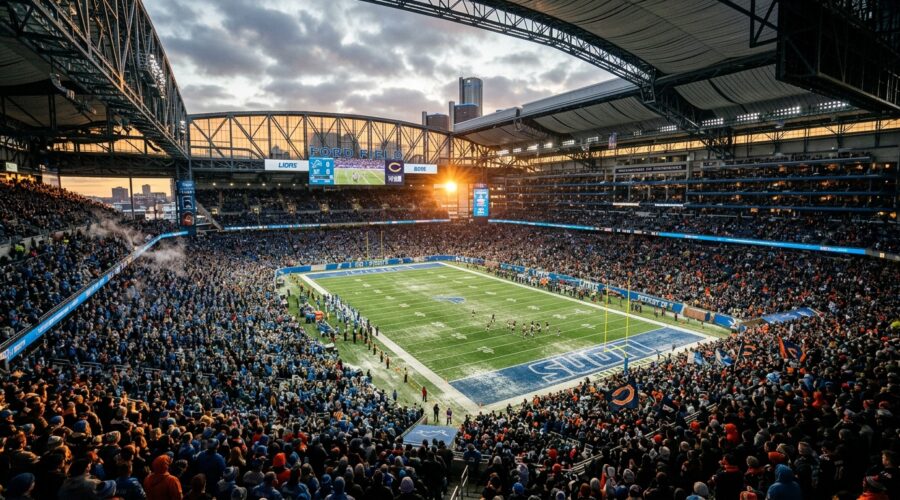
Every Thanksgiving, the Detroit Lions trot out onto their own field and remind the rest of the country that yes, they are still here, and yes, they would like you to watch them play football while your relatives argue about politics in the other room. This year, though, they’ve invited someone who used to live in that house.
Chicago Bears head coach Ben Johnson built the Lions offense that the entire NFL spent three years trying to replicate. He knew which routes Amon-Ra St. Brown ran against Cover 2 rotations. He knew which stunts Jared Goff couldn’t process in time. He knew where the bodies were buried — metaphorically, of course, though given Dan Campbell’s general disposition, you can never be entirely sure. Now he’s walking back into Ford Field at 1:00 PM ET on Thursday, November 26, trying to do the one thing he hasn’t been able to do in two tries: beat his old team.
The stakes are not subtle. The Chicago Bears (8-2) and the Detroit Lions (8-2) are tied atop the NFC North. The winner of this game seizes both the head-to-head tiebreaker and a commanding grip on the division title race. The loser watches their NFC North championship probability crater from roughly 46-50% to somewhere between 13-18%. For perspective, those are “you need help” odds in a conference with the San Francisco 49ers looming at 9-1 and the Vikings still lurking at 7-3. This isn’t a regular Thanksgiving game. This is a de facto playoff game served with cranberry sauce, and for the first time since 1956, two teams six games above .500 are sharing the Detroit Thanksgiving stage — only the fourth time in 193 all-time meetings between these clubs that both are at least six games over .500, with the three previous instances coming in 1934 (twice) and 1956. If you’re skipping this for the first quarter of naps, you’re doing it wrong.
The State of the Division: Why This One Actually Matters
To understand what’s at stake, let’s dispense with the standings quickly. Detroit holds the current NFC North tiebreaker by virtue of a 2-0 divisional record against Chicago’s 0-2 mark. That means even though these teams have identical 8-2 records, the Lions are currently the second seed in the NFC while the Bears are sitting fifth. Home playoff games, first-round byes, seeding for the Super Bowl bracket — all of it flows from that tiebreaker. A Bears win on Thursday doesn’t just feel good psychologically; it mechanically flips the tiebreaker and vaults Chicago from fifth seed to second, while Detroit tumbles. These aren’t small things.
The postseason probability models are worth noting here. Per FPI, both teams are already at or above 89% to make the playoffs — so this isn’t about survival. It’s about whether you’re hosting a wild card round or fighting to survive one. The difference between winning the NFC North and landing as a wild card can be the difference between a Super Bowl run and a home-elimination game you spend rationalizing in February. Win the division, and you get to play the worst possible seed at home in January. Lose it, and you’re making a road trip.
The Bears are road favorites at -2.5 (FanDuel), which is not how most road teams operate in divisional games. The market is essentially saying that the defensive carnage in Detroit combined with Chicago’s five-game winning streak makes the Bears the structurally superior team right now, even playing in a building where Lions are 5-0 this year. The over/under of 55.5 is the highest on the entire Thanksgiving slate. Somebody’s going to score. The only question is who does it more efficiently.
Ben Johnson Goes Home, and It Is Extremely Complicated
The coaching storyline here runs deeper than “guy returns to former employer.” Ben Johnson spent three seasons turning Ford Field into the NFL’s most dangerous offense. As offensive coordinator from 2022 through 2024, his Lions averaged 29.0 points per game — finishing 5th in the league in both 2022 (26.6 PPG) and 2023 (27.5 PPG) before detonating in 2024, when Detroit led the NFL at 33.2 PPG, the most prolific single-season output in franchise history. He helped transform Jared Goff from a quarterback people openly mocked into a legitimate Pro Bowl-caliber player. He installed the motion-heavy, run-action system that made Detroit nearly impossible to game-plan against. And then he left, taking the Bears head coaching job, and immediately started doing the exact same thing to Caleb Williams.
What he’s returning to is a Lions team now coordinated by Drew Petzing — who is, in a development that only the NFL could produce, Johnson’s former groomsman. Both men were graduate assistants at Boston College in 2010. They are legitimate friends who have spent the last year trying to professionally destroy each other within the same division. Petzing is running 5th in scoring offense (28.8 PPG), which means the student has not embarrassed the teacher. The Lions offense hasn’t collapsed without Johnson; it’s evolved into something that still fundamentally resembles what he built, with Petzing adding his own wrinkles. This is not exactly comforting for the Bears defense.
As for Johnson’s record against his old team: 0-2. Week 2 of 2025 was a 52-21 blowout that functioned more as a statement than a football game. Week 18 of 2025 was a 19-16 loss that ended Chicago’s season. Dan Campbell is 2-0 against his former coordinator, which is the kind of detail that gets mentioned exactly once during the CBS broadcast and then approximately seventeen more times in the fourth quarter if things get tight. This is Act III of their coaching relationship, and unlike the previous two, this one has genuine title implications for the team doing the winning.
Caleb Williams Is 0-4 Against Detroit, Which Requires Context
Four losses. Three of the four games decided by slim margins. Williams is 0-4 against the Lions and yet has been statistically respectable in almost every one of those appearances, which is a unique combination of “this guy is good” and “these games keep ending badly.” The Lions have historically done to Williams what good defensive teams do to young quarterbacks: disguise their coverages, create decision hesitation, and win on the margins. Detroit has found ways to beat him even when he’s throwing touchdowns at them. That is an underappreciated skill.
His 2026 numbers through Week 11 (seven games played — he missed three with a hamstring injury) are legitimately solid: 68.3% completion rate, 1,727 yards, 10 TDs, 6 INTs, 95.9 passer rating. The interception total has drawn some scrutiny, particularly the four-pick meltdown against Tampa Bay in Week 9, and an underwhelming 181-yard, 2-TD, 1-INT performance against the Saints in Week 11. His peak stretch — the Falcons, Patriots, and Seahawks games — was 76-of-103 for 860 yards, 4 TDs, and zero interceptions, which is the version of Williams that makes the Bears feel very confident about their quarterback situation.
The defining question for Thursday is which version shows up: the methodical October Williams or the turnover-prone November one. The Lions defense is compromised enough that the bar has been lowered. Williams does not need to be perfect. He needs to be better than a defense that has just lost both its most disruptive linebacker and its most irreplaceable edge rusher in the span of 15 days.
The Injury Catastrophe That Turned Detroit’s Defense Into a Survival Exercise
To understand the Lions’ defensive situation, you need a timeline, because a list doesn’t quite capture the sustained cruelty of what happened to this organization over the last month.
November 1. Lions beat Minnesota 19-15. All-Pro linebacker Jack Campbell — the defensive captain and emotional core of this team — suffers a neck injury while tackling Vikings tight end T.J. Hockenson on the first play of the fourth quarter. He remains motionless on the field and is transported to a hospital. Dan Campbell, who bites kneecaps for fun and once said the word “bite” twelve times in a single press conference, is visibly fighting back tears in the locker room. Campbell goes on IR five days later. The good news, eventually reported, is that he has full movement in his lower body. The bad news for the remaining 2026 season is that he is not playing another snap.
November 15. Ford Field travels to Munich, Germany. The Lions blow out the New England Patriots 35-10 in their first regular-season game on German soil. Aidan Hutchinson sacks Drake Maye in the first quarter, and in the act of leaping to celebrate, lands awkwardly and blows out his right knee. His season — which included 6 sacks, 19 QB hits, and the second-most pressures in the NFL — is over before halftime in Bavaria. For the second time in three seasons, a leg injury ends Hutchinson’s year. This is the kind of luck that makes you wonder what the Lions did to anger whatever deity manages sports injury distribution.
The additional losses — Avonte Maddox (CB, season-ending), Jimmy Rolder (LB, season-ending), Brian Branch (Achilles, returned Week 7), Kerby Joseph (knee, made his 2026 debut in Week 11) — read like the roster injury report of a team that plays in an actual war, not a sport that resembles one.
And yet. Here is the genuinely impressive part: Detroit’s defense has allowed just 15.5 points per game since Week 5, ranking third in the NFL in that stretch. The replacements — Alim McNeill with 6.5 sacks, D.J. Wonnum with 6, rookie Derrick Moore with 4 — have held the fort. The Lions have survived every single storm this season without breaking. That’s not an accident; that’s a team with remarkable organizational depth and a head coach who treats adversity the way most people treat Tuesday.
The problem is that they haven’t faced a quarterback of Caleb Williams’ caliber in this compromised state. Their recent schedule of Jacoby Brissett, Kyler Murray, Tommy DeVito, and Baker Mayfield has not exactly stress-tested a secondary missing two of its best players. Williams is in a different class than any of those quarterbacks, and without Hutchinson to collapse the pocket and Campbell to patrol the intermediate zones, he has options he wouldn’t normally have against this defense.
The Blueprint Exploits: Chicago’s Play-Action Scheme vs. Detroit’s Actual Weakness
This is the most analytically interesting part of the game, and it’s also the part that most directly explains why the Bears are road favorites despite playing in a building where the Lions are 5-0 this year.
Detroit’s defense, even before the injuries, allowed 7.9 yards per attempt against play-action (22nd in the NFL) and a 39.3% first-down-or-touchdown rate on play-action passes (24th). Those aren’t elite numbers under any circumstances. Against a defense now missing its most dominant linebacker and its best pass rusher, those numbers look like an open invitation.
Ben Johnson’s offense runs play-action on a substantial percentage of its dropbacks, particularly from under center. The Bears are first in plays per game (69.3), third in rush yards per game (142.4), and their entire offensive identity is built around convincing linebackers that the run is coming, then attacking the vacated intermediate zones. D’Andre Swift — who, in a detail that the football gods clearly scripted — is a former Detroit Lion — has 10 rushing touchdowns this year. He and Kyle Monangai give Chicago a genuine two-headed run game. And when defenses have to respect the run, the intermediate routes open for Luther Burden III (51 receptions, 654 yards, 4 TDs) and Rome Odunze (15.9 yards per reception).
Johnson knows exactly where the Lions’ play-action vulnerabilities sit, because he installed the coverage frameworks around which those vulnerabilities were designed to be hidden. He knows the leverage tendencies of their cornerbacks, the rotation patterns of their safeties, and the zones that Campbell leaves intentionally soft to protect against big plays. He isn’t just preparing for Detroit’s defense. He is, in a very real sense, preparing against himself.
The Jeffery Simmons Factor Is Not Small
On October 29, GM Ryan Poles traded for defensive tackle Jeffery Simmons from the Tennessee Titans, and Chicago’s defense has been functionally unrecognizable ever since. The third-down conversion rate allowed since Simmons arrived: 13%. That is the best mark in the NFL. The mechanism is not complicated: when Simmons draws double teams inside, Montez Sweat wins one-on-one matchups on the outside. The two are former Mississippi State teammates who understand each other’s game at an almost intuitive level. Against the Saints in Week 11, Simmons posted three sacks while Sweat added a safety. It was the defensive equivalent of a duet by people who have been practicing together for years.
Against Jared Goff specifically, interior pressure matters enormously. Goff is one of the least mobile quarterbacks in the NFL — his processing speed and accuracy are elite, but his ability to escape the pocket and manufacture plays under duress is limited. When an interior rusher like Simmons can disrupt his launch point even without sacking him, Goff’s completion percentage and accuracy decline meaningfully. If Simmons is healthy on Thursday — he was limited in practice this week with a knee concern — this is the matchup that most influences the game’s outcome.
The complicating factor: Kyler Gordon, who posted four sacks in just two games after returning from injury and whose blitz packages are central to Chicago’s third-down defense, is listed as DNP with a shoulder issue. If Gordon can’t go, the Bears lose one of their most disruptive secondary pieces at exactly the wrong time against Goff’s efficient short-to-intermediate passing game.
Jahmyr Gibbs Is the Best Running Back in Football Right Now and Chicago Has a Problem
13 rushing touchdowns. 1,098 yards. 4.9 yards per carry. Jahmyr Gibbs leads the NFL in rushing touchdowns by a margin that is almost embarrassing, and he does it with a combination of burst, vision, and contact balance that makes him genuinely difficult to gameplan against. He is both a between-the-tackles pounder and a perimeter threat, and he catches passes out of the backfield at a 45-reception pace that makes him a problem in zone coverage as well.
Chicago’s run defense has some gaps. The Bears rank 28th in opponent rush play success rate over the last two games — a soft underbelly that Dennis Allen’s defense has largely masked with its elite pass-rush numbers. But Gibbs is not the kind of back you mask with a good pass rush. He operates best against run-first defensive schemes that commit interior resources to stopping the downhill game, then hits the cutback or perimeter before linebackers can flow. T.J. Edwards and Devin Bush are capable stoppers, but against Gibbs at peak efficiency, capable is not always enough.
If Gibbs gets to 150 yards and two touchdowns on Thursday, the Lions probably win this football game regardless of everything else happening on the field. That is not a small “if.”
Amon-Ra St. Brown vs. the Bears Secondary: A History of Pain
In two games against Chicago in 2025, Amon-Ra St. Brown had 20 receptions, 254 yards, and 3 touchdowns — 9 catches for 115 yards and 3 TDs in the first meeting, and 11 catches for 139 yards in the second. He did this with the calm, systematic brutality of someone who has memorized the Bears’ coverage rotations so thoroughly that the game is essentially solved math at this point. St. Brown (70 receptions, 792 yards, 8 TDs in 2026) is a four-time Pro Bowler who creates separation not through athleticism alone but through route precision and release point manipulation — the kind of receiver who is most dangerous against cornerbacks who rely on physicality at the line.
Johnson knows St. Brown’s game better than any opposing defensive coordinator alive. He watched him develop from a mid-round pick into one of the best receivers in the NFC, and he personally drew the coverage schemes that were meant to contain him. How much of that institutional knowledge translates to Thursday’s defensive game plan is one of the most interesting chess-match questions of the week. If Gordon is limited, the slot coverage burden potentially falls to rookie Malik Muhammad II, and asking a rookie to solve a problem that Jaylon Johnson and Tyrique Stevenson Sr. have historically struggled with is a tall order.
The 2024 Thanksgiving Ghost
It is worth pausing for a moment on what happened the last time the Bears and Lions met on this field on this day. In 2024, Chicago led 23-7. The Lions came back to win 23-20. With approximately 30-36 seconds remaining, Caleb Williams was sacked — and crucially, the Bears failed to call a timeout, leaving only 6-7 seconds on the clock. A desperation pass to Rome Odunze then fell incomplete as time expired. The next day, Matt Eberflus was fired — the first Bears head coach fired during a season, and the cascade that eventually led to Ben Johnson being hired in the first place.
So in a very literal sense, the 2024 Thanksgiving loss to Detroit is why Ben Johnson is walking into Ford Field as Chicago’s head coach on Thursday. The game that created the opening is the same game he’s now being asked to avenge, against the same team, on the same field, with the same quarterback. The NFL does not have a writers’ room, technically, but it really does seem like it has a writers’ room.
The Four Key Matchups That Will Determine This Game
1. Caleb Williams vs. Detroit’s Compromised Secondary
Without Hutchinson generating consistent pocket collapse and without Campbell eliminating intermediate windows, Williams has the cleanest look against this Lions defense that he’s had in four career tries. The question is whether he attacks the downfield opportunities his line creates or settles for the safe short-to-intermediate game that has characterized his less impressive recent outings. Edge: Bears QB, decisively if Williams pushes the ball down the field.
2. Jeffery Simmons and Montez Sweat vs. Jared Goff and Detroit’s Interior Line
Penei Sewell is a Pro Bowl tackle. Detroit’s offensive line has allowed a 3.4% sack rate, among the NFL’s lowest. But Simmons and Sweat represent the best interior-exterior pass rush combo in football right now, and Goff is not someone who thrives when his launch point is disrupted. This is the irresistible force versus the immovable object, resolved entirely by whether Simmons is healthy enough to operate at full capacity. Edge: Slight Bears advantage if Simmons plays; coin flip if he’s compromised.
3. Jahmyr Gibbs vs. Chicago’s Run Defense
The Bears have surrendered too much ground in their recent run defense performances, and Gibbs is the best running back they’ve faced all season. Detroit’s offensive line creates the lanes; Gibbs has the vision and burst to find them before linebackers can fill. This matchup could be the game’s defining factor if the Lions go run-heavy early to establish tempo. Edge: Lions RB, clearly.
4. Amon-Ra St. Brown vs. Chicago’s Secondary
St. Brown has historically made the Bears pay. Gordon’s availability is the determining variable — if he plays through his shoulder injury, Chicago has its best slot defender available. If he doesn’t, Muhammad goes in against a receiver who is operating at the peak of his career. Edge: Lions WR, with the gap widening significantly if Gordon sits.
The Bold Stuff: Final Score Prediction and What Needs to Happen
The analytical case for Chicago is cleaner than it’s been all season. The Lions’ defensive infrastructure has been gutted by injuries, their primary pass-rusher and linebacker anchor are both out, and the Bears’ offensive system is precisely constructed to exploit the specific weaknesses that remain. Johnson’s intimate knowledge of Detroit’s coverage tendencies is a genuine competitive advantage that most road teams do not have. And Williams — 0-4 lifetime against Detroit — has been in these games before. He knows what the Lions do. He’s just never found a way to win while they were doing it.
The analytical case for Detroit is built on a quieter truth: this Lions team has absorbed catastrophic losses and kept winning. They were 7-2 when they lost Hutchinson in Munich. They are 8-2 entering Thanksgiving. The replacements have held. Goff is having a career-best season by passer rating (107.7 through 10 games, topping his previous best of 105.5 set in 2025), even as the raw counting stats are still catching up to a full season’s worth. Gibbs is arguably the best player on the field Thursday. And Ford Field on Thanksgiving — against a Bears team that is 0-2 in divisional road games — is not a friendly environment for Williams’ first career win against Detroit.
Both cases are legitimate. That’s what makes this game worth your time.
Final Score Prediction: Bears 29, Lions 27.
The rationale is narrow but defensible: Detroit’s defensive deficiencies create too many clean windows for a healthy, motivated Williams. Johnson produces three or four coverage-breaking plays against schemes he personally installed. The Bears pass rush unsettles Goff late in the fourth quarter. Williams finally gets over the Lions hump in the most important game he’s played in his NFL career. Gibbs probably rushes for 140 yards and two touchdowns, St. Brown probably catches eight balls for over 90 yards, and the Lions make this more uncomfortable than the final score suggests. The margin is real. It doesn’t have to be comfortable.
Chicago leads the NFC North. Ben Johnson beats his mentor for the first time. Someone eats their turkey cold because they refused to look away from the fourth quarter. That’s the holiday tradition Detroit Thanksgiving football was built for.
Bears at Lions, Thursday November 26, 2026, 1:00 PM ET. CBS. Ford Field, Detroit. Bears -2.5, O/U 55.5.