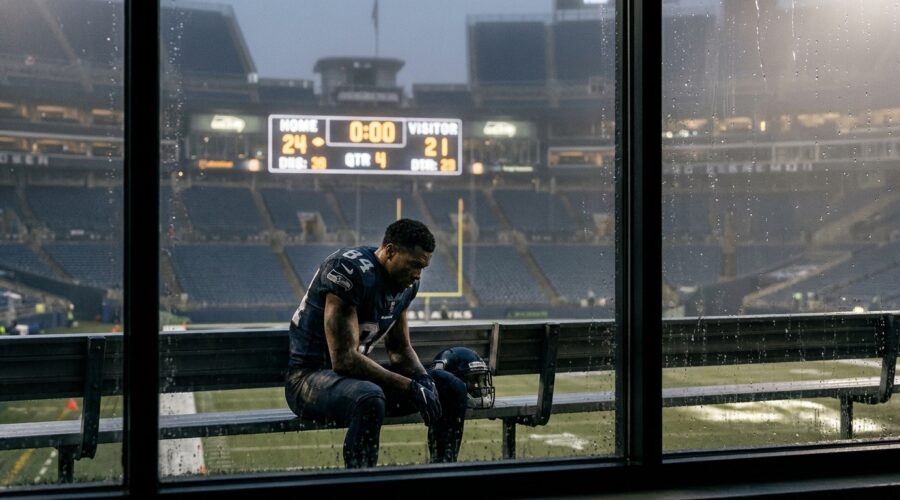
In the long, operatic saga of Brandon Aiyuk’s departure from San Francisco, we have finally arrived at the final act. It has involved a torn ACL, a voided $27 million guarantee, a property purchase in Northern Virginia, an Instagram post that functioned as a press conference, and a 75-minute meeting in Santa Clara that produced exactly one quote worth anything: Drew Rosenhaus, the super agent, standing outside the facility saying, “To be continued.”
The continuation ends November 24.
That is the hard deadline — the last moment the San Francisco 49ers can release Aiyuk without owing him a game check of approximately $1.52 million. After that, every day they hold him costs real money they have zero football reason to spend. The NFL officially reinstated Aiyuk from the Reserve/Left Squad list on November 9, granting the 49ers a standard two-week roster exemption under CBA Article 20, Section 4. The exemption runs through November 23, expiring November 24. The release window is now open and very likely to be exercised, with teams, analysts, and anyone with a pulse already mapping out what comes next.
So let’s map it out properly — the CBA mechanics, the market, the three landing spots, the wild card math, and the uncomfortable honest assessment of whether any of this matters before January.
The Mechanics, Because the Details Actually Matter Here
The roster exemption ran from November 9 through November 23. During that window, Aiyuk did not count against the 53-man roster and drew no salary. The 49ers could carry him invisibly, which is exactly what they did — Pro Football Talk reported on November 18 that the team had “shown no inclination to release Aiyuk until they absolutely have to,” a strategy that is simultaneously financially rational and, as Mike Florio noted, more than a little petty.
Kyle Shanahan’s reaction to the reinstatement was a clinic in head coach detachment: “It means absolutely nothing to our team. That’s all administrative stuff to me.” Which is true, in the sense that a 9-1 football team quarterbacked by a legitimate MVP candidate does not lie awake thinking about a wide receiver who has not played in two years. But it is also the kind of thing you say when you want to minimize your rival’s acclimation window, which is precisely what holding Aiyuk until the 24th accomplishes.
Here is the financial reality per Spotrac data. If the 49ers release Aiyuk, they absorb approximately $7.36 million in 2026 dead cap and $19.29 million in 2027 dead cap. If they activate him to the 53-man roster, they owe him roughly $13.75 million in remaining 2026 salary. The activation path has essentially zero football rationale for a team that is running away with the NFC’s top seed. So the probability distribution here is roughly: release at ~95%, trade at ~5% (the trade deadline passed November 10, one day after reinstatement, so this window is technically closed), and activation at something approaching rounding error.
As a vested veteran with four or more accrued seasons, Aiyuk clears waivers unclaimed — no team can scoop him for a waiver claim. He becomes an unrestricted free agent, free to sign any new contract with any team, somewhere around November 25 or 26. Free to sign by late November. Expected signing: late November to early December.
There is also the unresolved $13 million bonus repayment claim, in which the NFL Management Council contends Aiyuk owes the 49ers roughly $13 million from signing bonuses on the four-year, $120 million extension he signed in August 2024. That cloud hangs over any new contract negotiation, though practically speaking, it means any team signs Aiyuk to a minimum or prove-it deal — think $1 to $3 million for the remainder of the season, heavy on performance incentives — and sorts out the legal tangle separately.
The Player: What Is Actually Available Here
Before debating destinations, it is worth being honest about the product. Aiyuk was, at his peak, genuinely excellent. His 2023 season — 75 receptions, 1,342 yards, 7 touchdowns, second-team All-Pro, PFF’s second-ranked wide receiver — represented the high-water mark of a career that was supposed to anchor San Francisco’s passing offense for the next half-decade. He signed a four-year, $120 million extension with $45 million fully guaranteed at signing in August 2024 (with $76 million in total guaranteed money over the contract period), then tore his ACL, MCL, and meniscus on October 20, 2024, against the Kansas City Chiefs. He has not played a competitive snap since.
That is more than two years of competitive inactivity. The rehab period was complicated by his estrangement from the 49ers — he worked out alone, early mornings, away from the team facility, declining meetings, declining to participate in the structured rehabilitation environment that tends to accelerate multiligament knee recoveries. That matters, not because it makes him a bad person, but because it makes the medical and conditioning timeline harder to evaluate from the outside.
Drew Rosenhaus has been emphatic in his public assessments: Aiyuk passed physicals “with flying colors,” MRIs show no current structural concerns, he is “100% healthy,” working out “full-force,” running routes and catching footballs in independent sessions. “We’d be glad to go work out for interested teams if he is released by the 49ers,” Rosenhaus said on The Pat McAfee Show, which is agent-speak for “the product is ready for inspection.”
The skeptics are equally credible. Former NFL wide receiver James Jones was blunt on a November 19 Pregame appearance: “I feel bad for him. He’s really ruined his reputation. All these coaches and GMs are homies, and they talk to each other. I think he’s gonna get released, and I don’t think we’ll see Brandon Aiyuk play football this year.” Matt Barrows of The Athletic assessed Aiyuk’s staying probability in San Francisco at “pretty much 0%” and characterized any acquisition as essentially “buying a 2027 option.” Jordan Schultz reported that at least one NFC team internally discussed adding him to its practice squad rather than the active 53-man roster — which tells you everything about how some front offices are framing this.
The honest synthesis: physical health claims appear legitimate, competitive rust after two-plus years off is real, and best-case 2026 looks like an active debut somewhere in Weeks 13 or 14, with meaningful contributions across two to four regular season games. The more important question, particularly for the teams shopping here, is what they are actually buying. The answer might be the same word Barrows used: 2027.
The Washington Commanders (50-55% Probability): The Destination That Was Never Subtle
If you have paid any attention to Aiyuk’s public behavior over the past year, Washington was never particularly well-hidden. He posted on Instagram that he would “sign with the Commanders tomorrow.” He announced a property purchase near the Commanders’ Ashburn facility on July 24, 2026 — though it remains unclear whether that was a genuine transaction or Aiyuk trolling online, as USA Today Commanders Wire noted: “It’s unclear whether Aiyuk purchased a home in Virginia, or if this is another case of him trolling.” He posted wearing Commanders gear. He and quarterback Jayden Daniels were teammates at Arizona State. When Rosenhaus went on The Pat McAfee Show and said Aiyuk would likely sign with “a team that knows him, that has somehow been affiliated with him, either in college or with the 49ers,” Mike Garafolo immediately pointed his followers toward Washington’s Twitter account and tagged them. The dots are not exactly invisible.
The institutional connection goes beyond Daniels. GM Adam Peters spent years in the 49ers’ front office. He was part of the organization that drafted Aiyuk 25th overall in 2020. He understands the player’s strengths in a Shanahan-adjacent offensive system, and he has the kind of personal familiarity that makes due diligence on a complicated roster addition more manageable than it would be for a front office starting from scratch.
The on-field need is real, too, even if the team’s situation is less than glamorous. Terry McLaurin suffered a season-ending patellar tendon injury, leaving Washington’s receiver room as follows: Stefon Diggs, the veteran; Antonio Williams, a 2026 rookie; Treylon Burks; and Dyami Brown. That is a depth chart that works adequately when Jayden Daniels is healthy and the run game is dictating terms. It is not a depth chart that wins a playoff game against a top-four NFC team.
The complication is the record. Washington is 3-5-1. Their playoff odds sit somewhere in the low single digits. Rosenhaus hinting at the Commanders as a destination means Aiyuk might be choosing a team for personal reasons rather than professional optimization, which is his right but worth acknowledging. The 2026 upside here is limited. The 2027 upside — Daniels plus a healthy Aiyuk plus a recovered McLaurin plus whatever Peters builds around them — is legitimately intriguing. Signing Aiyuk now is a down payment on that.
Timeline: He clears waivers around November 25 or 26, signs by late November, could practice in Week 12 during Thanksgiving week, and debuts earliest in Week 13 on December 6 at Tennessee. The Commanders also host Minnesota in Week 16, which creates a spoiler scenario that would have real wild card implications.
The Los Angeles Rams (25-30% Probability): The Most Analytically Compelling Case
Washington is the sentimental favorite. Los Angeles is the football argument.
The Rams’ wide receiver room has been systematically demolished by injury. Puka Nacua, who had produced 70 receptions for 715 yards and 4 touchdowns across seven games, underwent MCL surgery on November 20. Pro Football Doc Dr. David Chao’s assessment was unambiguous: “It’s season-ending for all intents and purposes,” with a minimum three-month recovery and potential PCL complications extending that further. Davante Adams has been on IR since Week 6 with a hamstring injury, with Sean McVay indicating a return “at earliest” in Week 13. Jordan Whittington is also on IR with a back injury. The receivers currently active for Matthew Stafford are Konata Mumpfield, Tutu Atwell, Xavier Smith, and CJ Daniels — which is a functional NFL receiving group in the same sense that a studio apartment is functional living space. It works. Nobody is thriving.
The Rams are 6-4 and tied with Green Bay and Seattle for the final Wild Card spot in the NFC. They have a critical Week 14 game on December 13 at San Francisco — the type of game that, without a credible number one wide receiver, becomes a glorified walkthrough for a 9-1 Niners defense. They also have Kansas City and multiple division games remaining. Their current roster, at the receiver position, is not built to win three of those games.
Aiyuk changes that calculus in ways that extend beyond raw talent. Even at 70 to 80 percent of his 2023 peak, he is a dramatic upgrade over the current Rams options. If Adams returns in Week 13 as expected, the combination of Adams plus Aiyuk represents one of the more credible wide receiver duos available to any NFC playoff contender in December. That is a Stafford offense with legitimate downfield threats for the first time since October. The December 13 game at San Francisco would shift from a presumed Niners tune-up into a genuinely competitive NFC West clash, complete with a revenge narrative that writes itself.
The Rams reportedly inquired about Chargers wide receiver Ladd McConkey at the trade deadline and were rebuffed. They are actively looking for solutions. Their projected cap space accommodates a prove-it deal comfortably. The football logic for this signing is probably stronger than any other destination. The question is whether Aiyuk prefers football logic or Jayden Daniels.
The Minnesota Vikings (10-12% Probability): The Strongest Scheme Fit That Lacks a Personal Connection
Minnesota is the third option, and it is a legitimate one, even if it trails the other two in probability. The Vikings are 7-3 after losing 35-10 to the 49ers in Mexico City on November 22, a result that served mostly to remind everyone how good San Francisco is and how much Minnesota needs a secondary receiver behind Justin Jefferson.
The team’s season has been eventful. They started 6-0, lost to the Lions and Bills in back-to-back weeks, and the Bills loss was sufficiently bad — Carson Wentz going 8-of-25 for 81 yards with 2 interceptions — that they acquired Kirk Cousins from the Las Vegas Raiders in exchange for a 2027 third-round draft pick. Cousins threw for 207 yards (21 of 31) with two touchdowns and one interception in his first start back with Minnesota, winning 30-10 against Green Bay, which suggests the quarterback problem is solved. The Vikings have the best defense in the NFL by points allowed, surrendering 14.0 points per game. Jordan Addison is out with thumb surgery. The piece Kevin O’Connell’s offense is missing is a credible second option behind Jefferson in December and January.
Analyst Dustin Baker of Vikings Territory flagged the scheme similarities between O’Connell’s system and Kyle Shanahan’s offense at the trade deadline. Aiyuk would have a natural feel for the route concepts and spacing. The team is well-positioned for a deep playoff run. And yet Minnesota sits third in this probability ranking, because personal connections matter in a November free agent evaluation, and the Vikings have the weakest relationship with Aiyuk of the three primary candidates. The most likely Vikings outcome, per Jordan Schultz’s reporting, might actually be a practice squad addition rather than a full 53-man signing.
If Minnesota signs Aiyuk and plays him in December, the December 21 game at Detroit for NFC North supremacy becomes a genuinely different game. Cousins plus Jefferson plus Aiyuk plus the league’s top defense is a configuration that would worry most NFC head coaches in January.
What It Does to the Wild Card Race: The Actual Stakes
Seven NFC teams are plausibly fighting for three Wild Card spots. As of Week 11, Green Bay, Seattle, and Los Angeles are all 6-4, tied for one spot, with Minnesota and Chicago both at 7-2 holding the other two Wild Card spots. It is as compressed as a playoff bubble gets with five weeks of regular season remaining.
The Aiyuk signing has meaningfully different downstream effects depending on where he lands. Washington at 3-5-1 represents the lowest short-term impact on the race, though a Week 16 game against Minnesota could matter on the margins. If Washington upsets the Vikings with Aiyuk active, the ripple effects on seeding are real, even if Washington itself has no realistic postseason path.
The Los Angeles scenario is the one that reshapes the race most dramatically. An Aiyuk signing immediately improves the Rams’ odds of winning the Wild Card tiebreaker over Green Bay and Seattle. The December 13 game at San Francisco becomes a measuring stick game rather than a surrender. If the Rams make the playoffs with Aiyuk plus a returning Davante Adams, they become a team capable of winning a postseason game against anyone not named San Francisco. That either displaces Green Bay or Seattle from the bracket, which affects divisional seeding for the entire conference.
Minnesota with Aiyuk is the scenario that most concerns the other NFC contenders in a postseason context. The Vikings already have the No. 1 defense and a Hall of Fame quarterback. Adding a former second-team All-Pro wide receiver, even one operating at 75 percent capacity, to a lineup that already features Justin Jefferson is the kind of incremental improvement that turns a good NFC team into a genuinely dangerous one in a cold-weather January game.
Meanwhile, San Francisco watches all of this from the NFC’s top seed, 9-1, Kyle Shanahan presumably Coach of the Year, Brock Purdy at 185-of-264 for 2,369 yards, 20 touchdowns, 5 interceptions, and a 115.2 passer rating. The 49ers have absorbed injuries to Mike Evans, Deebo Samuel, De’Zhaun Stribling, and Ricky Pearsall and still beaten the Vikings 35-10 in Mexico City. Shanahan’s “it means absolutely nothing to our team” quote is probably the most accurate thing said in this entire saga.
The Uncomfortable Conclusion: What This Is Actually Buying
It is worth stepping back from the destination debate to acknowledge what Matt Barrows and James Jones are actually saying. Two-plus years of competitive inactivity is not nothing. A multiligament knee injury — ACL, MCL, and meniscus simultaneously — with a non-linear rehabilitation process and limited team-facility access during estrangement is not a standard recovery arc. Rosenhaus’s physical claims are likely accurate. Independent workouts running routes and catching footballs are genuinely encouraging. The claim that any of that translates to meaningful Week 13 production, in a new offensive system, against NFL-caliber coverage, is a significantly bigger leap.
The most honest projection for Aiyuk’s 2026 impact, absent some spectacular exception to every historical precedent we have for long-absence returns, is as follows: active roster by Week 13 or 14, targeted cautiously in two to four games, producing at something below his peak while learning a new system under playoff pressure. The team that signs him in late November is making a speculative bet on a 2027 version of Aiyuk more than a 2026 playoff run contribution.
That is not worthless. A 2027 prove-it deal with a contender, at a low base salary with performance incentives, that gives Aiyuk a chance to re-establish market value while giving a team a legitimate upside receiver — that is a transaction that makes sense for both parties. It is just not the cavalry arriving to save a playoff push in Week 14. It might be a contributor. It is more likely a lottery ticket that, if it hits, pays out significantly in 2027 and beyond.
The November 24 deadline is real. The release is essentially certain. What happens after is the most genuinely uncertain thing in the NFC right now. Three teams want him for three different reasons — one sentimental, one analytical, one schematic. One of them will probably get their answer in the next ten days. And then the rest of the NFC Wild Card race will recalibrate accordingly, because that is how it works when a former All-Pro wide receiver becomes available for a prove-it minimum in December with seven teams fighting for three spots.
Some call it drama. The NFL calls it November. At this point, they are the same thing.