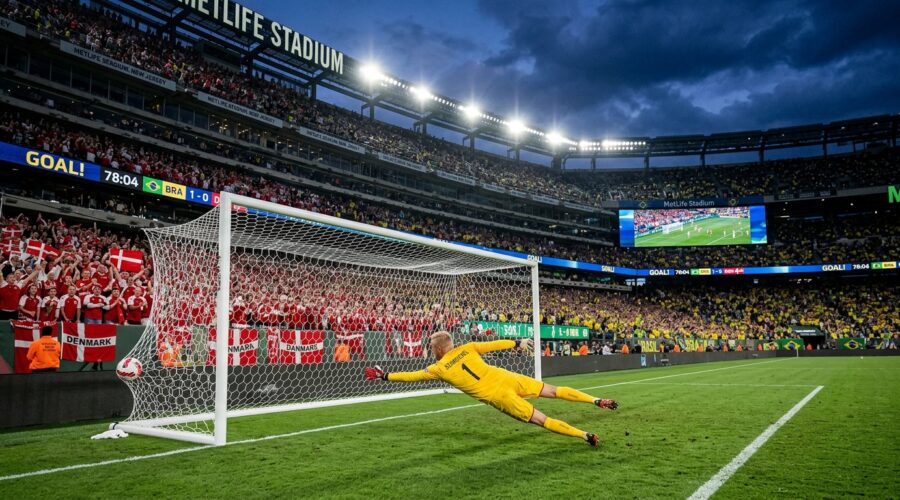
There are days at a World Cup when the tournament simply decides it has been polite long enough. Sunday, July 5, 2026 was one of those days. Within the space of a few hours, Brazil were sent home by Norway — eliminated earlier than they have been in thirty-six years — and England survived the most hostile cauldron in football to beat Mexico at the Azteca, the first time anyone has beaten them there at a World Cup in the modern era. The giants fell. The history books were cracked open and rewritten in ink that hasn’t quite dried yet. If you were watching anywhere in the world, you already know you were watching something. If you were not watching, this is the piece that explains, with some regret on your behalf, exactly what you missed.
Norway 2–1 Brazil | MetLife Stadium, New Jersey
The Weight of the Occasion
Brazil arrive at every World Cup carrying the quiet expectation of a nation that regards winning the tournament not as an aspiration but as a scheduling matter. Five world titles. The most decorated programme in the history of the sport. And yet, Brazil had never been eliminated in the Round of 16 since 1990, when Argentina’s Claudio Caniggia ended their tournament in Turin. That was thirty-six years ago. Some of the players who started Sunday’s match were not yet born.
Norway, for their part, arrived at MetLife Stadium carrying something altogether different: the specific, slightly bewildered joy of a small footballing nation that has stumbled into genuinely uncharted territory. They had never reached a World Cup quarterfinal before. Never. And between them and that milestone stood the most romantically decorated team in the sport’s history. You could not have written this fixture more neatly if you had tried.
The Shape of the Match
The first half belonged to tension rather than football. Brazil controlled the ball without ever quite threatening to do anything meaningful with it, and Norway — organised, compact, their defensive shape holding its discipline with the quiet stubbornness of a team that genuinely believes it can suffocate anyone — were content to deny space and invite the Seleção into the kind of possession that flatters statistics while accomplishing nothing.
The decisive moment of the opening forty-five minutes arrived in the most punishing form it could take for a Brazilian side: a missed penalty. Bruno Guimarães stepped up with the authority of a man who has been dispatching these in the Premier League for years, and Ørjan Nyland — a goalkeeper not generally considered among the most discussed names at this tournament — threw himself to his left and turned it away. It was a save that, in hindsight, may well define the entire World Cup. Patrick Berg had a goal ruled out for offside in what looked, to many watching, like a call that required considerable generosity toward the technology. But Solbakken’s men held.
Vinicius Junior had been Brazil’s brightest light throughout the tournament — his movement against Morocco in the group stage was the kind of football that makes you remember why you bother with the sport at all — but Norway’s defensive structure absorbed him. He flickered. He found pockets. And he found, every time he did, a red and blue wall that simply declined to be beaten.
Haaland and the History
Erling Haaland has spent a career navigating between two reputations: the clinical finisher who simply does not miss, and the man whose critics suggest the goals come too easily, against too little, to really tell us anything about greatness. Sunday evening at MetLife Stadium, against Brazil, with the tournament on the line, retired the second argument permanently.
His first goal came at the seventy-ninth minute, the kind of finish that makes the act look so elementary it is almost insulting. Norway lead Brazil 1-0. The silence in the Brazilian sections of the stadium was the sound of a nation processing something it did not have a framework for. Then, at ninety minutes precisely, Haaland scored again. The Norwegian bench erupted in the manner of people who cannot quite believe they are permitted to do this. Norway 2-0 Brazil. It was effectively over.
Neymar converted a stoppage-time penalty at the hundredth minute to make it 2-1 — a goal greeted with the particular sadness that attends a brilliant career taking what may have been its final bow on the World Cup stage. Too little, too late, and everyone on the pitch knew it.
Haaland now stands on seven goals in five matches, level with Mbappé and Messi at the top of the Golden Boot standings. There is something almost impolite about a man being this effective.
The Ghost of Marseille
In Marseille in 1998, Norway — almost certainly by accident and almost certainly with considerable surprise — beat Brazil 2-1 in the group stage of the France World Cup. Ståle Solbakken was part of the Norwegian squad that summer, though he did not feature in that particular match, appearing instead in other group games against Morocco and Scotland. Whatever the squad experienced collectively that day in Marseille, it lodged itself somewhere permanent in the psyche of Norwegian football.
Norway’s all-time record against Brazil now reads: three wins, two draws, zero defeats. In no rational version of football’s history should this be the ledger of a nation that has spent most of its international existence politely making up the numbers. And yet there it is. Solbakken, after the final whistle on Sunday, called it “the greatest night in Norwegian football history,” and it is genuinely difficult to mount a counterargument.
On the pitch, Haaland led his teammates in the Viking Row — that slow, communal rowing celebration that the Norwegian travelling support had been building toward all tournament — banging a drum, grinning with the particular abandon of someone who has scored twice to eliminate Brazil from a World Cup and has decided, quite reasonably, that this warrants a drum. “This is one of the most insane days in Norwegian history,” he said afterward. “Just enjoy it, embrace it and enjoy the moment.”
For Carlo Ancelotti, the reckoning begins. Brazil’s public has never been especially gentle with disappointment, and the coach, who has won the Champions League five times — with AC Milan in 2003 and 2007, and with Real Madrid in 2014, 2022, and 2024 — and been broadly regarded as one of the most tactically sophisticated managers of his generation, will find that none of that currency travels as far as it once did in the Brazilian press this week.
Mexico 2–3 England | Estadio Azteca, Mexico City
Forty Years of Ghosts
England’s last visit to the Azteca at a World Cup was on 22 June 1986, a quarterfinal against Argentina that produced two goals so famous they have their own philosophical categories. The first — Maradona’s hand, the referee’s silence, the sheer impertinence of it — became shorthand for an entire strand of football’s moral complexity. The second — sixty seconds of improvised genius that left five England defenders and the goalkeeper looking like furniture — became the standard against which all other goals are measured. England lost 2-1 and have not returned to the Azteca in World Cup competition since, until Sunday night.
Forty years is a long time to wait for a second visit. They made it worthwhile.
The Storm Before, and the Storm After
The match was delayed an hour before kickoff due to a pre-match weather event — one more layer of theatre in an evening that hardly required any. When it finally began, the Azteca held approximately eighty-seven thousand people who had come principally to watch Mexico go through, hosted at home in front of a nation that regards this as simply its due. They had topped Group A with nine points from nine, a perfect group stage record, and arrived as the most complete hosts’ team at any World Cup in recent memory. The stands were noise and colour and the weight of forty years of unfulfilled expectation.
Then Jude Bellingham scored at thirty-six minutes, and the noise became something more complicated.
Then, ninety-eight seconds later, Jude Bellingham scored again.
Two-nil England at the Azteca in the thirty-eighth minute of a World Cup Round of 16. Whatever anyone may have thought before kickoff about the likely shape of the evening, that was not it.
Bellingham, Kane, and the Business End
Julián Quiñones, Mexico’s top scorer in the tournament, pulled one back at forty-two minutes to send the sides in at half-time with England holding a 2-1 lead and the Azteca finding its voice again. The second half was where the match truly turned chaotic.
At fifty-four minutes, England’s Jarell Quansah was shown a straight red card following a VAR review for a high challenge on Jesús Gallardo. England down to ten men, thirty-six minutes left to play, one goal ahead, at altitude, in the Azteca. You might construct more difficult situations for a side to defend, but you would have to think hard about it.
Harry Kane, with the unhurried air of a man converting penalties in rather more straightforward circumstances, tucked one away at sixty minutes after Anthony Gordon was brought down, to make it 3-1. His sixth goal of the tournament and, with it, his fourteenth World Cup career goal altogether — drawing level with Gerd Müller for fifth on the all-time list. Kane reaches for these milestones with the quiet inevitability of a man who has decided records are simply the administrative side of being excellent.
Raúl Jiménez converted a penalty at sixty-nine minutes — awarded after a VAR review for a Kane foul on Brian Gutiérrez, which carried its own neat irony — to make it 3-2. Eleven minutes of added time were signalled. The Azteca found a volume it had been building toward all evening.
Jordan Pickford, who has spent the better part of a decade being simultaneously excellent and underappreciated, was magnificent in those closing stages. He denied a Jiménez header with the kind of save that earns a goalkeeper very little credit in the immediate aftermath because everyone is simply too relieved to be analytical about it. England held on. Final score: 3-2.
The Quinto Partido, Again
Mexico have been eliminated at the Round of 16 eight times since 1986. The Quinto Partido — the fifth game, the quarterfinal, the threshold the nation has been trying to cross on foreign soil for four decades — remains uncrossed. They had won a knockout match for the first time in forty years earlier in this tournament, against Ecuador, which briefly raised the hope that this time might be different. It was not different. Mexico topped their group with a perfect record, hosted a World Cup on their own soil, and still did not make the quarterfinal. There is a particular cruelty to this kind of pattern that transcends tactical analysis.
England vs Norway: Miami Gardens, July 11
The quarterfinal draw has produced a fixture that neither country will take lightly. England reach the last eight for a third consecutive World Cup — a consistency of result that would have seemed absurd a decade ago and now feels almost like a floor rather than a ceiling. Norway arrive having just beaten Brazil in New Jersey, with Haaland on seven goals and a collective belief that would have seemed delusional at the start of the tournament and now seems perfectly reasonable.
Solbakken was part of the Norway squad in 1998 when they beat Brazil in Marseille. He now manages the side that has beaten Brazil in 2026. He will know everything about England. He will know about Bellingham’s movement, Kane’s penalty record, Pickford’s reflexes, and the particular way Thomas Tuchel’s England compact defensively when the occasion demands it. Norway, for all the fairytale framing, are not naive. They have navigated, in Solbakken’s own words, “shark-infested waters” to reach this point.
In Miami Gardens on July 11, the sharks will be circling from both directions.
The Golden Boot and What It Tells Us
After Sunday’s matches, Mbappé, Haaland, and Messi all sit on seven goals apiece — three of the most decorated attackers of their generation level-pegging at the top of the tournament’s scoring chart with the quarterfinals still to come. Kane sits fourth on six. It is the kind of Golden Boot race that renders the statistical argument briefly compelling even to those of us who prefer our football felt rather than counted. Though it is worth observing that statistics have a habit of telling you what happened without getting particularly close to why, and the why of Sunday was considerably more interesting than any number.
The Day in Summary
Brazil, the five-time world champions, are out. Norway, who have never reached a World Cup quarterfinal in their history, are in. Mexico, who topped their group with nine points from nine in front of their own people, are out. England, who survived a red card and eleven minutes of added time at altitude in the most famous stadium in the Americas, are in. Neymar may have played his last World Cup match. Haaland may be playing the tournament of his career. The Azteca witnessed England win there at a World Cup for the first time — though admittedly, England’s sole previous visit had gone rather differently for entirely different reasons.
Days like Sunday come around rarely in football — days when the weight of history and the shock of the present collide with enough force that you feel it somewhere that statistics cannot reach. The 2026 World Cup, already a sprawling, continent-spanning affair of forty-eight teams and compressed narratives, produced two matches on July 5 that will be discussed for decades. Norway’s rowing celebration on the MetLife turf. Haaland and the drum. Bellingham’s ninety-eight seconds at the Azteca. Pickford diving to his right in the added time to keep England alive.
The quarterfinals begin July 9. Whatever comes next, Sunday has already earned its place.