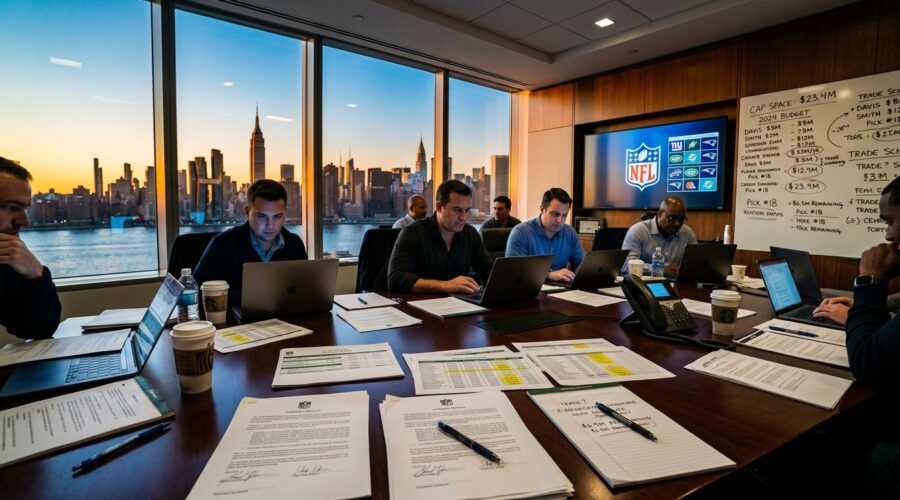
There are dates that live in the NFL’s institutional memory — the day Brett Favre became a Jet, the afternoon Peyton Manning signed with Denver, the morning the Rams mortgaged their future for Matthew Stafford. Then there is June 1, 2026, a Monday that surpassed all of them. By the time the sun set over the league offices in Manhattan, two of the most seismic player transactions in modern football history had been agreed upon simultaneously: Myles Garrett, the greatest pass rusher of his generation, was headed to the Los Angeles Rams, and A.J. Brown, one of the most physically punishing wide receivers alive, was leaving Philadelphia for New England. The NFL had been colonized, as ESPN put it, by a single date on the calendar. And nothing about the sport’s balance of power would look the same again.
The Mechanism Behind the Madness: Why June 1 Changed Everything
To understand why both trades happened on precisely this day, you need to understand a quirk of NFL salary cap accounting that most fans gloss over. When a player is traded or released, the remaining prorated bonus money on their contract accelerates onto the trading team’s cap as what is known as “dead money.” Trade that player before June 1 and you absorb the full remaining charge in a single season. Wait until after June 1, and you split it across two years.
That distinction is not a footnote. It is the engine that drove two franchise-altering deals through on the same afternoon.
For the Philadelphia Eagles, trading A.J. Brown before June 1 would have meant absorbing the entire $43.5 million dead-cap hit in 2026 alone. By waiting, they split it: $16.35 million in 2026, $27.1 million in 2027. The savings in the current year alone amounted to roughly $27 million in live cap space — enough to sign a starting linebacker, restructure a veteran, and still have room to breathe. The Cleveland Browns told a nearly identical story with Garrett: a pre-June 1 trade would have hit them for $41.09 million immediately. Post-June 1 processing cut that to $15.53 million in 2026, with $25.56 million deferred to 2027.
It is worth noting, as both CBS Sports and Over the Cap made clear, that the NFL does not technically allow a “post-June 1 trade designation” in the way it does for releases. The workaround is elegant in its simplicity: both deals were announced June 1 but formally processed June 2, the first business day after the deadline triggers, giving both trading teams the cap-splitting benefit. No rules were bent. The calendar was simply understood.
2026 marks arguably the first time in league history that two historically significant player trades leveraged this mechanism in concert, on the same day, with combined dead-cap charges exceeding $84 million. The June 1 date had always been an important moment in cap management circles. Now it belongs to the broader culture of the sport itself.
Trade No. 1: The Rams Bet Their Future on the Best Defensive Player Alive
Myles Garrett was never supposed to be traded. Cleveland Browns general manager Andrew Berry had said, with the kind of conviction usually reserved for men who mean it, that trading Garrett “would be a waste of time.” He was the franchise’s unimpeachable constant through nine turbulent seasons — through three starting quarterbacks, two coaching staffs, one catastrophic Deshaun Watson decision that cost the team six draft picks including three first-rounders, and a two-season record of 8-26. Through all of it, Garrett played at an alien level of excellence.
His 2025 statistics do not fully communicate what he is, but they try: 23 sacks in 17 regular-season games, breaking the NFL’s single-season record for sacks since individual tracking began in 1982. His career totals entering 2026 read like a textbook written in first-person: 125.5 career sacks, 413 pressures, 149 tackles for loss, the most of any player since his 2017 debut. He won his second Defensive Player of the Year award. He was named to his seventh Pro Bowl. He is 30 years old and there is no credible evidence that he is slowing down.
So what changed? A contract restructure in March 2026 that quietly deferred $29 million in bonus payments was the signal, if anyone was reading carefully. Berry had not softened his stance publicly, but the market had begun to move underneath him. The Browns were 8-26 over two years. The Watson contract, a deal so lopsided it redefined what a bad trade looks like, was expiring. The franchise needed to rebuild, and it needed a foundation to do it on. The 2027 NFL Draft class — projected to include Arch Manning, Dante Moore, LaNorris Sellers, and CJ Bailey — is widely considered one of the most quarterback-rich in years. To compete for one of those players, Cleveland needed draft capital. To get draft capital at the level that a Myles Garrett trade could generate, they needed a partner willing to go all in.
The Los Angeles Rams were that partner. They always were going to be.
Les Snead’s famous declaration — “f*** them picks” — is not just a memorable quote. It is a philosophy executed with discipline. Since the 2017 draft, the Rams have made only two first-round selections. They traded for Jalen Ramsey, for Matthew Stafford, for Cooper Kupp’s contract extension, for every piece that made up their 2022 Super Bowl championship. They mortgaged tomorrow for today because they believed, correctly, that windows are real and limited.
In 2026, that philosophy is backed by a specific logic: Matthew Stafford won the 2025 NFL MVP award with 4,707 yards and 46 touchdowns at age 37. He signed a one-year extension worth $45 million to return. The Rams had already traded for cornerback Trent McDuffie from Kansas City, giving up a first-round pick. They had drafted quarterback Ty Simpson with the 13th overall pick, solving their succession question and freeing them, psychologically and practically, to spend what was left. When head coach Sean McVay sat down with Garrett for the first time, he reportedly told him: “I didn’t f—ing sleep all week because of you.” That sentence describes both the anxiety of facing Garrett as an opponent and the desperation of trying to acquire him. The Rams felt both at once.
The final trade terms: the Browns received outside linebacker Jared Verse, a 2027 first-round pick, a 2028 second-round pick, and a 2029 conditional third-round pick. That conditional pick carries a clause worth paying close attention to: if the Rams ever trade Garrett to any team in the AFC North — the Ravens, Bengals, or Steelers — the 2029 third converts to a first-round pick. It is the kind of creative legal guardrail that reflects how seriously Cleveland’s front office understood what they were giving away. They were not going to let Garrett become a weapon used against them in their own division without receiving additional compensation for the privilege.
Garrett’s contract was reworked shortly after the trade, with the Rams converting option bonuses to signing bonuses and adjusting workout bonus timing. His 2026 earnings rose to approximately $37 million, up from $31.5 million under his prior structure, with the Rams borrowing from future years on the same total contract value. He is now the most expensive non-quarterback in football, playing on the team with the best odds to win the Super Bowl.
The market responded immediately. The Rams’ Super Bowl odds shifted from +800 to +550–+600. ESPN’s Football Power Index gave Los Angeles a 14.9 percent Super Bowl probability, more than four full percentage points higher than any other team in the league. An ESPN analyst summarized the feeling plainly: “This is the best team in the NFL. He might be the best player in the entire league.” Neither statement is easy to argue against.
What Cleveland Gets Back: Jared Verse and a Rebuild Worth Believing In
It would be easy to frame what the Browns gave up as irreplaceable, because in a literal sense, it is. Garrett is a once-in-a-generation player. There is no one on the current roster, or likely the next five drafts, who will do what he did. Berry acknowledged this at the team’s press conference with the kind of honesty that earned him goodwill even as it broke hearts in northeast Ohio. “Do we hold on to a truly generational player who has become the identity of our team, or do we make the difficult decision that we think is best for the organization over the long run? In that framework, the decision became clear.”
What Cleveland gets back is not Garrett. But it is not nothing, either.
Jared Verse is 25 years old. He was the 2024 NFL Defensive Rookie of the Year. He has been named to the Pro Bowl in each of his first two professional seasons. In those two seasons combined, he accumulated 99 pressures — third-most of any edge defender during that span, trailing only Micah Parsons and Myles Garrett himself. In his introductory press conference as a Brown, Verse was direct: “I’m not here to fill his shoes. I’m here to work, and I’m here to be the best version of me. And the best version of me is going to be the best defensive player in the league.” Whether or not he achieves that ceiling, he arrives in Cleveland at a cost of approximately $4.1 million against the cap in 2026 — a bargain that borders on embarrassing given his production.
Surrounding Verse is a young defense that includes second-year defensive tackle Mason Graham, 2025 Defensive Rookie of the Year linebacker Carson Schwesinger, and a restructured front seven operating under new head coach Todd Monken. The Browns now hold two first-round picks in the 2027 draft — their own and the Rams’ — positioned precisely when they need them most. The rebuild has a skeleton. It has a plan. Berry met with Garrett personally at the Haslam family home before the trade was finalized. “We told him we are extremely grateful for all that he contributed to our team and to our community,” Berry said afterward. “He will always be a Cleveland Brown.”
That framing matters — not because it softens the blow, but because it acknowledges one. Cleveland fans deserve at least that much truth.
Trade No. 2: The Patriots Find What Drake Maye Was Missing
The A.J. Brown situation in Philadelphia had been deteriorating for months before anyone made it official. His cryptic social media posts, pointed post-game comments, and a visible self-help book photographed in his locker were the kinds of signals that NFL beat reporters are trained to decode. The underlying friction, ESPN reported after the trade was announced, came down to a specific frustration: Brown felt that quarterback Jalen Hurts was too reluctant to target him on tight-window throws against zone coverage — the exact situations where Brown’s 6-foot-1, 225-pound frame and elite contested-catch ability give him the largest advantage over defenders.
That is a pointed critique. It reflects not just a personality conflict but a genuine schematic concern about whether the Eagles’ offensive system was capable of deploying Brown optimally. Howie Roseman, to his credit, recognized the dynamic and acted before it poisoned the locker room any further. He had already drafted receiver Makai Lemon with the 20th overall pick — Lemon won the 2025 Biletnikoff Award as the nation’s top college receiver — and tight end Eli Stowers in the second round. The infrastructure for a post-Brown offense was being built in parallel with the trade discussions.
The return for Brown: a 2028 first-round pick and a 2027 fifth-round pick. Roseman, asked about the modest haul at face value, was characteristically measured. “A pick is a pick,” he said — and he is right that a 2028 first from a Patriots team that may still be ascending under Drake Maye carries meaningful upside. The Eagles cleared roughly $27 million in 2026 cap space, removed a disgruntled star from their locker room, and retained DeVonta Smith, who now steps into the unquestioned No. 1 receiver role after four years of splitting targets. ESPN projects Smith for 128 targets, 90 receptions, 1,127 yards, and six touchdowns in 2026. Brown’s departure, strange as it sounds, may free Smith to become the player his individual talent always suggested he could be.
For New England, the calculus was simpler: Drake Maye needed a weapon, and A.J. Brown is exactly that.
Maye’s 2025 regular season was the kind that earns MVP consideration in almost any other year. He completed 72.0 percent of his passes for 4,394 yards, 31 touchdowns, and only eight interceptions. He added 450 yards and four touchdowns as a runner. The Patriots went 14-3 and reached Super Bowl LX — the first championship game of Maye’s young career. Then Seattle happened. Drake Maye was sacked 21 times across the entire 2026 postseason — a personal postseason record — including six times by the Seahawks in the Super Bowl itself. New England lost 29-13. Maye threw two interceptions and fumbled. The game exposed, brutally and publicly, what the Patriots had been managing around all season: they had no true alpha receiver capable of demanding defensive attention and consistently winning in contested situations when the pass protection broke down.
Stefon Diggs, who had led the team with 1,013 yards in 2025, was released in March 2026 at age 32. Romeo Doubs was signed to a four-year, $68 million contract to fill the void. Doubs is a solid receiver. He is not A.J. Brown.
Mike Vrabel, who coached Brown with the Tennessee Titans from 2019 through 2022, drove the acquisition. The relationship between coach and player is one that needed some repair after the Titans traded Brown to Philadelphia in 2022, but time has a way of clarifying what matters. Vrabel was direct about his reasoning: “He’s somebody that we feel strongly about as a person, a competitor and a teammate.” Brown, for his part, expressed something approaching joy at the prospect. He grew up cheering for the Patriots. He called Gillette Stadium a place that will mean “everything” to him in uniform. When he spoke publicly after his first Patriots practice, he was unambiguous: “I’m just ready to ball.”
ESPN projects Brown’s 2026 line at 130 targets, 86 receptions, 1,216 yards, and seven touchdowns. NFL.com, using Next Gen Stats data, projects Brown seeing a 25 percent target share with Maye throwing approximately 520 passes — a workload that places Brown in genuine top-five wide receiver territory. Doubs, already signed and already committed to at $68 million, drops to a clear No. 2 with projections of 88 targets, 60 receptions, and 763 yards. That is not a consolation prize. That is what happens when you add a genuine No. 1 receiver to a passing offense that was already second in the league in EPA per dropback on deep passes.
The Patriots open the 2026 regular season September 9 in Seattle — a Super Bowl LX rematch in the defending champions’ building, with banners being raised before kickoff. It is only the third time in NFL history that two Super Bowl participants have opened the following season against each other in Week 1 — joining the 1970 Kansas City Chiefs and Minnesota Vikings, and the 2016 Denver Broncos and Carolina Panthers. For Maye, who watched film of his own worst professional performance with the admitted intention of using the pain as fuel, there could not be a more clarifying starting point.
The Ripples: An AFC North Reshuffled, an NFC West Loaded, a League on Edge
The two headline trades did not happen in a vacuum. They were the loudest notes in a 2026 offseason that has been unprecedented in the scope and velocity of franchise-level player movement. Dexter Lawrence went from the Giants to the Bengals for the 10th overall pick. Sauce Gardner was traded from the Jets to the Colts for two first-round picks and a young receiver. Micah Parsons left the Cowboys for Green Bay in exchange for a first-round pick, a future first, and Kenny Clark. Trent McDuffie moved from Kansas City to the Rams. Jaylen Waddle went to Denver. Every single major deal yielded at least one first-round pick. Three involved multiple firsts. And the most dramatic near-trade of the offseason — Maxx Crosby to the Baltimore Ravens — collapsed at the last second over concerns about his surgically repaired knee, leaving Crosby stranded on a rebuilding Raiders team with his $29 million salary becoming fully guaranteed in 2027, now harder to move with public medical questions hovering over his market value.
In the AFC North, the power dynamics have visibly shifted. Garrett had sacked Joe Burrow 12 times over the course of his career — more than any other quarterback, a mark he reached before breaking the single-season sack record in Week 18 of the 2025 season. He will not get another opportunity in that division, at least not as a Brown. Burrow’s Bengals added Dexter Lawrence, arguably the best interior defensive lineman available, and Burrow has publicly predicted a Super Bowl title in 2026. The Browns are rebuilding. Aaron Rodgers, 42 years old, signed a one-year, $22 million guaranteed deal with the Pittsburgh Steelers. The Ravens added Trey Hendrickson. The division is being recalibrated in real time, and with Garrett gone, Cincinnati has the clearest lane.
In the NFC West, the Rams (+550–+600) are the favorites in what has become the most concentrated talent division in football. The defending champion Seattle Seahawks, who lost several key contributors from their title roster, now sit at +1100. The 49ers, with Brock Purdy and a rebuilt defense, are listed at +1700. Three teams from the same division sit among the top eight Super Bowl contenders in the entire league. The Rams added Garrett to a defense that already features Byron Young, Braden Fiske, Kobie Turner, Trent McDuffie, and Jaylen Watson. When CBS Sports’ Jonathan Jones reported on June 2 that Aaron Donald — retired since 2024 — had been engaged in internal conversations about returning to football specifically because of what the Rams were assembling, it felt less like a rumor and more like a gravitational pull. Nothing materialized. But the fact that it was discussed at all suggests something about what Los Angeles has built.
Winners, Losers, and What Comes Next
The conventional wisdom is that the Rams won June 1 outright. It is hard to argue otherwise. They added the best defensive player in football to an offense quarterbacked by the reigning MVP, surrounded by skill players averaging roughly 35 points per game in key stretches of 2025. ESPN’s FPI gives them a 14.9 percent Super Bowl probability — the highest of any team — and that number was calculated before any of the ripple effects of the trade had time to fully compound.
But the longer-arc winners may be the ones harder to see right now. The Cleveland Browns, so often the symbol of sustained organizational dysfunction, have structured a rebuild with a logic that is difficult to dismiss. Two first-round picks in the next two drafts, a 25-year-old former Defensive Rookie of the Year on a rookie contract, and a young defensive core that costs almost nothing against the cap. They are not going to be good in 2026. They know that. But the 2027 quarterback draft class is coming, and they will have the ammunition to select from it twice.
The New England Patriots, Super Bowl runners-up with a 22-year-old quarterback and now a genuine No. 1 receiver, look like the most dangerous team in the AFC heading into 2026. Maye ranked second in the entire league in EPA per dropback on passes of 20-plus air yards since taking over as a starter. Now he has the receiver capable of making those throws matter in postseason environments, when defenses are at their most disciplined and pressure packages are at their most relentless.
The losers — the Eagles without their most physically dominant offensive weapon, the Raiders with Crosby frozen in cap purgatory, every NFC team that must now devise a game plan accounting for Myles Garrett in a Sean McVay offense — will have months to process what happened to them on a single afternoon in June.
A Date That Will Be Remembered
Bleacher Report ranked the Garrett trade the single best offseason move of 2026. The Brown trade ranked second. Two deals, announced on the same day, by teams operating from entirely different strategic positions, each leveraging the same obscure mechanism in the NFL’s salary cap rulebook, each reshaping the competitive landscape of their respective conferences. The first time since 1997 that a reigning Defensive Player of the Year changed teams the following offseason. The first time in NFL history that two such seismic trades were processed simultaneously with dead-cap charges exceeding $84 million combined.
June 1, 2026 was not just a big day for the NFL offseason. It was the day the league made unmistakably clear that its most dramatic stories no longer belong to the draft or free agency alone. They belong to a Tuesday afternoon in early summer, when general managers pick up phones, run the numbers one more time, and decide that the window they have been building toward is now — and that the cost of hesitation is steeper than the cost of the trade itself.
The Rams believe that. Drake Maye believes that. Myles Garrett, heading to Los Angeles with a contract reworked to pay him $37 million in 2026 and a defensive coordinator who has been handed the NFL’s most dangerous weapon, will spend the next six months proving that belief correct on the field. The rest of the league will spend those same six months preparing for the consequences of a single date that changed everything.