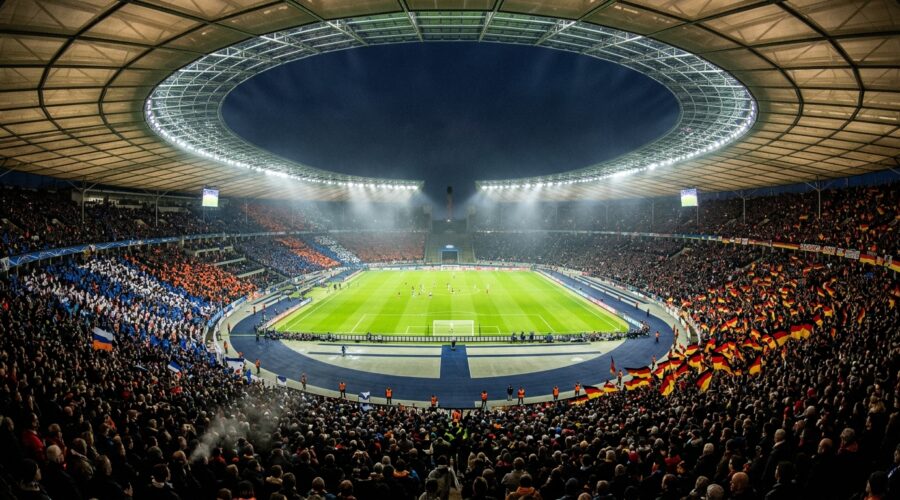
A sold-out Berlin night, two nations still rebuilding from rubble, and one qualification spot that cannot be shared
There is a particular kind of desperation that only football can manufacture — not the raw, theatrical desperation of a cup final, but the quieter, more corrosive kind that settles over a nation after years of underachievement. Germany know it intimately. They have been living inside it since Russia 2018, the World Cup that wasn’t supposed to happen to them. And yet here they are again, on a cold November night at the Olympiastadion, needing to beat the Netherlands to reach the quarterfinals of the UEFA Nations League just to prove, as Jürgen Klopp himself put it, that German football is in good hands.
That the minimum acceptable outcome for a nation that has lifted four World Cups is reaching the last eight of a league competition they invented a rivalry with their own mediocrity to avoid — well. It tells you everything about the past eight years.
Kick-off on Monday, 16 November 2026, is at 8:45 PM CET. The ground is sold out. It is Germany’s last home match of this long, painful World Cup year, and the occasion has acquired the texture of a reckoning.
The Weight of Summer
To understand what this match means, you first have to understand what preceded it. The 2026 FIFA World Cup, sprawling across the United States, Canada and Mexico, was supposed to be Germany’s restoration project. Julian Nagelsmann had guided them to the Nations League semifinals the previous year, topped their group at the expanded 48-team tournament, and arrived in North America with something resembling cautious optimism.
Paraguay ended it in Boston on the 29th of June. A 1-1 draw after ninety minutes, then extra time, then penalties. Kai Havertz missed. Nick Woltemade missed. Jonathan Tah missed. Germany were eliminated in the Round of 32, losing on spot-kicks for the first time in World Cup history. It was their fourth successive catastrophic tournament exit — group stage in 2018, group stage in 2022, quarterfinal at Euro 2024, and now this. Nagelsmann, to his considerable credit, did not hide: “We are no longer a first-class team,” he said into the microphones, before the DFB eventually persuaded him that the kindest exit was a quiet one.
The Netherlands were scarcely more composed. Ronald Koeman’s side, carried to the 2024/25 Nations League semifinals on individual brilliance rather than collective coherence, fell to Morocco in the same Round of 32 and went home having answered none of the structural questions that have haunted Dutch football since the last golden era. Koeman resigned. And the KNVB, in a move that felt either inspired or desperate depending on your disposition, turned to Xavi Hernández — a man whose entire footballing identity was forged at Barcelona and who has never, until now, managed a national team.
So this is the shape of Monday’s fixture: two nations that spent July licking serious wounds, trying to remember who they are, and finding themselves — four months later — in a de facto qualifier on a sold-out November night in Berlin.
The State of the Group
After five matchdays, Group A2 has sorted itself with the clinical efficiency of a mathematics problem. Serbia, their dignity shredded after five successive defeats — including a 7-0 annihilation home and away — are relegated to League B and providing window dressing for the final round. The real arithmetic sits above them.
The Netherlands lead with eleven points, unbeaten in five. Germany and Greece are level on eight points apiece, but Greece hold the head-to-head tiebreaker: they beat Germany 1-0 in September and drew 0-0 with them in October, which means that if the two sides finish level on points, Germany go through the door second. Or, more accurately, don’t go through it at all.
Germany’s qualification scenarios are navigable but require a win. Win and Greece fail to beat Serbia, and they go through as group winners. Win by five or more goals and they top the group regardless. Win by between one and four and they go through as runners-up, assuming the Netherlands still finish above them. Draw and Greece lose to Serbia and they scrape through in second. Any other combination — draw with Greece drawing or winning, any kind of defeat — and Germany are out. For a squad assembled around Florian Wirtz, Kai Havertz and Joshua Kimmich, reaching a Nations League quarterfinal should not feel like this much of a struggle. And yet.
The Netherlands, by contrast, are playing something close to exhibition football in terms of qualification stakes. They would need to lose to Germany by thirteen goals or more to miss out. Even their own travel arrangements suggest they know this: Xavi chose not to call up a replacement for the injured Frenkie de Jong, travelling to Berlin with twenty-three players rather than twenty-five. It is the kind of arithmetical serenity that makes you slightly envious.
Friday’s Warning Shot
If Germany needed any reminder of how dangerous this Dutch side can be, they received it on Friday the 13th of November in Amsterdam. The Netherlands dismantled Greece 7-0 — equalling the biggest winning margin in the eight-year history of the UEFA Nations League — and did it with a ferocity that felt almost personal. Five goals before the interval. Three of them from Tijjani Reijnders, who completed his hat-trick in twenty-one minutes and in doing so became the first Netherlands player to score a first-half treble for the national team since Marco van Basten against Malta in December 1990. Jurriën Timber added a brace. Crysencio Summerville opened the scoring inside six minutes. Donyell Malen applied the varnish late on.
It was, in Xavi’s own measured assessment, “amazing — especially in the first half.” And it was. The movement was fluid, the pressing was relentless, the transition from defence to attack had the kind of snap that takes months to install. This is Xavi Ball finding its legs at international level, and the speed of that acclimatisation ought to concern Klopp considerably.
Reijnders, now playing his club football in Saudi Arabia for Al Qadsiah following a move from Manchester City, is in the form of his life. He scored three times for his club in late October, then produced this in Amsterdam. Two hat-tricks in barely a fortnight for a player who, at club level, made his name as a midfielder who breaks lines rather than finishes them. Watch where he positions himself in Berlin. Watch how the German double pivot tries to track his runs from deep. That central midfield duel — Reijnders and Teun Koopmeiners against Joshua Kimmich and Aleksandar Pavlovic — may well decide the evening.
The one cloud over Amsterdam was Frenkie de Jong, who captained the side in the absence of the injured Virgil van Dijk but was substituted at half-time complaining of back discomfort. The KNVB confirmed on Saturday that he would not travel to Berlin. The statement was careful — “minor physical discomfort,” a precautionary measure — but De Jong and his back have a complicated relationship, and the news landed in German football circles with the warmth of an unexpected bonus.
Klopp’s Germany: Work in Progress, With Deadlines
When Jürgen Klopp was unveiled at the DFB Campus in Frankfurt on 24 July 2026, the reception was somewhere between a coronation and a collective exhale. After years of Hansi Flick’s tactical conservatism and Nagelsmann’s sophisticated-but-brittle system, here was a man the country could believe in. His opening line — “My whole life has prepared me for this job” — was met with the kind of emotional response that suggested Germany needed those words as much as they needed the man.
The reality of his first four months has been considerably less cinematic. Klopp took over from Nagelsmann officially on 15 August and assembled an experimental forty-four-man squad for his first Nations League window in September — an expression of ambition and perhaps mild chaos in equal measure. The results: a 1-1 draw with the Netherlands in Amsterdam on matchday one (Cody Gakpo scoring a spectacular late volley to deny Klopp a debut win), a 0-1 defeat at home to Greece on matchday two in what was nearly a sacking-level disaster, and then two wins against Serbia bookended by a goalless draw against Greece.
Five games in, Klopp has eight points and a squad that is still, clearly, finding its shape. The Gegenpressing system — that high, coordinated defensive press followed by rapid transitions — requires personnel to be automised in their roles. That takes time. The encouraging news from Belgrade on Thursday was that the system showed glimpses: Florian Wirtz finding pockets behind Serbian lines, Brajan Gruda — playing his first competitive start — dribbling through the Serbian defence for the third goal with the kind of young man’s bravado that reminds you football occasionally refreshes itself. Even Kai Havertz, who led Arsenal to their first Premier League title in twenty-two years but has yet to score for Germany in this Nations League cycle, was influential in buildup if not on the scoresheet.
But Germany are without Jamal Musiala, whose muscle injury has robbed Klopp of his most dynamic attacking option. Serge Gnabry is also absent. The attacking unit against the Netherlands will likely feature Wirtz at ten, Gruda and Derry Scherhant wide, and Havertz as the central striker — a lineup that carries pace and creativity but whose collective depth in front of a Dutch defence marshalled by Micky van de Ven remains to be tested at this level.
Marc-André ter Stegen, on loan at Ajax from Barcelona for the 2026-27 season, starts in goal. The back four — Philipp Treu, Malick Thiaw, Jonathan Tah, Maximilian Mittelstadt — is composed but relatively unproven as a unit. Kimmich captains, presses, organises. He is, as ever, the pulse of the German system.
Xavi’s Netherlands: Dangerous, Depleted, and Not Especially Fussed
Xavi arrives in Berlin unbeaten in five and with a defensive record that has conceded just six goals in that period. His appointment was met with intrigue — here was a man who spent his managerial career attempting to replicate Pep Guardiola’s Barcelona at Barcelona, with limited success, now tasked with instilling those same principles into a squad that until recently played a more reactive, individual-driven style under Koeman.
The early evidence suggests the philosophy is translating faster than many expected. His first bold act — dropping Memphis Depay entirely from his opening squad, despite the striker’s fifty-five international goals and hundred-and-twelve caps — announced a clean break with the recent past. His squad has responded. The 7-0 suggests either that Xavi has found his people very quickly, or that Greece were catastrophically poor, or some combination of both. The truth, as usual, sits somewhere in the middle.
The absentees for Berlin are significant. Van Dijk misses out, leaving the central defensive partnership of Jan Paul van Hecke and van de Ven — decent enough, but not the same wall. De Jong is missing from midfield, which removes their most sophisticated deep playmaker. Ryan Gravenberch, Jeremie Frimpong, Jorrel Hato and Nathan Aké all also sit out. A Dutch side that could field something close to its first-choice XI would be formidable indeed. The version that arrives in Berlin is well-stocked but stretched.
Denzel Dumfries captains, as he did for the final hour against Greece. His energy from right back — a hallmark of his game since his move to Real Madrid from Inter Milan this past summer — provides a constant outlet and threat on the overlap. Timber’s brace on Friday demonstrated that set-pieces and second balls represent a genuine danger, even from defensive positions. And then there is Reijnders, deployed as a false nine or advanced midfielder, whose movement in the final third remains difficult to account for.
And then there is Cody Gakpo.
The Player Who Keeps Haunting His Former Manager
When Jürgen Klopp arrived in Amsterdam for his first Germany match in September, he greeted his former Liverpool players — Van Dijk, Ryan Gravenberch, and Gakpo — with the long hugs of a man who had not properly said goodbye. Klopp had been away from club management for approximately two years and four months when this campaign began — a period that included his role as Head of Global Soccer at Red Bull before he took on the Germany job — and there is clearly genuine affection there.
Gakpo repaid that affection by volleying in a spectacular equaliser in the ninety-first minute, turning what would have been Klopp’s perfect opening chapter into a footnote. It was beautiful and slightly cruel in the way that only football manages. Klopp embraced him again at full time, which is either a mark of extraordinary emotional generosity or the behaviour of a man already conditioned by years at Anfield to absorb late goals with a certain bruised equanimity.
In Berlin, Gakpo will likely start on the left of Xavi’s attack. He knows Klopp’s defensive organisation better than any player on the pitch. He knows where the pressing triggers are, where the gaps appear when the high line holds too long, where the space opens in transition. That intelligence is a minor but meaningful Dutch advantage, and it represents one of those quietly compelling subplots that never make it onto the television graphics but that any serious follower of the game notices immediately.
The Systems, The Space, The Battle That Matters
The tactical contest on Monday will not be without intrigue. Klopp’s 4-2-3-1 is built to win the ball high and hurt teams in transition; Xavi’s 4-3-3 is designed to control possession and suffocate opponents through territorial dominance. These two systems make an interesting friction. When Germany press high, they invite Netherlands to play through them with the third-man combinations that Xavi has drilled throughout his coaching life. When Germany sit and absorb, they invite sustained Dutch possession that will eventually create openings through width and movement.
The key question is whether Kimmich and Pavlovic can disrupt the Dutch midfield’s rhythm early enough to prevent the Netherlands establishing the tempo. Without De Jong’s range-finding passing and Gravenberch’s ball-carrying, the Dutch build-up becomes slightly more predictable — Veerman and Koopmeiners are quality, but they are more compact, more combinational. Germany, if they can win the second ball consistently, will have opportunities to play Wirtz in space. And Wirtz in space against anyone at this level is a proposition worth backing.
Germany’s fullbacks are the other area of curiosity. Treu on the right is twenty-two and still building his international profile. Mittelstadt on the left is established but will face Dumfries’s power and potentially Summerville’s pace depending on Dutch positional rotation. If Xavi instructs his fullbacks to bomb forward simultaneously — which he rarely does but which the qualifying situation might not require him to prevent — Germany’s wide defenders will have demanding evenings.
The absence of Musiala is quietly devastating in this context. Musiala’s ability to drift between the lines and attract two defenders before releasing would have created space for Havertz to attack. Instead, Germany rely on Gruda’s directness and Scherhant’s energy to generate width and penetration. These are good players. Against the Netherlands, they will need to be considerably more than good.
The Occasion Itself
The Olympiastadion is sold out for the first time for a Germany home match in Berlin since November 2023. There is something fitting about that detail. This stadium — built for the 1936 Olympics, scarred by history, rebuilt, reopened — has witnessed Germany at its most glorious and its most humbling. Tonight it fills again for a Monday night Nations League match, which perhaps tells you as much about German football’s hunger as anything Klopp could say at a press conference.
Klopp has been careful to frame this window in cultural terms as well as tactical ones. His insistence that this is about showing the world that German football has rediscovered its identity — “we wanted to set up a final against the Netherlands in Berlin, and now we have it” — plays well in a country that has spent three World Cups questioning whether it still has the right to call itself a footballing superpower. Whether the players can convert that narrative into ninety minutes of competitive excellence is a different matter entirely.
Xavi, meanwhile, is managing a team that is effectively playing with nothing at stake — qualification secured unless the laws of physics temporarily suspend themselves — but which remains unbeaten in five and whose head coach will want to demonstrate in the second international window that the 7-0 against Greece was not a one-off delirium. His pre-match reflection on the September draw is telling: “We felt some pressure, too much pressure, nervous. We lost many balls. I want to give the players confidence to feel free to play.” That is the voice of a manager who has learned from one difficult away day and is determined not to repeat it. But it also implies the Netherlands did not function at their best in that first meeting, which is a quietly unsettling thought for Germany.
Verdict
Germany will win this match. They should win this match. The home support, the existential necessity, Klopp’s ability to squeeze performances from his teams in defining matches — these are real advantages. The Dutch injury list blunts Xavi’s most sophisticated attacking and constructive options, and there is something in the mathematics of the evening that simply does not favour a Netherlands side who know they are essentially through regardless.
But the nature of Germany’s predicament — needing a result against the in-form team in the group, without their two best attacking players, still embedding a system that is barely four months old — means this carries genuine risk. The Opta supercomputer gives Germany a 43.5 percent win probability. That feels roughly right. It is a slight favourite’s advantage dressed as conviction, which is an appropriately German way to approach a November evening.
Reijnders will cause problems. Gakpo will remind Klopp of things Klopp already knows. The midfield battle will be tight and consequential. And somewhere in all of it, Florian Wirtz will do something that makes 74,000 people stand up at once.
Germany 2-1 Netherlands. A winning margin that earns qualification — just — and delivers Klopp the defining early result of his national tenure. A margin that keeps Greece needing to do their own work against Serbia. A margin that is not yet the beginning of anything, but is at least the end of the worst of it.
The last home match of the 2026 World Cup year. It deserves to end on the right side of history. Whether it does is what Monday evening is for.