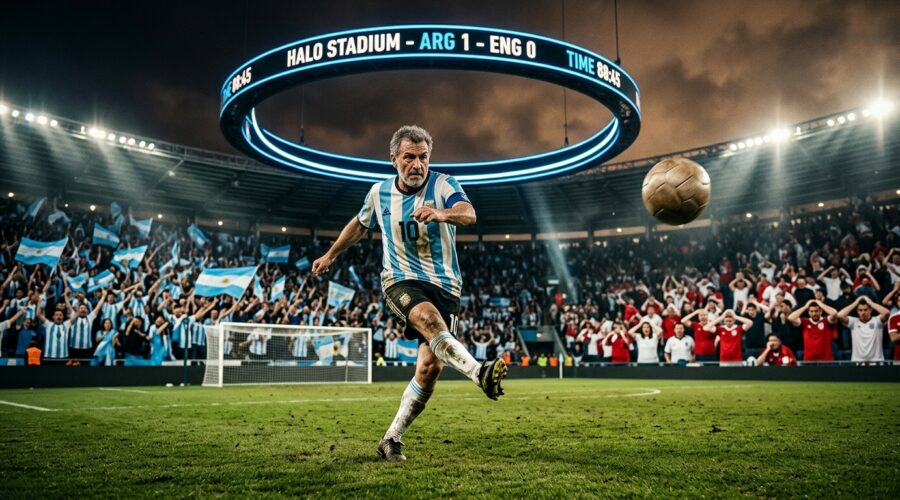
There is a particular cruelty that only football can administer, and it demands a specific set of ingredients: a brave underdog goal, a defensive substitution that looks sensible for precisely seventeen minutes, and then — in the dying light of the ninety — a footballing deity who has absolutely no business still doing this at thirty-nine years old, drifting to the left flank and whipping in a cross so perfectly weighted it seems less like a delivery and more like a verdict. Atlanta, Georgia witnessed all of it on July 15, 2026. England led. England invited Argentina on. England lost. The sixty-year wait goes on.
Mercedes-Benz Stadium, with its cathedral roof and its halo scoreboard blazing in the Georgia heat, had already hosted England once in this tournament. They had come here in the Round of 32, seen off Congo DR, and left with the quiet confidence of a team that knew what it was doing. They returned for the semi-final of the FIFA World Cup against the defending champions, against a Lionel Messi in the form of his life — or rather, in the form of a man who has decided that conventional understanding of what thirty-nine-year-olds can do in elite sport simply does not apply to him — and for fifty-five minutes, the plan held.
The First Half: Two Teams Taking Each Other Seriously
Thomas Tuchel set England up in their familiar compact shape, high pressing from Jude Bellingham and Harry Kane in the early phases, looking to suffocate Argentina before Messi could find rhythm. Lionel Scaloni responded by deploying Giuliano Simeone as a central midfielder in a 4-4-2 formation — alongside Mac Allister, Paredes, and Fernández — adjusting the midfield line from the arrangement that had been found wanting in previous rounds. It was a tactical chess match played at considerable pace, and, importantly, played seriously — two sides that had been genuinely battle-tested arriving for their examination simultaneously.
Messi in the first half was the chess piece you cannot stop watching even when he is not directly threatening. He glided between the lines, arrived at angles that did not seem geometrically possible, and sent England’s defensive shape into periodic states of quiet panic. Kane, meanwhile, dropped deep to link play in his understated way — the captain who makes himself available, who oils the mechanism without hogging the credit. The half ended goalless, which felt appropriate. Neither side had been dominated. The real match, it turned out, was still to come.
Gordon, and the Thirty-Five Minutes That England Will Never Get Back
The fifty-fifth minute produced a moment that, for a few thousand England supporters inside that stadium, briefly felt like the beginning of something extraordinary and, as it turned out, was merely the beginning of an exquisite sort of suffering. Anthony Gordon — the unheralded forward who had made himself indispensable across the tournament — converted a low cross from Morgan Rogers, a move initiated by Harry Kane’s pass, finishing clinically past Emiliano Martínez. The English contingent erupted. For a side that had reached the semi-final having scored fourteen goals — twelve of them from Kane and Bellingham, with Rashford and Gordon each contributing one — this felt like the depth of the squad announcing itself at exactly the right moment.
And then Tuchel made his move.
The introduction of Ezri Konsa and the shift to a 5-4-1 defensive formation was the kind of decision that makes perfect logical sense in the tunnel at half-time and disastrous emotional sense in a football stadium in the second half against Argentina. England managed seven — seven — passes in Argentina’s half following the substitution. Twelve per cent possession after taking the lead. Tuchel, to his credit, stood by the call afterwards. “You can discuss this with a million coaches, I have to make a decision on the pitch,” he said, with the measured calm of a man who has been asked the same question in about eight different languages. But Harry Kane himself admitted England had been too passive. Wayne Rooney was somewhat less measured about it. When England’s all-time record goalscorer — Kane himself, with 81 international goals, having long since surpassed Rooney’s tally — is publicly suggesting you crumbled, the post-match press conference has a particular texture.
The architecture of what followed was entirely predictable the moment Konsa came on. Argentina, never a side that interprets an opponent sitting deep as anything other than an invitation, ramped up the pressure. England’s back five retreated. The space between their midfield four and their defensive line yawned open. And into that space, with the patience of a side that has done this before — in Doha four years ago, and in multiple desperate knockout moments across this very tournament — Argentina walked, calmly and inevitably.
The Eighty-Fifth Minute and the Sound of a Nation Deflating
Enzo Fernández has had a complicated year by any measure. His desire to leave Chelsea has been an open secret. The club’s social media team, in one of the more unfortunate pieces of institutional judgment in recent memory, posted a photograph celebrating his equaliser before promptly deleting it under a torrent of abuse from their own supporters. But none of that noise reached Atlanta. What reached Atlanta was a young midfielder in a white and sky-blue shirt, receiving the ball just outside the penalty area in the eighty-fifth minute, and striking it with the kind of clean, thunderous certainty that puts the ball precisely where goalkeepers cannot go.
Jordan Pickford did not move. There was no point. The ball was already nestling in the net, perfectly placed, the trajectory of a man who had decided this was his moment in a tournament that had been waiting for him to claim one. The Argentine bench erupted. In Buenos Aires, thousands gathered in fan zones lost their minds collectively. In the stands at Mercedes-Benz, England supporters experienced the specific silence that falls when a lead you briefly believed was sufficient turns, in an instant, to dust.
Messi at Thirty-Nine, and the Cross That Ended It
What followed in the final minutes of the match was, depending on your nationality, either the most beautiful or the most unbearable thing football had offered all tournament. Argentina pushed. England, their shape now creaking, their midfield scrambled, held on through the ninety. And then, in the second minute of stoppage time, Messi drifted to the left.
He had finished the group stage of this tournament aged thirty-eight and turned thirty-nine before the knockout rounds began. He is, by the standards of almost every metric applied to elite footballers, doing something that should not be possible. Eight goals. Ten assists. A Player of the Match award in a World Cup semi-final at an age when most of his contemporaries have been retired for half a decade. During the tournament it was widely noted that Messi ran less than almost any other outfield player — finishing bottom of 618 outfield players for distance covered — and yet remained the most dangerous player on the pitch, positioning himself against the flow, waiting, knowing the ball will come back around. In the ninety-second minute, it came back around.
The cross he delivered to the back post was not a strike of violence. It was a question, asked with the outside of his boot, perfectly weighted: is anyone arriving? Lautaro Martínez, the substitute, the secondary figure of the evening, answered it. Arriving late and unmarked — which is, when you think about it, the most damning description of England’s defensive shape in those final moments — he powered home a header with the force of a man who understood the weight of what he was doing. Argentina 2–1 England. The match was over. Messi pumped his fist. The halo scoreboard blazed. Somewhere in the English end, Bellingham stood on the pitch for a long time, staring at nothing in particular.
England’s Arithmetic, and the Sixty-Year Equation
There is a version of England’s tournament that deserves enormous credit. This was only their fourth-ever World Cup semi-final — 1966, 1990, 2018, and now 2026 — and the first time since 2018 that they had progressed this far. Kane and Bellingham each finished with six goals and an assist across six matches. The victory over Norway in the quarter-final, where Bellingham scored twice including in the ninety-third minute, was one of the great England performances of the modern era. They were not a soft touch. They were not a team that blundered through.
They were, ultimately, a team whose manager made a substitution that handed the initiative to the best side in the world, managed by a player who had no intention of letting the initiative go. The sixty-year wait for a World Cup Final appearance — the last time England actually got there was 1966 — continues. France await in Miami on July 18 for the third-place match, which is the sort of fixture that everyone agrees is important and nobody quite believes is important.
Where This Leaves the Golden Boot, and the Final
The Golden Boot race has arrived at its most intriguing configuration. Kylian Mbappé, largely nullified by Spain in the first semi-final the previous evening in Dallas — a 2–0 defeat that confirmed Spain as the tournament’s most complete side — finishes with eight goals and three assists. Messi matches him on goals but leads convincingly on assists, ten to three. Under FIFA’s tiebreaker, Messi currently holds the edge. A goal in the final would settle the matter definitively. At thirty-nine years old, he is heading into a World Cup Final against a Spain side featuring Lamine Yamal — who was photographed as a toddler beside Messi and now carries his own nation’s hopes on young shoulders — and the symmetry is so cinematically perfect it almost feels manufactured.
Erling Haaland goes home with seven goals in six matches and no medal, which is an outcome that feels simultaneously impressive and melancholy. Kane and Bellingham, two of the finest players of their generation, go home with six goals apiece and a plane to Miami to play for third. The numbers are fine. The thing they came for is not theirs.
A Final Observation, From the Terraces
Argentina’s road to this final has been, by their own standards, chaotic in the most Argentine way imaginable. They have come from behind in multiple knockout matches. They have played through the drama of near-eliminations with the serene calm of a side that has decided winning narrowly is simply their preferred aesthetic. Scaloni has managed the tournament with quiet intelligence, adapting his shape, protecting his captain, and trusting that at some point the match would reach a moment in which Messi’s involvement would prove decisive.
In Atlanta, that moment was the ninety-second minute. It is almost always the ninety-second minute with Argentina these days, and they have apparently decided that is perfectly acceptable.
Spain versus Argentina in New Jersey on July 19 is the World Cup Final that the draw, and probably fate, always intended to produce. Two nations for whom football is not merely a sport but a foundational story. One with the generational brilliance of youth and a merciless defensive structure. The other carrying, at its centre, a thirty-nine-year-old man who just delivered two assists in a World Cup semi-final and still has the audacity to look like he is enjoying himself.
England fly to Miami. The rest of the world gets the final it deserves. And somewhere in Atlanta, the halo scoreboard eventually went dark.