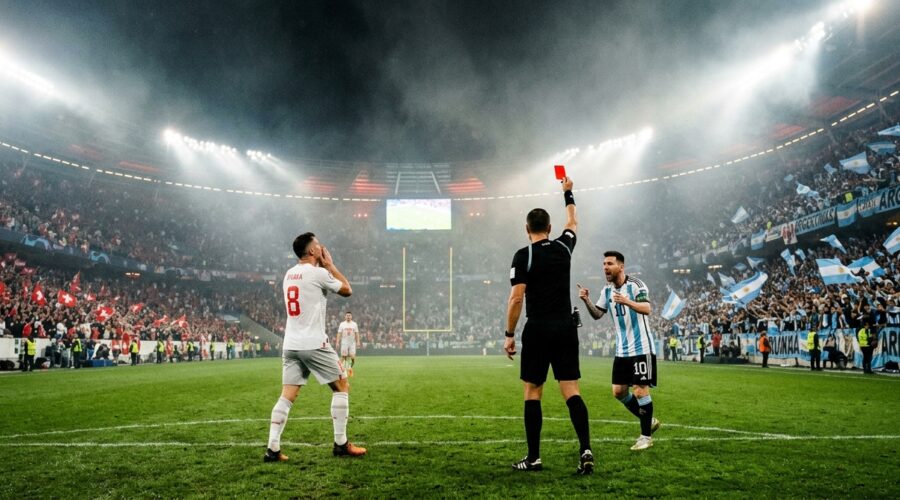
Argentina 3–1 Switzerland (AET) — FIFA World Cup 2026 Quarter-Final, Kansas City Stadium
Match 100 of 104. A round number at a tournament that has spent six weeks generating moments too large for any spreadsheet to contain. And if you needed a single evening to crystallise everything this expanded, sprawling, magnificent and occasionally maddening World Cup has been — the grit, the controversy, the creeping weight of a single man’s final chapter — then Kansas City obliged on Sunday night with something close to a masterclass in footballing theatre.
Argentina are through to the semi-finals. Switzerland are going home. And somewhere between those two facts sits a red card that will still be argued about in Swiss pubs at last orders for years to come.
Seventy-Two Minutes and One Moment That Changed Everything
For sixty-seven minutes, this was the match Switzerland needed it to be. Murat Yakin’s side had arrived in Kansas City not to bus the park — they are a better side than that — but to sit compact, deny Argentina the central channels they love so dearly, and wait. It was working. The Nati had conceded Mac Allister’s early header from a Messi corner, absorbed a first-half Argentina that generated possession (54%) and volume (22 total shots across the match) but struggled for the killer pass, and then — spectacularly, beautifully — leveled through Dan Ndoye in the 67th minute. The wide man drove down the right like a door being forced open and finished with the composure of someone who had been waiting all tournament for exactly that moment.
Switzerland were level. The upset was genuinely on. The Kansas City crowd, which had no business being as invested as it was, held its breath.
Then, five minutes later, Breel Embolo went to ground.
What followed was one of those VAR sequences that has become the signature aesthetic of modern football: the pause, the earpiece, the referee jogging to the pitchside monitor, the gathering confusion in the stands. Leandro Paredes had initially been shown a yellow for a challenge on Embolo. VAR reviewed it. Determined that Embolo had gone to ground before contact. Reversed the yellow to the Swiss forward — who already had one. Second yellow. Red card.
Embolo left the pitch in tears. His coach was furious. His captain, Granit Xhaka, was incandescent. “VAR can kill a game,” Xhaka said afterwards, with the clipped precision of a man who has spent his career at the sharp end of football’s most contentious decisions. “We had just leveled and felt the momentum. Then everything was taken from us in an instant.”
The debate around the decision will run and run. Simulation calls are, by their nature, subjective — a judgment about intent, about timing, about fractions of a second that even high-definition cameras struggle to resolve. What is not subjective is the context: Embolo became only the fourth player in sixty years of World Cup history to receive a second yellow for simulation, a category so rare it might as well be classified alongside meteorological phenomena. The company he joins — Francesco Totti in 2002, Asamoah Gyan and Luis Pérez in 2006 — does little to settle the argument either way. Those decisions were contested too.
What is harder to dispute is the timing. Five minutes after the equalizer. At the precise moment Switzerland had seized the emotional momentum of the match. If VAR is to be accepted as football’s instrument of fairness, it has to live with the charge that it applied fairness at the most structurally devastating possible moment for one of the sides.
Yakin put it simply, and you could hear the resignation behind the anger: “There was definitely no reason to award that yellow card. The decision changed the game.”
Kobel: The Tournament’s Finest Unreported Story
Before we discuss how Argentina eventually dismantled a side reduced to ten men, justice demands a paragraph or three for Gregor Kobel.
The Borussia Dortmund goalkeeper is 28 years old, plays in the Bundesliga, succeeded the celebrated Yann Sommer as Switzerland’s first-choice only in 2024, and has spent this entire tournament being quietly extraordinary while everyone else looks elsewhere. He saved a penalty in the shootout against Colombia in Vancouver. He made five saves against Argentina, several of them genuinely outstanding, and finished the tournament with 16 total stops — the most of any keeper still standing when Switzerland’s campaign ended. Across the quarter-final, with his side a man down, he single-handedly kept the match alive for eighteen minutes after the red card. Argentina, with their full complement and one of the most relentless pressing systems in world football, could not find a second goal past him in normal time.
That is not a footnote. That is a performance. In a tournament that has given us Mbappé and Messi and Bellingham and the Golden Boot arms race at the top of the game, Kobel is the kind of player who gets properly appreciated only in retrospect, usually by the people who had to beat him. Argentina know exactly how good he was on Sunday night.
Álvarez, Almada, and the Extra-Time Inevitability
There is a particular kind of Argentine victory that feels both hard-won and somehow fated — where the sheer force of their attacking intent eventually bends the game to their will through accumulated pressure rather than a single decisive moment of inspiration. That is what extra time against Switzerland became.
Ten men against eleven, in the Kansas City summer heat, after ninety minutes of intense football. Switzerland’s exhaustion was written in their bodies even as their spirit refused to yield. Argentina pressed. Messi, his nine-game consecutive scoring streak ended but his influence undiminished, moved around the pitch as the tournament’s most dangerous ghost — the man without a goal who nonetheless conjures chaos in every defensive line he encounters.
Substitute Thiago Almada clipped a pass through in the 112th minute. Julián Álvarez — the Spider, La Araña, the man who covers more ground in ninety minutes than most players manage in a week — received it, steadied himself, and drove a right-foot strike into the top corner from range that was, frankly, not a finish that ten-man defences in the 112th minute of extra time in a World Cup quarter-final deserve to concede. It was a screamer. The best kind.
Lautaro Martínez added the third from a rebound in the 121st minute after Kobel — to the very last — got a hand to Almada’s shot. Even then, Argentina had to work for it. Even then, Switzerland made them earn it. Remo Freuler was not wrong when he said afterwards: “We were in this game. We showed the world what Switzerland can do.” They did. They showed the world, and then the world reduced them to ten men, and the world went on without them. Football is not always kind about the distinction between those two things.
Five Knockouts, All at the Wire
This is now five consecutive knockout victories for Argentina, and every single one of them has been navigated on the edge of disaster. They came from two goals down against Egypt in the Round of 16. They needed extra time in three of their five matches. There has been nothing comfortable, nothing inevitable-feeling in the moment, nothing that would allow a neutral observer to conclude that Argentina are simply better than the teams they are beating and will therefore win.
That is, in its own way, the most compelling thing about them.
They have the best player in the history of the sport — at 39, playing what is almost certainly his final World Cup, two victories from completing the most remarkable swan song the game has ever witnessed. And yet they do not feel like a machine. They feel, genuinely, like a team that believes it will find a way rather than a team that knows it. There is a difference, and it matters. Belief is more interesting to watch than certainty.
Messi himself, in the post-match scrum, articulated it with the directness of someone who has stopped having time for diplomatic non-answers: “Football is this — not just tactics and strategies. Those things are important, but if we hadn’t had the heart we had, we would’ve been out.”
He is right. But it also helps to have Julián Álvarez, who was the deserved Man of the Match, and a midfield built on the engine of Rodrigo de Paul and the intelligence of Mac Allister. Lionel Scaloni’s system — the 19 central final-third entries, the 149 in-behind runs, the 436 offers to receive that give you a picture of an attack constantly probing, constantly creating options — is tactically well-constructed for a reason. Heart and system are not mutually exclusive. Argentina have both.
The Final Four and What Comes Next
The semi-final bracket, when laid out, reads like something a tournament director invented in a dream and then refused to believe could actually happen. France against Spain on July 14 in Arlington, Texas. And then, on July 15 in Atlanta, England against Argentina.
For the first time in the history of the World Cup, the four highest-ranked teams in FIFA’s rankings have all reached the semi-finals simultaneously. You may file that under either meritocracy finally works or the expanded format removed the randomness that made tournaments interesting, depending on your temperament. Both interpretations have some truth to them. The football has largely been worth watching regardless.
France against Spain is the tie that tactical analysts will spend most of their preparation time on — two systems of genuine sophistication, Mbappé and his eight goals against Spain’s collective fluidity and Mikel Oyarzabal’s quiet menace. It is a match that deserves its own column.
But England against Argentina is the match that the global game has been waiting for since the draw was made. It carries the weight of 1986 — the Hand of God, the Goal of the Century, Maradona against an England side still raw from the Falklands — and 1998, when Beckham was sent off and England lost on penalties in Saint-Étienne with the particular anguish only English football can generate. And 2002, when Beckham converted the penalty himself, wearing the redemption like a suit that almost fit. England lead the competitive head-to-head three wins to one in World Cup football. Argentina have won all six of their World Cup semi-finals. Something has to give.
Messi against England, in the semi-final of what is almost certainly his final World Cup, in Atlanta. Forty years since the Hand of God. The ghost of Maradona hovering somewhere above the Mercedes-Benz Stadium roof. England, with Kane and Bellingham and their own aching sense of history, standing between Argentina and the final.
There are matches that justify the existence of football as a global spectacle. This will be one of them.
Switzerland’s Proud and Painful Exit
Before we look entirely forward, a moment for what Switzerland achieved. A nation of eight million people, perennially underestimated, perennially competitive. They knocked out Colombia on penalties in Vancouver, Kobel saving the decisive spot-kick. They eliminated Algeria. They reached the quarter-final of a World Cup for the first time since they hosted the tournament in 1954 — seventy-two years ago, in a football world so different it might as well be another sport entirely.
They were good enough to be level with Argentina at 1–1 with eighteen minutes of normal time remaining. They may well have been good enough to make it to the final whistle. A controversial red card decided that we will never know, which is perhaps the most Swiss misfortune of all: to be denied a definitive answer by a moment of procedural controversy rather than outright defeat.
Freuler, in tears in the mixed zone, said it hurt more than any result in his career. Given his career has included a Europa League final and seasons at the highest level of club football, that is not a small thing to say.
Match 100
This was Match 100 of 104 in the expanded World Cup format. A round number that invites reflection. The expanded format has its detractors — and they are not wrong that it has produced its share of padding in the early rounds — but it has also produced five weeks of football that culminated in a quarter-final between the defending champions and a Swiss side that had no business being here and was magnificent in the being here regardless.
Four matches remain. Two semi-finals that will each, in their own way, be unmissable. A third-place playoff that will either be a consolation or a further source of heartbreak. And a final at MetLife Stadium in New Jersey on July 19 that, if Argentina continue their particular combination of nerve, system, and Messi, could complete the most extraordinary individual farewell in the history of team sport.
Two wins from the end of everything. The longest goodbye in football.
Kansas City just moved it two steps closer.