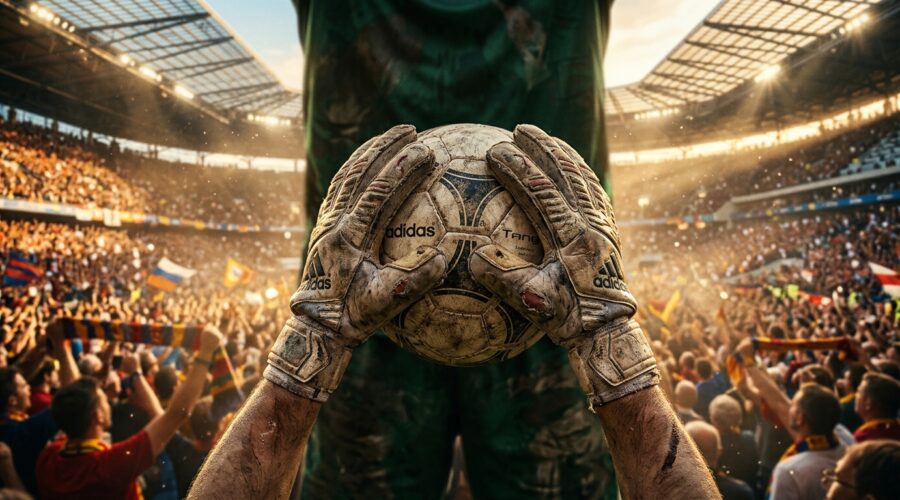
There is a photograph lodged permanently in the memory of anyone who watched the 2014 World Cup final. Not Götze’s volley, exquisite as it was. Not the Maracanã erupting in gold and black. It is Manuel Neuer, somewhere near the edge of his area, reading a game happening forty yards in front of him, already positioned for a threat nobody else in the stadium has spotted yet. Half-goalkeeper, half-libero, and entirely in control. He was thirty years old, and he played like a man who had simply decided that the conventional parameters of his position did not apply to him.
Twelve years later, in the sweltering June heat of Houston, Texas, he walked out for his fifth FIFA World Cup. He is forty. He is Germany’s number one. And he is, against most reasonable expectation, still the best goalkeeper in the country.
A Retirement That Did Not Take
On August 28, 2024, Neuer posted an Instagram video announcing the end of his international career. The words were gracious, measured, and characteristically understated: “Everyone who knows me knows that this decision wasn’t easy for me. I feel very good physically and the 2026 World Cup would have been appealing, but now is the right time to focus fully on FC Bayern Munich.” Germany’s official send-off was warm to the point of poetry: “For one of the greatest goalkeepers of all time, all words seem too small.”
He had made 124 appearances across fifteen years of international football. Four World Cups. Four European Championships. A Golden Glove and a winner’s medal from Brazil. It felt, and was intended to feel, conclusive.
Then Oliver Baumann, the capable Hoffenheim goalkeeper who had done nothing wrong in twelve months of World Cup qualifying, received a phone call. According to reports in Bild, Baumann was told directly by Julian Nagelsmann that he would not be the number one for the tournament. When asked about it publicly, Baumann did not perform theatrical indifference. “It wasn’t exactly cool,” he said, with the quiet honesty of a man who had earned his place and had it taken back by history. He would remain available, he added, even in a supporting role. That is the sort of professionalism that deserves recognition, even if football rarely dispenses recognition to its understudy characters.
What changed between August 2024 and May 2026 was simple enough in the telling, and rather more complicated in the feeling. Neuer extended his Bayern Munich contract to 2027, satisfying the prerequisite Nagelsmann had quietly established: this would not be a farewell lap. If Neuer was coming back, he was coming back as a working goalkeeper, not a monument. Nagelsmann, a man who is — in a detail that still arrests the imagination somewhat — two years younger than his own starting goalkeeper, was categorical when he confirmed the squad on May 21: “We plan with him as Number 1. Everyone knows the aura and quality Manu has, what he brings to a team.”
The decision was politically complicated and footballing-ly correct. Baumann had the caps, eleven of them, and none of Neuer’s authority in a tournament environment. The experience gap between the two men is not a gap so much as a canyon.
What He Did in 2014
To understand why Germany wanted Neuer back at forty, you must return to Brazil, because that is where the template was forged.
In seven matches at the 2014 World Cup, Neuer conceded four goals, kept four clean sheets, and saved at a rate of 86.2 percent. He completed 244 passes — more than Lionel Messi’s 242, more than Wesley Sneijder’s 242 at that tournament. He was named in the All-Star Team, the Dream Team, and won the FIFA Golden Glove. He finished third in the 2014 Ballon d’Or, one of the best results by a goalkeeper in the award’s history.
The Guardian, mid-tournament, described him as Germany’s eleventh man. That captured something real. Neuer was not merely a goalkeeper who made saves; he was a structural component of Germany’s entire tactical architecture. The high defensive line that Joachim Löw’s team used so aggressively was only viable because the man behind it was willing — eager, even — to charge thirty metres off his line to deal with problems before they became crises.
The definitive image came in the round of sixteen against Algeria. Extra time, the game balanced on a knife’s edge, and there was Neuer: sprinting from his goal, tackling, heading, sweeping, performing the functions of a centre-back in a space that was, technically, nowhere near his jurisdiction. It was goalkeeping reimagined as a proactive discipline rather than a reactive one. The hashtag that followed — #JustNeurerthings — was glib but accurate. There was genuinely nobody else doing what he was doing.
In the final against Argentina, he kept a clean sheet. Argentina managed just two shots on target across the entire match. He lifted the World Cup at the Maracanã with the quiet satisfaction of someone who had known, for weeks, that this was how it was going to end.
Germany 7-1 Curaçao: History’s Scoreline, Again
There are coincidences in football, and then there are the kind of coincidences that make you wonder briefly about the scriptwriting. On June 14, 2026, in front of 68,021 people at Houston Stadium, Germany opened their World Cup campaign with a 7-1 victory. The same scoreline as the 2014 semi-final against Brazil. The Mineirazo, replicated almost absurdly against the smallest nation ever to qualify for the tournament — Curaçao, a Caribbean island of fewer than 200,000 people, making their first appearance on the game’s largest stage.
The match unfolded with a clarity that was almost too comfortable. Felix Nmecha opened in the sixth minute, combining with Florian Wirtz before steering a first-time finish into the far corner. Curaçao equalised in the twenty-first through Livano Comenencia — a deflected effort, yes, but it still counts, and their supporters in the stands greeted it with the uninhibited delirium of people who had just watched their nation score a goal at a World Cup for the first time in history. One savours those moments on their behalf before the scoreline reasserts itself.
Nico Schlotterbeck headed Germany back in front from a corner. Kai Havertz converted a penalty in first-half stoppage time. Jamal Musiala, fed by Joshua Kimmich’s defence-splitting pass, added a fourth within two minutes of the restart. Nathaniel Brown — a German-American twenty-one-year-old marking his World Cup debut — made it five. Substitute Deniz Undav added a sixth. Then, in the eighty-eighth minute, Havertz chipped a seventh with the casual authority of a man who had already done the difficult work earlier in the evening. Brace completed. Job done.
Havertz, with two goals, sits joint top of the 2026 Golden Boot standings alongside Folarin Balogun of the United States and Sweden’s Yasin Ayari. He is, quietly, becoming Germany’s most important forward at a tournament where Germany very much need one.
For Neuer personally, the evening was undemanding in terms of shot-stopping — one save required, one goal conceded via deflection, the kind of night where a goalkeeper demonstrates his value mostly through the authoritative calm he radiates rather than any specific act of brilliance. The young backline — Tah, Schlotterbeck, Brown — functioned with the composed confidence of defenders who know precisely who is behind them. That, in itself, is the Neuer effect. It is not always measurable. It is rarely absent.
On the night, he became the oldest German player ever to feature at a major tournament: forty years and seventy-nine days. He surpassed Lothar Matthäus, who held that record from Euro 2000. Matthäus, for what it is worth, had declared publicly before the tournament that Neuer was world class and belonged in the national team. Football is occasionally generous with its poetic moments.
The Zoff Precedent
The reasonable objection to Neuer’s presence — the one that goes, essentially, but he is forty — is not unreasonable. Goalkeepers age more gracefully than outfield players, yes, but no position is immune to time. The counterargument, and it is a compelling one, comes from the summer of 1982 in Spain.
Dino Zoff was forty years and 133 days old when he captained Italy to the World Cup in Madrid. He won the Golden Glove. He kept two clean sheets across the tournament. He was presented the trophy by the King of Spain and lifted it with, according to contemporary accounts, a shy smile — as if he found the fuss slightly disproportionate. He remains, to this day, the oldest man ever to win a World Cup. The IFFHS ranked him the third greatest goalkeeper of the twentieth century, behind only Yashin and Gordon Banks.
The Zoff template does not guarantee anything for Neuer. Templates rarely do. But it establishes that the idea of a forty-year-old goalkeeper winning a World Cup is not a fantasy or a sentimental indulgence — it has happened before, with a man of similar stature and similar reputation, on football’s biggest stage.
If Neuer is hunting historical company, he could do considerably worse than Dino Zoff.
The Squad Around Him
Germany’s 2026 squad has the feel of a generation arriving at precisely the right moment. Florian Wirtz, now at Liverpool, is among the most creative midfielders in European football. Jamal Musiala, operating behind Havertz in a front four, has the electric close-control and spatial intelligence that makes defenders look temporarily confused about the nature of their profession. Joshua Kimmich, wearing the captain’s armband, is the conductor — precise, visionary, and entirely untroubled by pressure situations.
Antonio Rüdiger brings Champions League steel to the back line. Aleksandar Pavlović anchors the midfield with a composure that belies his age. The bench carries genuine options: Goretzka, Rüdiger, Undav, Beier — players who came on against Curaçao and did not merely fill minutes but contributed meaningfully to what became a rout.
The notable absentee is Marc-André ter Stegen, who would otherwise have been the natural successor to Neuer’s jersey and is instead watching from Barcelona with a serious hamstring injury. In a different circumstance, ter Stegen’s absence might have forced a reconfiguration of Germany’s goalkeeping plans. Instead, it accelerated a conversation that was already happening anyway.
Group E — Germany, Ivory Coast, Ecuador, Curaçao — is navigable but not comfortable. Ivory Coast won their opening match against Ecuador through Amad Diallo’s ninety-second-minute strike, which is precisely the kind of moment that tells you not to condescend to an opponent on the basis of geography or tournament seeding. They are organised and physical. Ecuador, anchored by Chelsea’s Moisés Caicedo and Willian Pacho of Paris Saint-Germain, conceded to a late goal but remain defensively coherent and will not disintegrate quietly.
Germany face Ivory Coast in Toronto on June 20. That is the genuine examination. The Ecuador finale at MetLife Stadium on June 25 may or may not carry meaningful stakes, but right now, with three points and a goal difference of plus-six after one game, Germany are exactly where they intended to be.
Redemption and the Weight of Recent History
It would be remiss not to acknowledge what Germany are playing against as much as what they are playing for. The 2018 World Cup in Russia was a group-stage elimination — equalling their worst World Cup result since 1938, a standard they would again match in Qatar 2022 — and it was met in Germany with the kind of stunned silence that follows genuinely unexpected institutional failure. Qatar 2022 brought another group-stage exit. Euro 2024, hosted on home soil with all the attendant expectation that entails, ended in a quarter-final defeat to Spain, the eventual champions, in Stuttgart.
Neuer was there for all of it. He has worn the number one shirt through the glorious summer of 2014 and through the increasingly difficult seasons that followed. In the weeks that followed that Spain defeat, he and three other senior players — Kroos, who announced immediately after the match, and Müller and Gündogan, who followed in the weeks after — all retired from international football, and it had the feel of a door closing, a generation drawing its curtain.
That he is now back, standing in goal in Houston with forty years on him and five World Cups in his biography, speaks to something that resists tidy analysis. Part of it is Nagelsmann’s calculated pragmatism — the recognition that no amount of qualifying form accumulates into Neuer’s specific kind of authority. Part of it is Neuer’s own refusal to be finished before he has decided he is finished. And part of it, perhaps the least comfortable part for those of us who prefer our sentiments unexamined, is that football occasionally offers the opportunity for a second act, and the wise player takes it.
He described his first night back in simple, unadorned terms: “I waited so long for this day and was determined to play. It felt very good to be on the pitch with the guys. It’s always very important to have a good start in a major tournament.” Not poetry, exactly. But then Neuer has always preferred the communication of action to the communication of words. The seven goals behind him told the more eloquent story.
What Comes Next
Germany have a 71 percent probability of winning Group E, according to market forecasters. That is the kind of figure that sounds comfortable right up until the moment Ivory Coast’s front three starts moving in coordinated patterns through your midfield, or Ecuador absorbs pressure for seventy minutes and then exposes a high defensive line on the counter. Football, as Neuer knows better than most, has a long history of ignoring probability distributions.
But Germany, at this particular moment, look like a team with genuine tournament ambition rather than merely tournament participation. They have a generational midfield, a striker with two goals in one game already, a captain in Kimmich who makes everyone around him function more clearly, and behind all of it — behind the high line and the press and the choreographed interchanges — they have the man who stood at the Maracanã in 2014 and lifted the most important trophy in football.
He is forty years old. He is the oldest player Germany have ever fielded at a major tournament. And if Dino Zoff, lifting a trophy in Madrid at the same age, taught us anything, it is that the hands that have held the cup before already know the shape of it.
The question — the only question that matters now — is whether they will hold it again.