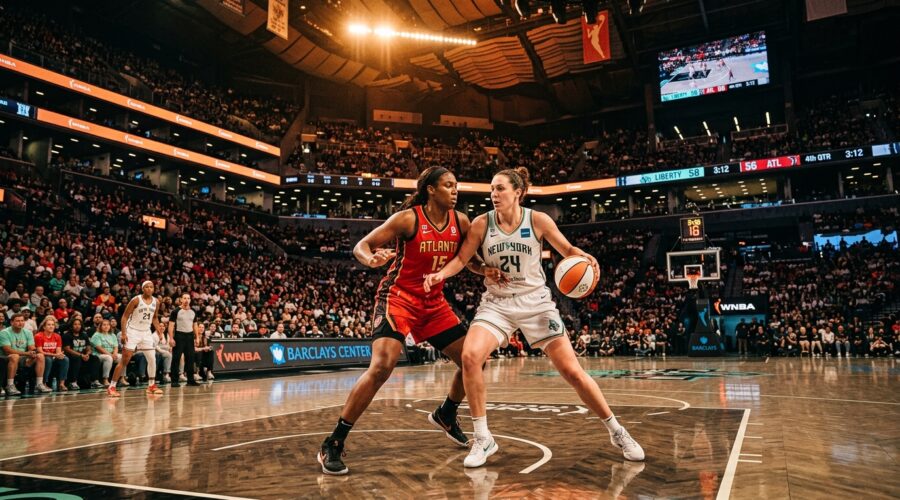
Two nights. Two games. One building in Brooklyn that has seen its share of defining WNBA moments. And sitting at the center of all of it is a question that will determine the shape of the entire Eastern Conference playoff bracket: can the New York Liberty survive, or will the Atlanta Dream bury them?
On September 21 and September 23, the Atlanta Dream travel to Barclays Center to face the New York Liberty in what amounts to a two-game playoff series before the actual playoffs begin. The stakes are straightforward and brutal. New York, at 26-16 and sitting in the sixth seed, needs to win both games to have any realistic hope of climbing to fourth. Atlanta, already locked in at fourth with a 28-14 record, is playing to protect its home-court advantage in Round 1 and to send a message to whoever awaits them in October. A sweep in either direction reshuffles every first-round matchup in the East. A split locks both teams into familiar territory and sends them off to different postseason brackets.
But the scoreboard implications, as significant as they are, are almost secondary to the individual drama this two-game set is delivering. Because at the heart of this series is one of the most fascinating big-on-big matchups the league has produced in years: Angel Reese against Jonquel Jones. Youth against experience. Volume against efficiency. The most relentless rebounder in WNBA history against the most decorated player of the modern era who still somehow feels underappreciated.
The WNBA’s 30th anniversary season deserves a final regular-season statement. These two nights at Barclays Center are it.
The Numbers That Got Us Here
Start with Angel Reese, because there is truly no other place to begin. On September 19, 2026, during Atlanta’s 106-81 destruction of the Chicago Sky, Reese became the first player in WNBA history to reach 500 rebounds in a single season. That is not a typo. Five hundred rebounds. In one regular season. In a league where rebounding has historically been an afterthought in the broader basketball conversation, Reese has turned it into the defining statistical story of the year.
Her full-season line entering this series is almost offensive in its completeness: 16.6 points, 12.3 rebounds, 2.8 assists, and 1.8 steals per game across 41 appearances. She already owns the WNBA single-game rebound record with 26 boards against the LA Sparks on August 24 — the same game she broke A’ja Wilson’s single-season rebound record of 451. She set the single-season double-double record at 29. She reached 1,000 career rebounds in just 79 games, ten games faster than Tina Charles. The +/- gap the Dream carry with her on the floor is not a small number: Atlanta posts a net rating of +10.2 in her minutes versus +0.2 without her, a ten-point swing that may be the most dramatic player-specific differential in the league this season.
Defensively, the picture is equally striking. Atlanta posts a 102.7 defensive rating in her minutes, second-best in the league among players with over 1,000 minutes. When she sits, the Dream’s defense drops by 14.2 points per 100 possessions — the largest such decline of any qualifying player in the WNBA. She has guarded more pick-and-roll situations than any player in the league, and opponents post just a 77.2 rating when they target her as the screener. She is 23 years old. She made her first WNBA playoff appearance earlier this season after the Dream clinched a postseason berth in August. Everything she has done this season has been building toward something she is experiencing for the very first time.
Then there is Jonquel Jones, who at 32 is quietly assembling one of the most comprehensive individual resumes in league history. Consider what she has accumulated: a 2021 regular-season MVP, a 2024 championship and Finals MVP, the 2026 All-Star Game MVP — an honor that made her the first player in WNBA history to simultaneously hold the All-Star Game MVP, regular-season MVP, Finals MVP, and Commissioner’s Cup MVP — and two Commissioner’s Cup titles. She claimed that All-Star Game MVP in front of a record crowd of 19,783 at the United Center in Chicago on July 25, 2026. It is the kind of achievement that deserves a much louder conversation than it typically receives.
Her 2026 numbers are quieter than Reese’s headlines but no less impressive in context: 14.6 points, 8.9 rebounds, 2.6 assists, and 1.1 blocks per game, shooting 49.5 percent from the field and 39.7 percent from three. That three-point number is the most important one. It is the number that makes her the most tactically threatening player Reese will face all season, and potentially the variable that determines the outcome of both games.
The Tactical Chess Match Nobody Is Talking About Enough
Here is the core dilemma that Atlanta head coach Karl Smesko must solve before the first tip-off on Monday night: what do you do with Angel Reese when the opposing center is shooting 39.7 percent from three?
Smesko’s system, built from the ground up over more than two decades — first at Florida Gulf Coast University, where he founded and developed the program from scratch starting in 2002, and then brought to Atlanta in 2024 — is constructed on a simple but ruthless philosophy: three or layup, with elite rebounding to recover the misses. It is a system that is perfectly designed around what Reese does, because when long shots miss, she is there. Her offensive rebounding creates second and third possessions at a rate no other team in the league can replicate. The Dream lead the WNBA in both three-point attempt rate and total rebounding, and that combination — volume from distance, vacuum underneath — is genuinely hard to defend against.
Jones disrupts all of that by refusing to stay inside. When Jones drifts to the arc, which she does constantly and effectively, Reese faces a choice with no good answer. Follow her out of the paint and you concede the entire interior to Breanna Stewart’s drives and the cutting lanes that Marine Johannes and Leonie Fiebich exploit. Stay in the paint and Jones buries the open three. The June 11 Commissioner’s Cup game earlier this season illustrated what happens when Jones is allowed to operate freely: 16 points, 10 rebounds, 5 assists, 4 three-pointers, and 3 blocks in a 104-90 New York rout. The Liberty shot 16 of 31 from three that night. When that happens, rebounding becomes irrelevant because the shots are going in.
Reese’s offensive profile also contains a real vulnerability that New York’s length is designed to exploit. She ranks in the 99th percentile of shots attempted at the rim but only the 11th percentile of rim finishing efficiency. She gets there constantly; she converts less often than you would expect. Against a front line that features Jones at 6-foot-6 with 1.1 blocks per game, Han Xu providing additional rim deterrence, and Stewart protecting the interior on the weak side, Reese’s finishing efficiency could be squeezed further. The June 11 performance — 25 points on 11 of 22 shooting, with just 9 rebounds in a 14-point loss — showed that a fully operational Liberty defense can keep even Reese from being world-ending on both ends simultaneously.
Atlanta’s answer, if there is one, likely runs through Jordin Canada. The Dream’s point guard averages 7.3 assists per game, third in the league, and her ability to manufacture clean looks in the pick-and-roll is the engine that makes everything else work. But in that June 11 game, Canada went scoreless and finished zero for five from the field. Atlanta’s offense collapsed with her. For the Dream to win either of these games, Canada needs to dictate the pace, not react to New York’s. She needs to make Jones pay for every step she takes toward the three-point line by feeding Reese in the post before Jones can recover, forcing the Liberty to make uncomfortable rotations.
Rhyne Howard, averaging 18 points and 2.3 steals per game, gives Atlanta a real weapon in the perimeter matchup against whoever guards her. Allisha Gray, the Dream’s quiet leader at 19 points per game and a team-best +311 plus/minus, is the player whose efficiency most directly correlates with Atlanta winning comfortably. When Gray and Howard are both making shots, the Liberty’s help defense has nowhere to rotate, and suddenly Jones is stuck on an island trying to stop the avalanche.
What New York Needs From Sabrina Ionescu
The Liberty’s season has been defined by absences. Sabrina Ionescu missed 12 of 41 games with a back injury, and her reduced availability shifted the entire chemistry of the team’s offense in ways that are still being felt. Satou Sabally played only 13 games. Leonie Fiebich, as impressive as she has been in a limited role — 43.2 percent from three in 19 games — cannot be the answer at both ends in a high-stakes back-to-back.
When Ionescu is right, she is one of the most dangerous players in the league in clutch situations. Her 88.7 free throw percentage and 4.9 assists per game give New York a ball-handler who can break down Atlanta’s pressure defense and manufacture clean looks in the late clock. Her back health entering these two games is the unanswered question the Liberty cannot afford to ignore. She sat out more than a quarter of the season. A two-game stretch against the most physically demanding frontcourt in the league, played on back-to-back nights with less than 48 hours between tip-offs, is exactly the kind of gauntlet that separates teams that are genuinely ready from teams that are borrowing time.
Breanna Stewart, who leads the Liberty at 20.7 points, 8.1 rebounds, and 3.2 assists per game, is the constant. She has been there before — Finals games, elimination scenarios, physical battles against elite forwards. Her +124 plus/minus this season reflects the degree to which New York’s offense still flows through her, and her ability to attack Reese off the dribble and draw fouls is the most direct path to breaking Atlanta’s defensive structure. If Stewart gets to 25-plus and forces Reese into foul trouble early, the entire complexion of both games changes.
The Seeding Map and Why It Matters for Everyone Else
The playoff implications of this series extend well beyond the two teams playing. As of September 20, the standings entering the final stretch show Minnesota at 32-10, Golden State at 31-11, Las Vegas at 29-13, Atlanta at 28-14, Indiana at 27-15, and New York, Washington, and Dallas all clustered at 26-16. A New York sweep, combined with Indiana dropping its remaining games, could push the Liberty all the way to fourth — eliminating Atlanta’s home-court advantage and shuffling every first-round matchup in the East. Atlanta would fall to fifth, setting up a first-round meeting with New York instead of Indiana. The entire bracket reshapes.
If Atlanta sweeps, the Dream lock in the fourth seed with certainty, likely drawing the Indiana Fever in Round 1 — a favorable matchup given the Dream’s rebounding dominance against Indiana’s interior. New York tumbles toward seventh or eighth, potentially opening the first round against the Golden State Valkyries or Las Vegas Aces, the two teams with the best chance to represent the West in the Finals.
A 1-1 split, which is the most likely outcome based on the competitive balance of this series and the results of five previous meetings, preserves the status quo: Atlanta at fourth, New York at sixth or seventh, both teams intact for October without the bracket chaos that a sweep in either direction would produce.
New York currently leads the season series 3-2. Atlanta needs at least one win to avoid surrendering the head-to-head tiebreaker entirely. That pressure sits heavier on the Dream’s shoulders than the raw standings suggest, because the tiebreaker consequences in a conference where three teams are knotted at 26-16 could cascade in unpredictable directions.
Two Theories of What a Franchise Big Looks Like
Beneath the playoff mathematics and the tactical chess match is something more fundamental: a genuine philosophical debate about what a franchise cornerstone at the center position looks like in the modern WNBA.
Angel Reese is volume and force and relentlessness. She is 23 years old and operates on the idea that if she touches enough possessions, creates enough second chances, and physically overwhelms enough opponents, the aggregate will always favor her team. The rebounds she pulls down that should belong to the other team are possessions that Atlanta would not otherwise have. The possessions themselves are the point. She is not yet a complete offensive player — the three-point shooting at 20.8 percent is a liability, and the rim finishing efficiency creates real inefficiency against the right defense — but she is getting better, and the things she already does at a generational level are difficult to game-plan against because there is no clear solution to someone who simply refuses to let the ball hit the floor.
Jonquel Jones is precision and versatility and earned wisdom. She has been doing this for a decade. She knows exactly where to be on every possession, which spaces to occupy to maximize her shooting percentages, and how to use her size against shorter defenders and her mobility against slower ones. The 39.7 three-point percentage is not just a number — it is a strategic weapon that reorganizes defensive schemes in real time. Jones does not need to dominate every moment of a game to be decisive. She needs to be excellent in the right moments, and over a career’s worth of evidence, she almost always is.
They are two entirely different arguments for the same position, and these two games will offer a real-time comparison of which argument holds up under pressure.
The Stage the WNBA Deserves
Game 1 on September 21 is the last regular-season WNBA game NBC Sports will broadcast in 2026. Sue Bird and Cheryl Miller will anchor the pre-game show — two Hall of Famers who between them represent everything the league has been over its first 30 years, setting the table for what the league is becoming. Noche Latina Night at Barclays Center means the crowd will be alive from the opening tip. Barclays is always loud for the Liberty, but it will be particularly loud that night.
Game 2 on September 23 moves to USA Network, framed explicitly as a potential first-round preview, played on Fan Appreciation Night during the WNBA’s 30th anniversary season. There is poetry in that framing, even if the league’s marketing department did not intend it: the anniversary of a league that has spent 30 years building toward nights like this one, two teams playing for their playoff lives in front of a national audience, the whole thing anchored by a 23-year-old making history with every rebound and a 32-year-old who has already won everything and is quietly hunting her second ring.
Angel Reese made her WNBA playoff debut this season — a milestone that came after two years with the Chicago Sky, who missed the postseason both times, before she joined Atlanta and finally reached October for the first time. That context makes everything she has built in 2026 feel even larger. Every record she set, every board she grabbed that should not have been possible — the 26-rebound game, the 500-rebound season, the double-double record that will take years for anyone to approach — all of it has been prologue. These two games at Barclays Center are the final exam before the tests that will define her first postseason run.
Jonquel Jones knows exactly what a playoff run demands. She carried New York through the 2024 postseason and came out the other end with a championship and a Finals MVP trophy. What remains for her is not personal validation — she has enough of that — but legacy confirmation. A second ring would move her from decorated to all-time. The path to that second ring runs through October, but the foundation gets set on September 21 and September 23.
Two games. One building. The most consequential back-to-back the East has seen all season. Everything is on the line, and for once, the stage is large enough to hold all of it.