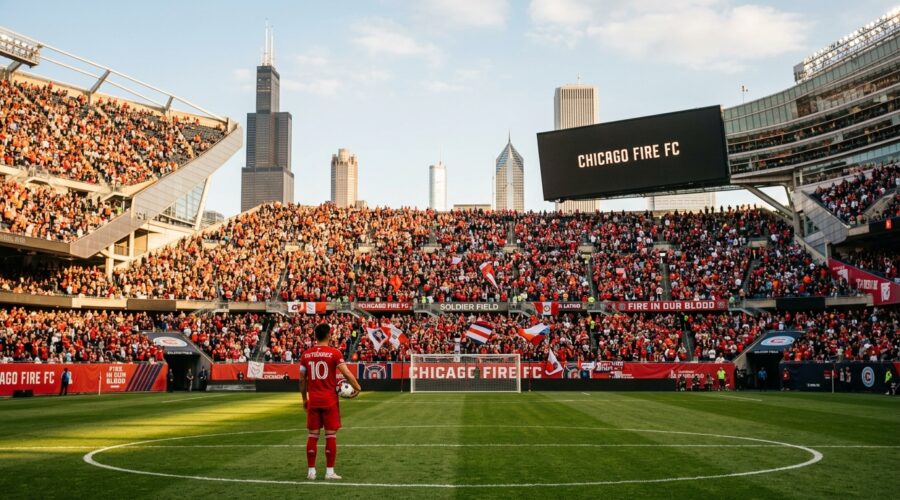
There is a moment that tells you everything you need to know about what Robert Lewandowski has meant to Chicago Fire FC. It is not the acrobatic volley he tucked away against Inter Miami on September 9 — though that goal, arriving ten minutes in off a whipped Andrew Gutman cross to the far post, was the kind of movement that makes centre-backs age in real time. It is not the brace against Charlotte on his home debut, or the winning goal at Orlando, or the composed finish that levelled things at Seattle. It is the number 63,094.
That is how many people were inside Soldier Field four days ago, watching a Tuesday night MLS regular-season match in a city that, for most of the last decade, treated its professional football club as a polite inconvenience. A club record. A city that has been persuaded, apparently all at once, to care very deeply about a sport it had previously filed under “nice to have.” And at the centre of it all, a thirty-eight-year-old Pole who turned down a hundred and fourteen million dollars a year to play on the lakefront.
On Sunday afternoon, Apple TV cameras roll again for Matchday 26. Chicago Fire host the New England Revolution at Soldier Field, 5:30 PM ET. The Eastern Conference play-off picture is knife-edge tight, Carles Gil is in the form of his life, and Lewandowski enters the match scoring in three consecutive league games. The occasion has the particular quality of a test — not of a player’s ability, which has long since been established beyond reasonable dispute, but of a club’s collective ambition.
The Summer’s Most Expensive Decision Was Not Signing Him — It Was Believing He Would Come
Let us briefly revisit how this happened, because the transfer is genuinely strange in the best possible way. Lewandowski left FC Barcelona at the end of a season in which he still scored fourteen league goals in thirty-one appearances. Hansi Flick and Deco had decided the future belonged to younger legs; Joan Laporta, to his credit, apparently disagreed but was overruled. This is the man who scored 344 goals in 375 appearances for Bayern Munich, who has 89 international goals for Poland — a national record — and whose total career tally across clubs and country exceeds seven hundred.
Saudi Arabia came in with the kind of offer that tends to end conversations before they begin: two years, two hundred million euros. It did not end this one. Gregg Berhalter, now Chicago’s head coach and Director of Football, had been talking to Lewandowski’s camp since January 2026. He was patient, which is unusual for American sports, and determined, which is not. His agent Pini Zahavi, in a characteristically frank interview with Sports Illustrated, was unambiguous: “The Fire’s management fought harder than anyone else for him. They weren’t pretending; they were genuinely crazy about him.”
What sealed it was not entirely about football. Chicagoland is home to approximately 721,538 people of Polish ancestry — the largest metropolitan Polish community outside Poland itself. Lewandowski had made multiple visits to the city with his wife Anna between December 2025 and June 2026. He knew what he was choosing, and he chose it. He consulted former teammates who had made similar journeys west — Xherdan Shaqiri, Bastian Schweinsteiger, and, most pertinently, Thomas Müller, now at Vancouver Whitecaps FC — and received what amounts to a unanimous endorsement. On June 29, Chicago Fire FC announced the signing. The second-highest paid player in MLS history had arrived. The club president Dave Baldwin offered a sentence that will probably end up on a banner: “This is not the Chicago Fire you thought you knew.”
Hugo Cuypers, the previous club-record signing and a man who had contributed thirteen league goals in eleven appearances, was moved to a Liga MX club to free the Designated Player slot. The calculus was brutal but logical. When the best available version of a thing presents itself, you make room.
What He Has Actually Done Since Arriving
The cynical read on a thirty-eight-year-old superstar arriving in MLS is that you are buying the legacy, not the player. The cynical read has not fared well.
His debut came July 22 against Inter Miami at Nu Stadium in Miami, with an attendance of 25,123. He did not score that night, which gave the doubters their twenty-four hours. On August 1, in his home debut against Charlotte FC, he scored twice. Goals seven hundred and twenty-one and seven hundred and twenty-two of his career, if you are keeping count, and the fourth Fire player in club history to score multiple goals on a home debut, following Frank Klopas in 1998 and the less romantically paired Herron and Frankowski in 2008.
Six goals and two assists in nine MLS appearances since. A goal every hundred and four minutes. Three goals and two assists in his last three outings, with strikes in three consecutive matches going into Sunday. The form line reads: winning goal at Orlando, one goal and one assist in a 2-2 draw at Seattle, one goal and one assist in a 4-4 draw at Toronto, and then that volley against Inter Miami four days ago, winner of the Matchday 25 Goal of the Round with forty percent of the fan vote. The Leagues Cup brought three more goals across seven appearances before Chicago’s run ended with a 2-1 quarter-final defeat to Monterrey in late August.
The system around him is worth noting because it is not built on nostalgia. Berhalter’s 4-4-2 or 4-2-3-1 uses Lewandowski as a reference point rather than a finishing station. He drops, combines, and creates angles. Maren Haile-Selassie, arguably the club’s most important player in the months before Lewandowski’s arrival, has flourished alongside him — seven goals and seven assists across twenty-three appearances, three goals and an assist in the same last-three-game run. Philip Zinckernagel, now signed to a new Designated Player contract of his own, provides width and craft with five goals and nine assists from twenty-two appearances. Jonathan Bamba stretches the pitch. Robin Lod and the quietly excellent Anton Salétros control the midfield. And Chris Brady, who made six saves against Inter Miami four days ago, anchors things from goal on the back of a USMNT World Cup squad call-up.
This is, in other words, a team. Which makes it considerably more dangerous than a vanity project with one very famous name.
The Standings, Unvarnished
Chicago sit fourth in the Eastern Conference with thirty-nine points from twenty-three games: eleven wins, six defeats, six draws. Nashville SC are long gone at the top with fifty-four points from twenty-five. Inter Miami are second on forty-five. Then it gets complicated.
New England Revolution are third on forty points from twenty-four games. Charlotte FC are fifth — also on forty points, from twenty-five games. Chicago are fourth on thirty-nine, but crucially with games in hand over nearly every rival in sight. That game in hand against New England becomes, on Sunday, the game itself.
A Chicago win moves them into third. A New England win opens a four-point gap and makes the mathematics of a top-three finish significantly more demanding. A draw leaves everything unresolved, which is perhaps the most honest summary of where this Eastern Conference campaign currently stands.
New England arrived at this position via a 2-1 win at NYCFC on September 9, settled by a Carles Gil penalty deep into injury time. They displaced Chicago from third with that result. There is something almost theatrical about the timing — a rival knocking you off your perch the same night you are setting a club attendance record at Soldier Field. The Eastern Conference, this season, has no interest in your feelings.
The Revolution and the Problem Named Carles Gil
New England’s manager Marko Mitrović was appointed in November 2025 following Caleb Porter’s departure, and he brings a curriculum vitae that is more interesting than most in MLS. His formative coaching years were spent as an assistant at Chicago Fire FC between 2016 and 2019 — which will add a particular flavour to Sunday’s touchline dynamic, given that Berhalter now runs the club Mitrović once helped prepare matches for. He subsequently managed in the English Championship at Reading and led the United States Under-20 side to the quarter-finals of the 2025 FIFA Under-20 World Cup before taking the Olympic team to the same stage at Paris 2024. He presses high, attacks with conviction, and has been candid about his intentions: he wants New England playing football that looks like something.
Whether that something can solve the particular problem of Carles Gil is a question all of his opponents are still working out. The Spaniard is this year’s most credible MLS MVP candidate outside of whatever Messi has decided to be in a given fortnight. Ten goals and eight assists from twenty-four appearances, including three game-winning goals and four selections to the Team of the Matchday. A five-time All-Star. The player whose 97th-minute penalty at NYCFC on Tuesday essentially defines New England’s season in miniature: relentless, late, and slightly infuriating if you support anyone else.
Gil operates in the spaces between lines that well-organised defences try to eliminate and less organised ones simply forget to close. He and Jack Harrison — three assists in seven appearances since arriving from the Premier League — have already developed an understanding on New England’s left that is causing problems for teams better resourced than Chicago’s current midfield. Dániel Gazdag brings composure and box intelligence. Dor Turgeman, with six goals and four assists, is an ambitious young striker growing into the confidence his manager clearly already has in him. Alhassan Yusuf adds physicality and drive through the middle.
Matt Turner, in goal, requires no further introduction to anyone who has watched American football over the last five years.
The tactical challenge for Berhalter is not especially subtle, but it is genuinely difficult: contain Gil without sacrificing the possession and territory that Lewandowski requires to function. The instinct will be to press Gil early and high, which is precisely the kind of pressure Mitrović’s system is designed to exploit on the counter. There is a very real scenario in which Chicago chase the game. There is also one — perhaps more likely, given the home crowd and the current momentum — in which Lewandowski punishes a high defensive line with the kind of movement that has made centre-backs uncomfortable on three continents.
The City, the Crowd, and the Weight of New Expectations
There is a version of this article that spends three paragraphs discussing expected goals and pressing metrics, and it is a version you should be glad you are not reading. The more interesting story is the one playing out in the stands.
63,094 people at a midweek game. Season ticket sales that have spiked dramatically not just for 2026 but for 2027. Corporate partnerships arriving at a rate the club was not accustomed to. The Chicago Bulls presenting Lewandowski with a custom jersey at the United Center. The Cubs inviting him to visit Wrigley. ESPN running a feature comparing the current club’s transformation to the original 1998 Fire — the first MLS expansion team to win both the league and the U.S. Open Cup in their inaugural season. That original Fire, for those who need the history, was a different kind of miracle, built on character and collective effort. This one is built on rather different foundations, but Dave Baldwin’s insistence that the decision was about on-field performance rather than commercial theatre is backed up, at least so far, by the evidence.
Lewandowski himself has spoken about the city with a warmth that does not feel scripted. “I know that a lot of Polish people are living in Chicago. A lot. It means also for me, for my family, that I can meet Polish people — that is also something interesting. The connection between Chicago and Poland is very, very important.” For a player who turned down the largest football contract in Saudi history to be closer to a community, that is either a very elaborate performance or a genuine expression of where a man is in his life. The evidence of the last two months suggests the latter.
Sunday’s crowd will not break Tuesday’s record — nothing short of Messi tends to do that — but it will be substantial, loud, and expectant in a way that Chicago Fire crowds have not been for some years. The club’s seven-game unbeaten MLS run will be on the line. Third place in the Eastern Conference will be at stake. And a man with over seven hundred career goals will be asked, once again, to prove that the best of him did not remain in the Nou Camp when he cleared his locker in May.
The Match, in Plain Terms
Squawka’s expected model gives Chicago a fifty percent win probability. That number is, for once, more interesting than misleading. It tells you this is a genuine contest between two sides with legitimate claims to the same prize, rather than a formality with a result attached. New England’s five wins in their last seven, against some reasonable opposition, suggest Mitrović has constructed something coherent. Chicago’s seven-game unbeaten run, at home against a club-record crowd, suggests Berhalter’s system is approaching its best shape.
The variables are narrow and specific. Does Salétros and Lod’s midfield partnership have enough mobility to track Gil through his characteristic late runs from deep? Can Turgeman or Gazdag find half-yards against what has been a reasonably solid Chicago defensive structure? And the question that will define the match’s fundamental narrative: can the New England centre-backs keep Lewandowski from receiving the ball in the positions he most covets — turned, a yard inside the area, left foot — even once in ninety minutes?
In Lewandowski’s experience, once is usually enough.
Conclusion: This Is the Examination
Every serious new arrival in MLS eventually reaches the match that matters in a way that the previous matches did not. The debut, the first goal, the crowd records — those are the appetiser. The main course is a Sunday evening in September, with a rival who knows your manager’s habits better than most, and three points that will determine whether the new-look Chicago Fire belong among the Eastern Conference’s serious play-off contenders or merely near them.
Lewandowski has been answering questions for the best part of twenty years. He answered the one about whether he could still score goals at thirty-eight with six in nine appearances. He answered the one about whether he could adapt to a new league, a new system, and a new life on the shore of Lake Michigan with a form of quiet, unhurried efficiency that should surprise no one who watched him closely at Bayern or Barcelona. The only question left, the one that Sunday will begin to answer, is whether everything being built around him — the system, the squad, the momentum, the sixty-three thousand believers who turned up on a Tuesday night to see it — is real enough to compete when it truly costs something.
Chicago Fire versus New England Revolution. Matchday 26. Sunday, September 13, 2026. The football will tell you what you need to know.