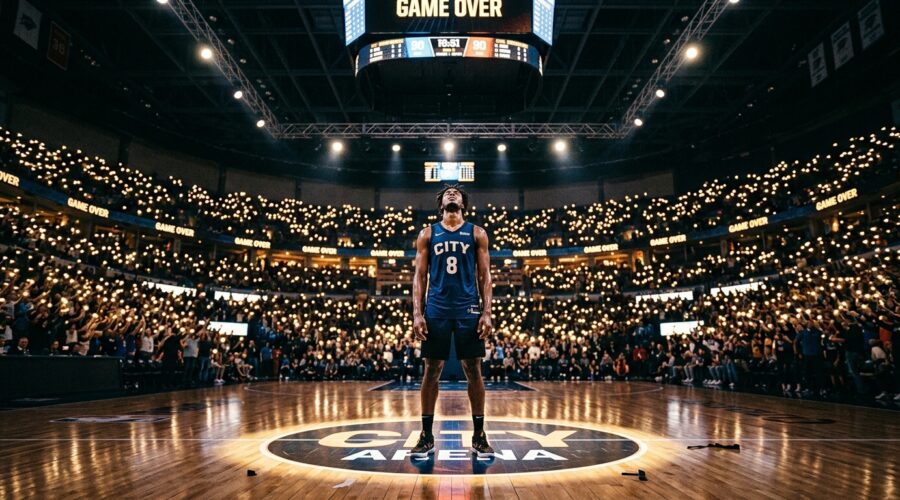
On the night of April 3, 2026, in a mostly meaningless late-season game between a lottery-bound Dallas team and the Orlando Magic, a 19-year-old kid from Maine dropped 24 points in the fourth quarter — alone, without his coach, without a veteran safety net — and became the youngest player in NBA history to score 50 points in a single game. The Mavericks still lost by 11. Cooper Flagg walked off the floor to a standing ovation anyway.
That scene — extraordinary individual brilliance inside institutional chaos — is the defining image of Flagg’s rookie season. And it tells you everything you need to know about what Dallas has on its hands.
How Dallas Even Got Here: A 1.8% Miracle
To understand the magnitude of Flagg’s arrival, you have to understand the wreckage that preceded it. On February 2, 2025, the Dallas Mavericks stunned the basketball world by trading Luka Dončić — a five-time All-NBA player who had just carried the franchise to the NBA Finals — to the Los Angeles Lakers in exchange for Anthony Davis, Max Christie, and a future draft pick. The backlash was immediate and visceral. Fans felt betrayed. Analysts were baffled. The franchise seemed to be dismantling something that had taken a decade to build.
What followed was a cascading organizational collapse. Davis aggravated an adductor injury almost immediately. Kyrie Irving tore his ACL before the season ended. Dereck Lively II, Daniel Gafford, and P.J. Washington all missed significant time. The Mavericks limped to a 39-43 record, just good enough to fall into the lottery — with a 1.8% chance at the top pick.
On May 12, 2025, Dallas won the lottery anyway.
It was the kind of outcome that makes you believe in either divine intervention or cosmic debt. The Mavericks had traded away their franchise player and been punished for it — and then, against all probability, were handed the tools to rebuild. On June 25, 2025, at Barclays Center in Brooklyn, they selected Cooper Flagg out of Duke with the first overall pick. Standing at the podium, the 18-year-old said he was ready “to be a sponge.” He was lying — not out of deception, but out of modesty. He was already far better than that.
The Season in Numbers: Where History Lives
The 2025-26 Dallas Mavericks finished 26-56. Kyrie Irving sat out the entire year with his ACL. Anthony Davis was traded to Washington in February as the organization finally committed to a full rebuild. The team ranked 27th in offensive rating, 26th in three-point percentage, and logged a net rating of -5.4. It was, by almost every measure, a rough place to start a career.
Cooper Flagg averaged 21.0 points, 6.7 rebounds, 4.5 assists, 1.2 steals, and 0.9 blocks per game across all 70 starts. He shot 46.8% from the field with a true shooting percentage of 54.8%. His PER of 17.9 ranked above the league average of 15. His VORP of 2.0 and Win Shares of 3.8 were remarkable for a teenager shouldering a franchise by himself.
Those numbers placed him in specific, rarefied company. Flagg became just the fourth rookie in the past 50 years to average at least 20 points, 6 rebounds, and 4 assists per game. The other three? Larry Bird, Michael Jordan, and Luka Dončić. He also joined Michael Jordan as the only rookies since steals became an official statistic in 1973-74 to lead their team in total points, rebounds, assists, and steals in the same season. ESPN noted that his stat line closely mirrors both Luka Dončić’s legendary ROY-winning season (21.2/7.8/6.0) and LeBron James’s first-year numbers (20.9/5.5/5.9) — except Flagg accomplished it two years younger than LeBron, on a far worse team, as a first-time primary option at the NBA level.
As TalkSport put it, “The NBA’s best rookie since Victor Wembanyama just put up Luka Doncic-like first-year stats, and is already in Michael Jordan territory as a 19-year-old.”
The Night He Announced Himself: 49 Points and a Former Roommate
The moment that first stopped the basketball world cold came on January 29, 2026, in a loss to the Charlotte Hornets. Flagg scored 49 points with 10 rebounds, 3 assists, and a block, obliterating Cliff Robinson’s 46-year-old record for the most points ever scored by a teenager in NBA history. It was the highest-scoring performance by any rookie since Trae Young put up 49 in 2019.
The subplot made it richer: the Hornets’ leading scorer that night was Kon Knueppel, who finished with 34 points. Knueppel had been Flagg’s Duke roommate. Media called it a “historic rookie duel,” and they weren’t exaggerating. Two former college teammates, both lottery picks, both producing at historic levels — in the same game, on the same floor, as professional basketball players for the first time.
The basketball world had been watching Flagg carefully since October. After that night in late January, it was watching with urgency.
Three Straight 30-Point Games as a Teenager (No One Had Done It Before)
Within days of the Charlotte game, Flagg did something no teenager in the history of the NBA had ever done: he recorded three consecutive 30-point games. The stretch was capped on February 3 with a 36-point, 9-rebound, 6-assist performance against the Boston Celtics in a 110-100 loss. Dallas lost the game. Flagg didn’t flinch. He was dictating by then — no longer reacting to NBA defenses but reading and attacking them at will.
The internal growth was visible to anyone paying attention. Early in the year, Mavs Moneyball noted, “he was reacting.” By February, “he was dictating.” That is not a subtle distinction for a 19-year-old starting point guard for the first time in his life. That is the evolutionary arc of a franchise cornerstone, compressed into 100-odd games.
April 3, 2026: 51 Points, No Coach, Down 30
Nothing in Flagg’s rookie season defined him more completely than what happened on that Friday night in Dallas against the Orlando Magic. It deserves to be recounted in full.
The Mavericks were trailing by 30 points. Head coach Jason Kidd was ejected — assessed a technical after storming onto the court to protest what he believed was an uncalled foul on Flagg. Seconds later, forward Naji Marshall, who had picked up a technical at the end of the first half, collected his second and was also gone. Assistant coach Frank Vogel was left in charge. The arena was quiet in the way arenas go quiet when a game feels over.
Then Flagg scored 24 points in the fourth quarter by himself.
He finished with 51 points on 19-of-30 shooting, 6-of-9 from three, and a perfect 7-for-7 from the free throw line — in just 34 minutes. He became the youngest player in NBA history to score 50 points in a game at 19 years and 104 days old, the first teenager to ever reach that threshold. Dallas still lost, 138-127. The standing ovation at the end was not for the outcome. It was for bearing witness to something that will be cited for decades.
“It’s always fun getting into that type of mode,” Flagg said afterward. “The basket feels big. But I like to win. That was my main focus.”
The maturity embedded in that postgame quote is worth sitting with. He scored 51 points as a teenager in a hostile elimination game environment, and his primary note of dissatisfaction was that the team lost. That is not manufactured media training. That is character.
April 5, 2026: The Rematch That Wasn’t Supposed to Happen
Two days after the 51-point explosion, the Los Angeles Lakers came to Dallas. The team featuring Luka Dončić.
Flagg scored 45 points, grabbed 8 rebounds, and handed out 9 assists in a Dallas win. He shot 14-of-27 from the field and 15-of-17 from the free throw line. Over those two back-to-back games, he had accumulated 96 points — placing him alongside Wilt Chamberlain as the only rookies in NBA history to score 96 or more points over consecutive games. He also became the first rookie since Walt Bellamy in 1962 to score 45 or more points in back-to-back games.
The symmetry of facing Luka’s Lakers in that specific moment — 48 hours after becoming the youngest 50-point scorer in league history, on a team built from the aftermath of Luka’s departure — was not lost on anyone. Dallas won that game. That matters too.
Rookie of the Year: The Burden vs. Efficiency Debate
When the 2025-26 Kia NBA Rookie of the Year was announced on April 27, 2026, Cooper Flagg won with 56 first-place votes and 412 total points. Runner-up Kon Knueppel — his former Duke roommate, again — received 44 first-place votes and 386 points. The 26-point margin was the second-closest since the current voting format began in 2002-03.
The debate had real merit on both sides. Knueppel shattered the rookie record for three-pointers made, contributed to a Charlotte team that went 44-38 and made the play-in tournament, and was staggeringly efficient from the outside. The argument for Knueppel was about winning. The argument for Flagg was about everything else.
Flagg was the only player in the entire NBA to lead his team in all four major statistical categories — points, rebounds, assists, and steals. He did it on a 26-56 team with no co-star, no consistent spacing, and a roster that was being actively dismantled around him mid-season. Sports Illustrated gave him an A+ season grade and wrote: “He was the first, and sometimes only, option every night. He still produced at a high level.”
Flagg at 19 years and 112 days became the second-youngest Rookie of the Year winner in NBA history — behind only LeBron James, who claimed the honor at 19 years and 106 days in 2003-04. He is the third Maverick ever to win the award, joining Jason Kidd (1994-95) and Luka Dončić (2018-19). The company he keeps, at every turn, is absurd.
The One Real Weakness
For all the historical superlatives, Cooper Flagg’s 2025-26 season had a genuine, non-negotiable flaw: three-point shooting. He connected on just 29.5% of his 3.5 attempts per game, and his struggles were compounded by the team context — Dallas ranked 26th in the NBA in three-point percentage at 34.4%, creating consistently poor spacing around their only offensive creator. There were flashes of what the shot could become. In one Sacramento game he was 75% from three. Late in the year his shot-making improved. But the raw number is the raw number, and it represents the most important individual developmental storyline heading into Year 2.
His 2.3 turnovers per game were also an expected byproduct of a 19-year-old learning to run an NBA offense with a 26.9% usage rate — manageable and, more importantly, correctable. The minor ankle and wrist injuries at the end of the season bear monitoring but appear non-threatening.
These are not dealbreakers. They are the footnotes on a generational talent’s rough draft. The question entering next season is not whether Flagg is good. The question is how good, and how fast.
The Organizational Reset Around Him
The Mavericks moved deliberately this offseason to build a real structure around their cornerstone. Masai Ujiri — the architect of Toronto’s 2019 championship — was named team president. Mike Schmitz, one of the most respected talent evaluators in the game (responsible for finding OG Anunoby at No. 23 and Pascal Siakam at No. 27 for Toronto), was hired as GM. On May 10, 2026, Dallas secured the ninth pick in the 2026 NBA Draft, with the primary goal of landing a young starting-caliber point guard to play alongside Flagg long-term.
Kyrie Irving, who missed the entire 2025-26 season with his ACL tear, is set to return. Ujiri has specifically flagged Kyrie as the ideal veteran co-star for this moment — “Kyrie likes to play off the ball,” he said at his introductory press conference, “and I know it’s going to help Cooper.” That is not a throwaway line. A ball-dominant playmaker paired with a creator who thrives without the ball is exactly the kind of complementary dynamic modern championship teams are built on.
The model for what Dallas is attempting is visible elsewhere in the league: San Antonio built around Victor Wembanyama with disciplined, patient roster construction. Oklahoma City built around Shai Gilgeous-Alexander with years of deliberate drafting. The Mavericks are now operating from the same blueprint — a transcendent young talent at the center, a sharp front office doing the surrounding work, and enough long-term cap flexibility to act when the moment is right.
Plans for a new arena and entertainment district signal something deeper than basketball strategy: a full franchise identity reset, from the ground up, with Flagg as the cornerstone on which everything else is built.
What the Numbers Really Mean
It is worth stepping back and stating plainly what Cooper Flagg’s rookie season actually represents in historical context.
He averaged a stat line comparable to LeBron James’s debut and Luka Dončić’s debut — but at two years younger than LeBron and on a team with considerably less support. He joined Larry Bird, Michael Jordan, and Luka Dončić in the exclusive club of rookies to average 20-6-4 in the past 50 years. He joined Michael Jordan as the only rookie to lead his team in the four major statistical pillars. He set the record for youngest 50-point game in NBA history. He broke the teenage scoring record. He recorded the first three consecutive 30-point games ever by a teenager in NBA history. He scored 96 points over two back-to-back games in the company of Wilt Chamberlain.
He did all of this at 19 years old, in his first professional season, on a 26-win team that was being reconstructed around him in real time.
ESPN perhaps said it best: “It can’t be stressed enough how far ahead of schedule Flagg showed to be on the offensive end this season — a development many around the NBA feel gives him a chance to develop into being one of the league’s best players.”
The Throughline: What Kind of Person He Is
Statistics only tell part of the story. The other part is the person behind them.
Cooper Flagg played 70 games on a team that won 26 of them. He never publicly complained. He never sulked. He never used the team’s dysfunction as a platform for individual grievance. When asked about losing more than he ever had in his life, he said: “I never allowed it to impact my competitiveness every game.” At the draft podium he said he was ready to be a sponge. By April he was operating as one of the most dangerous offensive players in the league — not because he absorbed information passively, but because he absorbed it and immediately put it to use.
The 51-point game — down 30, no coach, no veteran presence, against a professional NBA team — captures that character in its purest form. Flagg did not score 51 points to pad his stats. He scored 51 points because he does not know how to stop competing. The standing ovation he received walking off the floor of a losing team’s arena was the crowd’s recognition of something rare: not just talent, but the particular kind of will that turns talent into legacy.
Dallas has found its cornerstone. The foundation is being built around him. And the most terrifying thing about Cooper Flagg’s rookie season is not what he did — it is what he has not done yet.