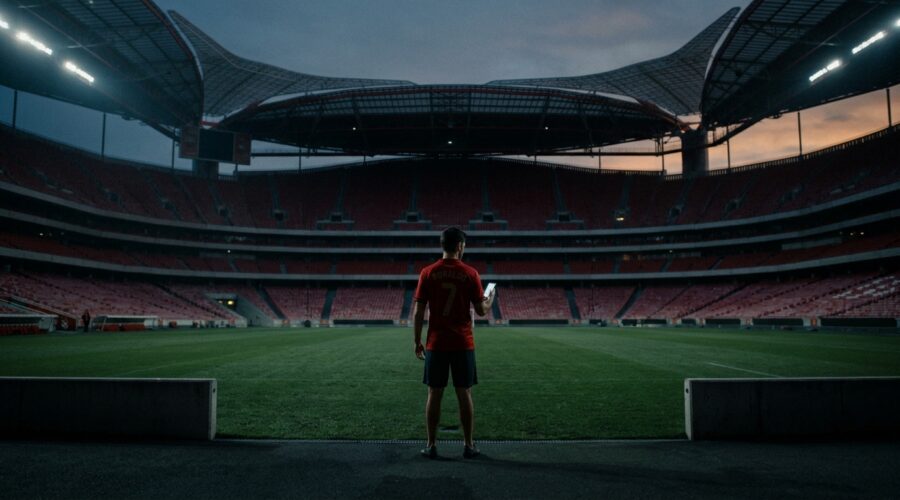
On the evening of November 5, 2026, while Jorge Jesus was preparing his squad for a Nations League double-header, his phone lit up with the same notification the rest of the world received simultaneously. Cristiano Ronaldo had retired from international football. No phone call. No handshake. No courtesy. Just a farewell video uploaded to Instagram and YouTube by a 41-year-old man who had spent 23 years demanding the world watch him, and who chose, in the end, to depart on his own terms — which is to say, badly.
Rio Ferdinand, who has never been troubled by understatement, called it simply: “It was a movie.” He was not wrong. It was cinematic, though perhaps not in the way Ferdinand intended. It was a movie with a magnificent first two acts, a bloated third act that outstayed its welcome, and a final scene so chaotic the director appeared to have walked off set before it wrapped.
What happened between Cristiano Ronaldo and Portuguese football in those final, fractious months is not really a story about ego — or at least, not only about ego. It is a story about the particular tragedy of exceptional men who cannot locate the door until someone else has already locked it from the outside.
The Tearful Flight Home and the Decision That Wasn’t
It had all begun, as so many Portuguese football dramas do, with elimination. On July 6, 2026, in the brutal heat of Arlington, Texas, Mikel Merino converted an injury-time winner to send Spain through to the quarter-finals of the 2026 FIFA World Cup at Portugal’s expense. The final score was 1-0. Ronaldo left the pitch in tears. Roberto Martinez announced his resignation during the press conference after the final whistle.
On the flight home, Ronaldo drafted a farewell letter. It was, by all accounts, heartfelt and unambiguous. And then FPF president Pedro Proença sat down next to him and persuaded him not to send it.
This was the first mistake — not Ronaldo’s, nor strictly Proença’s, but the collective mistake of everyone who confused Ronaldo’s willingness to be talked out of retirement with a genuine appetite to keep playing at the highest level on someone else’s terms. Proença, apparently energised by the responsibility, also solicited Ronaldo’s opinion on who should replace Martinez. Jorge Jesus, who had coached Ronaldo at Al Nassr for one season, was duly appointed on July 10, signing a four-year deal through the 2030 World Cup. The optics were unavoidable: Ronaldo had effectively endorsed the man who would manage him. The territory had been marked before Jesus had taken a single session.
Jesus, to his credit, was straightforward about how he saw things. He stated publicly that Ronaldo would play the first and last Nations League match of the September window. He also stated, with admirable bluntness, that Ronaldo would be treated like any other player. These two positions, it turned out, were mutually incompatible.
Oslo: The Match That Changed Everything
Portugal travelled to Oslo on September 27 for a Nations League group fixture against Norway. According to Ronaldo’s later account — a 2,000-word Instagram statement published on October 6 that read like a legal brief written by a man in considerable emotional distress — the original arrangement between himself and Jesus had been straightforward: Ronaldo would sit out the Norway and Denmark matches to manage his fitness. This, he said, was what had been agreed.
What Jesus did instead was change his mind mid-match. With Portugal winning 2-1 and the game in hand, Jesus told Ronaldo to begin warming up and prepare for thirty minutes of action. Ronaldo warmed up. He prepared. And then, as Gonçalo Ramos secured the points and the final whistle approached, he was never called upon. Jesus’s explanation was unequivocal and, tactically speaking, entirely defensible: “He was angry with me. He didn’t come on. I had a plan. Never let any player — not Cristiano, not anyone — change my ideas as coach.”
The state of the game justified the decision. The problem was not the decision. The problem was the warm-up. Telling a player of Ronaldo’s psychological architecture to prepare for action and then leaving him standing on the touchline is not a tactical choice — it is an act of management that required either enormous confidence or remarkable naivety about the man involved. Jesus may argue it was the former. The subsequent four weeks suggest it was at least partly the latter.
At the final whistle in Oslo, Ronaldo walked directly down the tunnel without acknowledging the traveling Portuguese supporters — the first time, reportedly, he had done so since EURO 2008, when he was an unused substitute throughout the entire competitive match. By the time the squad had relocated to Malmö for training ahead of the Denmark fixture, Ronaldo had stopped attending sessions. He was, in the language of training ground diplomacy, absent.
Copenhagen and the Private Jet
What followed was a sequence of events that would strain credulity in a television drama. Proença flew to Copenhagen for emergency mediation. A fragile understanding was apparently reached. Jesus then appeared at a press conference and confirmed that Ronaldo would be named on the bench against Denmark, adding that he could not guarantee Ronaldo a starting role in the next match. This was reasonable, proportionate, and transparent. It was also the final straw.
While Jesus was still speaking at that press conference, Ronaldo’s private jet departed Madrid. He left camp without authorisation. The Portugal team beat Denmark 4-2 without him. Jesus arrived in the mixed zone afterwards and said, with the serene composure of a man who had decided to stop caring: “A high-quality victory with four goals. It can’t be overlooked. It’s more important than everything that happened.”
It was a pointed remark. It was also correct. Portugal had just beaten Denmark four-two without Cristiano Ronaldo. That fact would have consequences.
The Statement, the Suspension, and the €255 Fine
On October 6, the statement arrived. Two thousand words. First person. Detailed, deliberate, and largely concerned with demonstrating that Jesus had broken his word on two separate occasions — first by asking Ronaldo to warm up after agreeing he would not play, and second by failing to publicly clarify this at his press conference as they had reportedly agreed. Ronaldo described Jesus’s conduct as an “absolute breach of trust.” He explicitly invited the FPF to punish him for leaving camp.
They obliged. On October 19, the FPF’s Disciplinary Council handed down a 30-day suspension and a fine of €255 — the maximum permissible after mitigating circumstances were taken into account under Article 160(1) of their disciplinary regulations. The mitigating factors included remorse shown, contributions to football, and what might generously be described as athletic merit. As part of his official defence, Ronaldo submitted his CV. His actual CV, listing his awards and achievements. One imagines it was thorough.
The fine of €255 is worth pausing on. Based on his Al Nassr salary, Ronaldo earns approximately £488,000 per day. The mathematics, if you care to do them, suggest he could have settled that fine in roughly 39 seconds. The FPF’s regulatory framework, one suspects, was not designed with this particular defendant in mind.
The Final Exit
In late October, with the November Nations League squad announcement imminent, Ronaldo learned that his name was on the preliminary selection list. Per reporting from the Portuguese newspaper Observador, he feared what a public exclusion would look like — the humiliation of being named on a provisional list and then dropped, the story becoming not about his legacy but about his irrelevance.
On November 5, 2026, he announced his retirement. The farewell video was moving, well-produced, and notably absent of anything resembling a reference to the previous eight weeks. His written letter was generous and gracious: “To the Portuguese people, the day has come for me to hand back the No. 7 shirt of our national team. I never felt it belonged to me alone. But for 23 years, I had the privilege and the responsibility of wearing it, defending it and carrying it with me into stadiums all around the world.”
Jorge Jesus found out from the announcement. A phone call that had been arranged between the two men through Proença never took place. Ronaldo, by all accounts, has no intention of speaking with Jesus again.
The FPF subsequently offered Ronaldo a formal farewell tribute match. He declined. The match has no date, no opponent, and no prospect of happening on current evidence. Proença called him “eternal captain” regardless — which was generous given that the captain had walked out of a training camp while the manager was still holding a press conference.
What the Numbers Actually Say
It would be a failure of proportion to let the manner of the ending swallow the substance of the career. The numbers Ronaldo leaves behind are, in the truest sense of an overused word, extraordinary.
234 caps. 146 international goals. Ten hat-tricks. Goals against 49 different nations. A goals-per-game ratio of 0.62 across 23 years of international football. His post-30 international total alone — 94 goals after his 30th birthday — would rank among the greatest international tallies ever recorded by any player in history. Portugal’s second-highest all-time scorer, the excellent Pauleta, managed 47 goals in his entire career. Ronaldo scored 94 after the age at which most forwards are quietly grateful to be getting minutes.
He scored in six different World Cup editions — 2006, 2010, 2014, 2018, 2022, and 2026. He is one of only two players in history, male or female, to have scored at six World Cups — joined by Brazil’s Marta, who achieved the same feat across six Women’s World Cup tournaments between 2003 and 2023. He accumulated 11 World Cup goals in total, placing him 11th all-time, tied with Hungary’s Sándor Kocsis — though ten of those eleven came in the group stage. The solitary knockout goal — a penalty against Croatia in the Round of 32 in Toronto, July 2 — arrived in his sixth and final tournament, almost as a reluctant concession to the occasion. It was, characteristically, still on his terms.
He leaves Portugal having won three major trophies: Euro 2016, the UEFA Nations League in 2019, and the Nations League again in 2025. Before Ronaldo’s debut in August 2003, Portugal had never won a senior international competition. That is not a footnote. That is the entire story.
The Messi Comparison Nobody Can Avoid
Lionel Messi also retired from international football in 2026. The Argentine did so on August 31, after leading his country to the World Cup final on July 19 at age 39, contributing eight goals and four assists — statistically, by some distance, his greatest World Cup. When the curtain came down on his Argentina career in October, it came down at the Estadio Monumental in Buenos Aires on October 6, in front of approximately 85,000 people who had come specifically to see him off — a farewell match against Benin. He scored a penalty, provided two assists, and the crowd, in a detail that belongs in literature, reportedly refused to let him leave. Ronaldo’s own final match, by contrast, drew some 48,000 — a figure comfortably exceeded by the 70,823 who attended Super Bowl LX earlier that year.
Messi scored his 126th international goal that night. Ronaldo’s record stands at 146. It is a gap of twenty, and it is real, and it is significant, and it will almost certainly never be closed. Those who want to rank Ronaldo above Messi in the international hierarchy can point to those twenty goals and several hundred caps and they will not be wrong in a statistical sense.
But there is a different question worth asking, and it is not about goals. It is about what Argentina looked like around Messi and what Portugal looked like around Ronaldo — specifically, what each team looked like when their central figure was removed from the equation. Argentina without Messi still felt, in those final years, like a team. Portugal without Ronaldo, in those autumn Nations League games, went to Oslo and Copenhagen and won. They beat Denmark four goals to two. They played with pace and structure and collective intelligence, and nobody in a red shirt spent ninety minutes trying to find one man in the penalty area.
This is not a condemnation of Ronaldo. It is an observation about the relationship between individual genius and collective football, and about which of the two eventually proves more sustainable. Ronaldo gave Portugal their trophies. He also, in those final seasons, gave Portugal their ceiling.
The 1,000 Goals and the Saudi Question
When Ronaldo announced his retirement from international football, his combined career total — club and country — stood at 985 goals. He needs fifteen more to reach one thousand. That milestone, if it arrives, will arrive at Al Nassr in Riyadh, in a league that most serious football observers treat with the mild suspicion reserved for things that are technically impressive but somehow beside the point. His contract runs through June 2027.
There is something melancholy about this, though Ronaldo would likely dispute that framing vigorously. He reportedly hoped — there is no clean way to say this — that goal number 1,000 might arrive in a Portugal shirt. The Norway fallout and the subsequent retirement ensured it will not. The greatest scorer in men’s international football history will instead chase an unprecedented round number in the Saudi Pro League, which is not quite the stage the achievement deserves, though it is, in fairness, the stage he chose.
The Last Appearance Nobody Noticed
On September 24, 2026, Cristiano Ronaldo played his 234th and final match for Portugal. It was a 1-0 Nations League win over Wales in Lisbon, the goal scored by João Félix in the 22nd minute. Ronaldo had a goal disallowed by VAR and missed several chances before being substituted after 67 minutes. There were no particular ceremonies, no special tributes, no sense in the stadium that history was being made. No one knew it was his last appearance. Ronaldo himself may not have known it with any certainty.
Three days later, in Oslo, everything changed. And so his actual final act for his country — sixty-seven quiet minutes against Wales on a September evening in Lisbon, without fanfare or awareness — has an accidental elegance that the messy weeks which followed almost entirely obscure.
He deserved better than the ending he got. He also engineered the ending he got. Both of these things are true simultaneously, and that tension — between what Ronaldo gave Portugal and what Portugal, and perhaps football, failed to give him in return — is what will occupy the argument for years to come.
Eternal Captain, Reluctant Farewell
Pedro Proença called him the “eternal captain.” Bruno Fernandes said it was a privilege to share great moments with his childhood idol. Renato Veiga, in a remark that told you everything about the fault lines running through the final weeks, said he was very close to Ronaldo but had been given instructions and could not discuss the matter. Neymar, who had walked away from Brazil in July under rather less dramatic circumstances, contributed a single word: “Legend.”
The AP described an international career that “ultimately ended in acrimony.” That is accurate and insufficient in roughly equal measure. It ended in acrimony, yes, but it also ended with 146 goals, with Euro 2016 and two Nations League titles, with goals in six World Cups, with a record that no one alive will touch in our lifetimes. Portugal, the country that had never won anything before this man pulled on the shirt, won three major trophies while he wore it. The number seven is now temporarily assigned to Rafael Leão. FIFA regulations prevent the official retirement of international squad numbers, so it will be worn again, by someone else, eventually. That feels right. The shirt was never meant to belong to any one man.
What Ronaldo could not accept, in the end, was the natural order of a career’s conclusion — the diminishing of minutes, the manager’s prerogative, the quiet demotion from protagonist to supporting role. This is not a character flaw in any conventional sense. It is precisely the same quality that made him what he was. The refusal to accept limits is what produced the 146 goals. The refusal to accept limits is also what produced the private jet departing Madrid while the press conference was still running.
The farewell match the FPF offered him sits unclaimed, dateless and opponentless, somewhere in a drawer in Lisbon. He turned it down. Perhaps it felt, after everything, like acceptance of a version of events he could not bring himself to endorse. Perhaps, for a man who has spent his entire adult life demanding the world on his terms, a ceremonial goodbye organised by an institution he felt had not protected him was simply one compromise too many.
Rio Ferdinand said it was a movie. He was right. It was the kind of movie where the final frame cuts to black before the closing scene, where the audience is left in the dark, and where the question of how it should have ended lingers far longer than the film itself.
Fifteen goals. Al Nassr. Riyadh. The story is not finished. It is just no longer the story Ronaldo — or any of us, perhaps — imagined it would be.