Peter Shilton was 40 years old when he played his final match for England — a third-place play-off at the 1990 World Cup in Bari — and nobody seriously thought his record of 125 caps would ever be touched. Goalkeepers have the longevity advantage, everyone agreed. The position forgives you the physical ravaging that centre-forwards endure. A striker, by his very nature, is a man running headlong into defenders for a living, burning bright and burning out. The idea that an English number nine would still be going strong at 33, still scoring goals by the hatful at the highest level in European football, still pulling on the white shirt with conspicuous relish — well, that was the kind of thing you said to end a conversation at the pub.
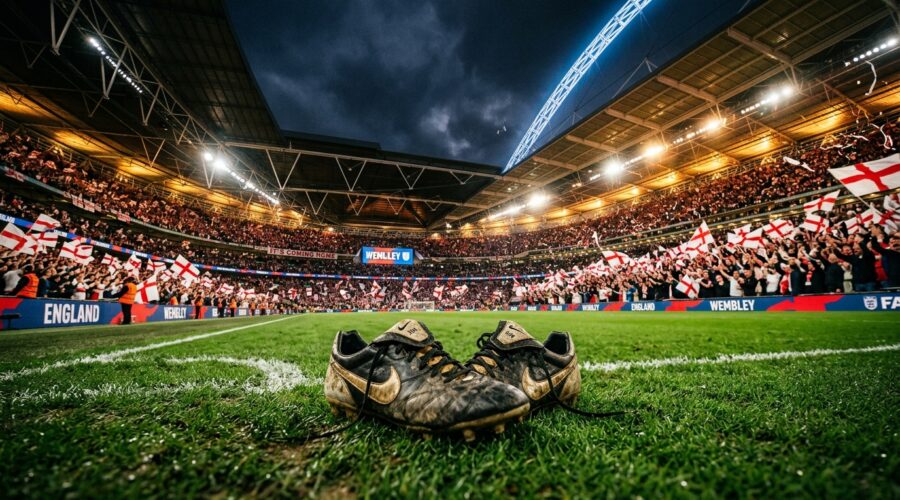
On November 12, 2026, at Wembley Stadium, Harry Kane walked out against Croatia and made the pub conversation look foolish. His 126th cap for England. The outright record. Shilton, the great man himself, was there on the pitch to hand him a memento. It was generous of him, though there was no need for ceremony. The numbers had already done the talking.
The question now is not whether Kane holds the record. He does, comprehensively. The question the record forces us to confront is a bigger, more uncomfortable one — uncomfortable, at least, for those of us who grew up worshipping at the shrines of Moore and Charlton. Is Harry Kane the greatest player ever to represent England? Not just the most decorated in raw statistical terms, but genuinely, historically, the greatest?
The answer, looked at honestly, is almost certainly yes. And the case is not even particularly close.
The Record That Was Supposed to Stand Forever
To understand what Kane has done, it helps to appreciate what Shilton’s record actually represented. Peter Shilton played international football from 1970 to 1990. Twenty years. Through three different decades, six different England managers, and an era when fixture lists were considerably shorter than they are today. He kept 66 clean sheets in his 125 appearances for England. He was the best goalkeeper in the world for a sustained period that most keepers only dream of. His 125 caps stood for 36 years — longer than Kane has been alive — and was widely regarded as untouchable.
Kane equalled it on October 6, 2026, against Czechia in a UEFA Nations League fixture at Wembley — and characteristically, he did not arrive at the milestone quietly. He forced an own goal after 27 minutes, scored his 90th England goal, then his 91st, as England ran out 3-0 winners. Six goals in four games across that international break. Thirteen goals in thirteen England games across the 2026 calendar year. At 33, Kane was not limping to the record. He was sprinting.
“It’s right up there among so many milestones,” Kane said afterwards. “My England debut was a dream come true and this was beyond even my wildest dreams. An extreme privilege. I hope I’ve not reached my ceiling and there’s more to go. I still feel like I’ve got room to improve.”
Room to improve. At 33. With 91 international goals. The sheer brazenness of the ambition is almost comical — except that every available piece of evidence suggests he means it.
Shilton, for his part, could not have been more gracious. “Records are there to be beaten,” he said. “Really, I couldn’t think of anyone better than Harry — not only because of his football record but also the type of person that he is. He’s been a great professional and has an impeccable CV.” He added, with the quiet pride of a man watching his own legacy pass into worthy hands: “He plays the hardest position — centre forward. He’s scored quite a few goals.”
Quite a few. That is one way of putting it.
The Numbers, Laid Bare
Statistics are a blunt instrument and Kane himself would be the first to acknowledge it, but some numbers are simply too vast to dismiss with a wave of the hand. When you lay Kane’s England record beside those of the men considered his rivals for the crown, the margins are not tight. They are staggering.
| Player | Caps | Goals | Goals as Captain | Ballon d’Or |
|---|---|---|---|---|
| Harry Kane | 126+ | 91 | 96 caps as captain (record) | 1 (2026) |
| Peter Shilton | 125 | 0 | — | 0 |
| Wayne Rooney | 120 | 53 | — | 0 |
| Bobby Moore | 108 | 2 | 90 caps as captain | 0 |
| Bobby Charlton | 106 | 49 | — | 1 (1966) |
| Gary Lineker | 80 | 48 | — | 0 |
Kane is 38 goals ahead of Wayne Rooney — 38 — in the all-time England scoring list. That is not a margin, it is a chasm. Jimmy Greaves, the most naturally gifted goalscorer England has ever produced, managed 44 goals in 57 caps. Kane has scored 91 in 126. His 14 World Cup goals have obliterated Gary Lineker’s previous England record of 10 — a record Lineker built across two World Cup appearances and 12 games, in an era when the Golden Boot still felt like England’s ceiling for individual achievement at a tournament. Kane took 18 games across three tournaments to leave it in ruins.
His 96 appearances as England captain are an all-time record, overtaking the 90 shared by Bobby Moore and Billy Wright. Kane has led England more often than any man who has ever led England, including the man who lifted the World Cup.
The Golden Season
To truly understand what Kane accomplished in the year leading up to that record-breaking night, you have to zoom out from Wembley and look at the whole picture — club and country combined — because the picture in 2025-26 was simply unlike anything seen from an English player in the modern era.
At Bayern Munich, Kane scored 61 goals in 51 matches. Thirty-six in the Bundesliga to claim his third consecutive top-scorer title, 14 in the Champions League, and a hat-trick in the DFB-Pokal final to complete a domestic treble. He set the Bundesliga record for fewest games to reach 100 goals — 98 matches, surpassing a standard that had stood since Dieter Müller set it in 1977 across 129 games, a record that had endured for 49 years. Add his 12 England goals across the year and the combined tally across club and country was 73 goals in 63 games. The most prolific season by any player on the European continent that year, by some distance.
The 2026 Ballon d’Or, awarded on October 26 at the London Palladium — itself a lovely touch, the ceremony relocated to London for its 70th anniversary, acknowledging Stanley Matthews as the first winner in 1956 — was the formal recognition of a year that had already made the award feel like a formality. Kane beat Kylian Mbappe into second place. He became only the fifth Englishman ever to win football’s most coveted individual honour, joining Matthews (1956), Bobby Charlton (1966), Kevin Keegan (1978 and 1979), and Michael Owen (2001). The first in 25 years.
“Being in London, it is extra special,” Kane said at the ceremony, with the carefully understated contentment of a man who has learned not to get too carried away. “It felt like a good omen.”
Six Tournaments, One Relentless Story
Major tournament football is where England’s relationship with its own history tends to get complicated — where self-belief curdles into expectation, where expectation curdles into recrimination, and where recrimination eventually curdles back into self-belief in time for the next campaign. Kane has lived through all of it, and has been the one constant thread across six tournaments spanning a full decade.
| Tournament | Goals | Result |
|---|---|---|
| Euro 2016 | 0 | Round of 16 |
| World Cup 2018 | 6 (Golden Boot) | Semi-final |
| Euro 2020/21 | 4 | Final (runners-up) |
| World Cup 2022 | 2 | Quarter-final |
| Euro 2024 | 3 (shared Golden Boot) | Final (runners-up) |
| World Cup 2026 | 6 | Semi-final |
| Total | 21 goals | 4 semi-finals or finals |
Euro 2016 — which we might charitably set aside as the work of a younger man finding his feet — featured a goalless group-stage campaign and a limp exit to Iceland that had nothing particularly to do with Kane and everything to do with a collective failure of nerve. What followed was a decade of sustained, almost implausible tournament relevance. The 2018 Golden Boot. Two consecutive European Championship finals. A second World Cup semi-final in 2026, England’s best finish at the tournament since Shilton’s last hurrah in Italy thirty-six years earlier.
The 2026 World Cup semi-final in Atlanta deserves particular attention because it illustrated, in compressed and painful form, the essential texture of Kane’s England career. England were the better side for the best part of an hour, Kane and Bellingham orchestrating a performance of genuine controlled ambition. England led. Then, in the final quarter, the defensive shape began to fold, the press disintegrated, and Argentina found the gaps that well-organised teams always find in England when England’s nerve goes. Santiago Fernandez equalised on 85 minutes. Lautaro Martinez headed the winner in stoppage time. 2-1.
“We got the goal and I think we fully deserved to be ahead,” Kane said afterwards, with the quiet composure of a man who has learned to absorb football’s cruelties without letting them define him. “It’s another kick in the teeth. We’re knocking on the door. We just need to find that missing piece to get over the line.”
Twenty-one major tournament goals. Gary Lineker managed ten across two tournaments — and Lineker is rightly regarded as one of the finest tournament strikers England has ever produced. Kane has more than doubled that return.
The Man Before the Records
Records are won on training pitches long before they appear in the newspaper, and the story of how Kane arrived at this point is as important as the numbers themselves.
He was born at Whipps Cross University Hospital in Leytonstone on July 28, 1993, grew up in Chingford — the same east London streets that produced David Beckham, as it happens — and was rejected by Arsenal’s academy at the age of eight on the grounds that he was too chubby and not athletic enough. That Arsenal scout will have had worse days, but probably not many. Kane responded to rejection the way he would go on to respond to everything: by working harder than anyone around him.
He joined Tottenham’s academy, went on loan to Leyton Orient, Millwall, Norwich, and Leicester, learning different aspects of his game at each stop, grafting in the lower reaches of the football pyramid while his contemporaries were establishing themselves at Premier League clubs. When his chance finally came for Spurs, he took it with both hands and never gave it back — eventually scoring 280 goals for the club, an all-time record surpassing Jimmy Greaves.
His England debut, on March 27, 2015 against Lithuania, announced him in characteristic fashion. Coming on as a substitute for Wayne Rooney, he scored 79 seconds later — a stunning introduction, though Bill Nicholson’s 19-second debut goal in 1951 remains the fastest on record, and Harold Hassall had also bettered Kane’s time with a 22-second debut goal in 1953. Kane was not in the mood for a gentle introduction, all the same.
What strikes those around him, consistently, is that the statistical accumulation has not inflated the man. Jarell Quansah, who has shared the England dressing room with Kane, described him simply: “He’s an ultimate professional and he’s done everything. It’s the standards he sets off the pitch. He will always be the first outside for meetings. He’s always waiting for the squad to get together. He’ll never let the squad do anything by themselves. Him as a whole, he’s just a true great captain.”
Jude Bellingham, who shares a footballing generation with Kane and has watched him at close quarters through two World Cups and a European Championship, was blunter still: “He is the greatest player that has ever played for England. He is an amazing role model, a great human being and you learn from him every day. I am honoured to share the pitch with him. Nothing he ever does surprises me anymore.”
Against the Legends: An Honest Reckoning
The greatness debate in English football always, eventually, loops back to 1966. The World Cup, Wembley, the Jules Rimet trophy lifted by Bobby Moore in the afternoon sunshine. It is the original sin of English football nostalgia — the event against which all subsequent achievement is measured and found wanting, the wound that has never entirely healed.
Bobby Moore is rightly revered. His reading of the game, his elegance under pressure, his ability to conduct a defensive line like a conductor directing an orchestra — these were genuine, extraordinary qualities. Pele called him the finest defender he ever played against, and Pele’s opinions on football tend to carry a little weight. Moore captained England 90 times. He lifted the trophy that matters most. These are not small things.
But we should be honest about the architecture of Moore’s achievement. England won the 1966 World Cup on home soil, with home advantage, in front of home crowds, playing all seven of their games at Wembley. The draw was kind. The officiating at crucial moments was contentious. None of this diminishes Moore’s personal contribution — the man was exceptional — but it provides context that is routinely stripped away in the retelling. Kane, meanwhile, has taken England to two European Championship finals and a World Cup semi-final on neutral or hostile territory, against the finest sides in the world, while producing goals on the occasions when England needed them most.
Bobby Charlton won the Ballon d’Or in 1966 — now Kane has one too, so they are level on that measure — and scored 49 international goals in 106 caps. Forty-nine. Kane has 91. The gap is not a matter of degree; it is a matter of category.
Gary Lineker, perhaps the most elegant striker England has produced, managed 48 goals in 80 caps, won a World Cup Golden Boot in 1986, and accumulated 10 World Cup goals across two tournaments — a record that felt permanent until Kane dismantled it en route to 14. Lineker also never won a major honour with England. That matters, in the context of what follows.
The Trophy-Shaped Silence
It is the objection that hangs in the air whenever Kane’s name is raised in this conversation, the one that the records cannot entirely drown out: Harry Kane has never won anything with England.
Euro 2021 final, lost to Italy on penalties. Euro 2024 final, lost 2-1 to Spain. World Cup 2018 semi-final, lost 2-1 to Croatia. World Cup 2026 semi-final, lost 2-1 to Argentina. Four near-misses of genuine, painful proximity. The fact that the margins were so small makes it worse rather than better — there is a particular cruelty in coming close repeatedly, in building the case almost to its conclusion and then watching it unravel in the final stages.
Kane himself has never flinched from this truth. “I would swap every individual honour I’ve ever won for a champion’s medal,” he said before the 2024 European final. It is exactly what you would expect someone of his character to say, and it is worth taking at face value. He means it. The absence of a major trophy is a genuine lacuna in an otherwise extraordinary record.
But consider what this argument actually requires you to believe. It requires you to believe that Gary Lineker — who also never won a major trophy with England — is a lesser player because of it, which almost nobody argues. It requires you to believe that Peter Shilton, whose greatest achievement with England was a third-place finish at a World Cup, is elevated by silverware he never collected. It requires you to believe that the difference between Kane and Moore is primarily trophy-shaped, while ignoring that Moore’s triumph was achieved on home soil in an era when England faced a much smaller pool of serious competition, with the benefit of a bracket that never required them to face the very best sides in the draw until they were already in the final.
Knockout football is binary and merciless. One deflection, one missed penalty, one defensive lapse in the 85th minute, and history pivots. It seems a strange basis on which to adjudicate between individual players who gave everything they had across careers of exceptional distinction.
What Comes Next
Kane has signed a contract extension with Bayern Munich through June 2029. He will be 35 at its expiration. If he continues to play for England at anything approaching his current rate — and there is precisely no evidence suggesting he will not — he will almost certainly reach 140 caps before he is done. More pressingly, he needs nine more goals to reach 100 international goals. No England player has ever done it. No England player has come remotely close. Nine goals, for a man who scored 73 across a single season in 2025-26, is not an aspiration. It is an appointment.
There is also, it should be noted, the small matter of the 2028 European Championship. If Kane is fit, he will be there. And he will be leading the line.
Peter Shilton, in his video message to Kane ahead of the record-breaking 126th cap, said something quietly remarkable: “Maybe go on and set a record that will never be beaten — because you’re still going strong, Harry.”
From the man whose record had stood for 36 years, that is not idle flattery. It is a considered assessment from someone who understands exactly what sustained excellence at international level demands.
The Verdict
The debate will never be fully settled, because that is the nature of the debate — nostalgia is not a logical system, and Bobby Moore lifting a golden trophy in the July sunshine of 1966 is an image too powerful to be dismantled by a spreadsheet, however impressive the spreadsheet. Some conversations exist not to be resolved but to be conducted, and England’s greatest player is exactly that kind of conversation.
But if you are asking for the honest answer — the one that requires you to look at the full body of evidence, the records broken, the tournaments navigated, the individual honours accumulated, the consistency sustained, the leadership provided over 96 games as captain — then the honest answer is Harry Kane.
More caps than any Englishman who ever played. More goals, by 38, than the second-placed man on the all-time list. More World Cup goals than Gary Lineker. More tournament goals than anyone who ever pulled on the Three Lions shirt. The Ballon d’Or. The captaincy record. The goals record. The appearance record. The career still going.
The boy born in Leytonstone who was sent away from Arsenal at eight years old for being too chubby has, through the most straightforward combination of talent and relentless, undeviating work, made himself the definitive England player. Not the most romantic. Not the most storied. Not the holder of the one medal that would make the argument unanswerable. But the greatest, in the full and honest meaning of the word.
Peter Shilton, standing on the Wembley pitch and handing over that memento, seemed to understand it perfectly. Records, he said, are there to be beaten. And really, he couldn’t think of anyone better.
Neither can anyone else.