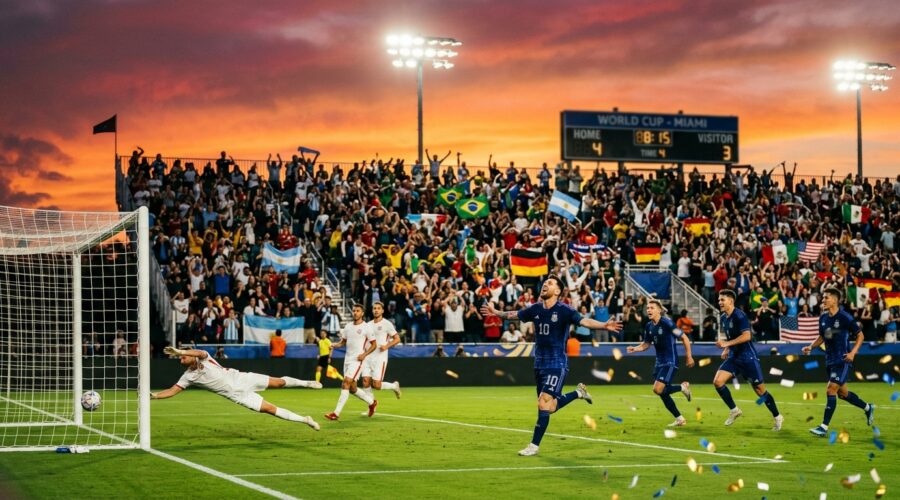
They tell you the third-place match is a funeral with a scoreboard. Two semifinal losers, still raw with disappointment, going through the motions in the Florida heat while the world’s attention drifts to tomorrow’s final. The players don’t want to be there. The managers don’t want to be there. The footballing gods, it is generally assumed, have clocked off for the weekend.
Nobody told England and France.
What unfolded at Hard Rock Stadium in Miami Gardens on July 18, 2026, was not a consolation. It was a riot. A genuinely, historically, statistically monstrous football match that produced ten goals — the most ever scored in a World Cup third-place fixture, surpassing the 6–3 France had themselves put past West Germany back in 1958, and tied for the second-highest-scoring World Cup match since 1982, behind only Hungary’s extraordinary 10–1 dismantling of El Salvador that same year. It was the kind of match that makes you feel slightly foolish for having ever used the word meaningless near a football pitch.
England won it 6–4. Bukayo Saka scored a hat-trick. Kylian Mbappé broke Lionel Messi’s all-time World Cup scoring record. Jude Bellingham wrote himself into England’s history books. And Didier Deschamps walked away from fourteen years in charge of Les Bleus with his head held high and his eyes, by all accounts, rather less dry.
Where do you even begin.
The First Half: Tuchel’s Masterpiece
Thomas Tuchel sent England out in a 4-1-4-1 that looked deceptively modest on paper but proved suffocating in practice. Declan Rice sat deep and dictated, as he has all tournament, but what Tuchel had engineered was something more interesting than a simple defensive screen. The two central midfielders — Morgan Rogers and Eberechi Eze — were given licence to press high and connect the lines, stretching France’s 4-2-3-1 horizontally. Marcus Rashford gave Malo Gusto a torrid evening down the left. And then there was Saka, positioned on the right, who appears to have entered a phase of his career where opposing fullbacks are simply decorative.
Declan Rice needed only three minutes. A goal fashioned from urgency rather than elegance, but one that set the tone with the bluntness of a sledgehammer. France, who had looked fluid and dangerous in their run to the semifinal, could not find their footing. Their midfield two of Adrien Rabiot and Warren Zaïre-Emery were asked to cover vast amounts of grass and found themselves a step behind England’s tempo at every turn.
Ezri Konsa headed the second from a set piece in the 18th minute — the sort of goal that tells you the opposition’s defensive structure is beginning to fracture — and by the time Saka made it three with a composed finish in the 37th, France were not merely losing. They were being systematically dismantled by a team that had clearly come to Miami with something to prove.
Saka’s second, and England’s fourth, arrived in first-half stoppage time. Four goals to nil at the break. Against France. In a World Cup. The audacity of it was almost difficult to process from the stands.
In the technical area, Didier Deschamps had seen enough. He had, to his considerable credit, already decided what needed to happen.
Four Changes and a Warning
Four substitutions at halftime is not a tactical adjustment. It is a statement of intent — or, depending on your sympathies, an admission that the previous forty-five minutes were beyond salvage. Deschamps removed Ibrahima Konaté, Theo Hernandez, Rayan Cherki, and Desire Doue, replacing them with Dayot Upamecano, Lucas Digne, Ousmane Dembélé, and Bradley Barcola. In doing so, he essentially fielded a different team and dared England to start again.
The second half told a different story. Mbappé scored within three minutes of the restart, converting with the unhurried certainty of a man who has been doing this at World Cups since he was a teenager. Barcola added a second for France in the 54th minute, and suddenly the lead had been halved. The mathematics were terrifying: four goals scored in less than a quarter of an hour, a deficit of two, and a France side that had found its legs.
Then came the 66th minute, and the moment the entire tournament had been quietly building towards.
Minute 66: The Record That Rewrites History
Mbappé’s second goal of the match was, in isolation, a fine finish — controlled, precise, the kind of thing he makes look routine to the point of insult. But its significance stretched far beyond the scoreline. It was his 22nd goal in World Cup football, surpassing the record of 21 that Lionel Messi had set across five tournaments and three decades of sustained brilliance.
There is something almost poetically absurd about it happening in a third-place match, in Miami, in a game France were losing. Mbappé does not seem particularly bothered by the theatrical conventions of the occasion. He simply scores when the ball arrives, as if he has never seriously considered the alternative. He finished the tournament with ten goals in a single edition — tied for third in history for a single tournament, alongside Gerd Müller who scored ten for West Germany in 1970, behind only Sándor Kocsis’s eleven in 1954 and Just Fontaine’s thirteen in 1958 — the same Fontaine who scored in the first third-place match to enter the record books. The company Mbappé keeps has always been extraordinary, but even by his own standards, this was something else.
He was asked afterwards about Messi, who faces Argentina’s final against Spain tomorrow with the chance to reclaim the record with a single goal. Mbappé replied with the careful warmth of a man who genuinely respects his rival: “Leo scores all the time. Tomorrow he will score for sure.” Whether that reads as graciousness or mild resignation is left as an exercise for the reader.
Saka, Bellingham, and the Penalty That Mattered More Than the Goal
England were rattled. At 3–4, the French momentum was genuine and the crowd had shifted. This is the moment in matches where character is not merely tested but exposed. And what England produced in those final minutes said something important about this group of players and the culture that Tuchel has built around them.
With eight minutes to go, England won a penalty. Jude Bellingham, the man who had scored seven goals in this tournament — the most by any England player in a single World Cup — picked up the ball. Saka needed one more for his hat-trick. There was no hesitation. Bellingham handed it over without a second’s negotiation.
“Jude was never taking it,” Saka said afterwards with a quiet smile. “He was the first one to say, ‘go and get your hat-trick.’ He was holding the ball for me so no-one else got it.”
It was one of those small moments that football occasionally offers up to remind you that the game at its best is a collective act. Bellingham, who had every right to that penalty, gave it away with the ease of someone who understood exactly what mattered in that moment. Saka converted. Three–five. The hat-trick completed. And Saka became only the second England player in history to score a hat-trick in a World Cup match, after Sir Geoff Hurst in the 1966 final — sixty years between them. The echo was not lost on anyone of a certain vintage.
France pressed desperately for an equaliser and found one when Dembélé — who finished the tournament with six goals and has spent the last month reminding everyone that he is one of the most dangerous forwards in the world — pulled one back in the 90th minute plus six. Four–five. One goal between the teams. The finale had become genuinely alarming.
Bellingham settled it in the 90th plus eight. His seventh goal of the tournament, bundled in with all the composure of a man who has been through enough in football to know exactly how to finish a sentence. Four–six. Done.
The Invisible Architect
Amid the blizzard of individual records, Michael Olise’s contribution to this tournament risks being swallowed by the noise. It should not be. The France midfielder finished the World Cup with seven assists — the second-highest total ever recorded in a single tournament, behind only Raymond Kopa’s eight assists in 1958. Seven. In one World Cup. The company he keeps at the top of that particular list is as rarefied as it gets.
There was a moment in the second half when Olise fashioned a chance that, had it been taken, might have changed the entire complexion of the match. It was not taken. These things happen. But his vision, his capacity to find runners in spaces that other players are still calculating, was the connective tissue of France’s tournament. He deserved a great deal more of the conversation than he received, which is perhaps the peculiar fate of the creator — always at the mercy of the finisher’s glory.
Deschamps: Last Dance
Didier Deschamps managed his final match as France head coach on a humid Saturday evening in Florida, and the manner of it was entirely in keeping with his fourteen years: technically sophisticated, emotionally charged, and ultimately falling just short of the prize he most wanted.
His record as a World Cup manager is, in plain terms, extraordinary. Twenty wins in twenty-seven matches — surpassing Helmut Schön’s previous record of sixteen wins in twenty-five matches, itself the all-time benchmark before Deschamps came along. He won the World Cup in 2018, reached the final in 2022, and leaves in 2026 with third place and a fitting, chaotic send-off that the football world will be talking about for years. He reportedly moved to tears in his final press conference, and it would have taken a harder heart than most to begrudge him that.
His pre-match statement — “The end is near, but life goes on” — had the quiet stoicism of a man who has processed a great deal of football’s cruelty over the years and made his peace with it.
Mbappé’s tribute, delivered with rare eloquence, cut to the heart of it: “People haven’t always known how to appreciate your greatness, but time and history will take care of that.” Which is another way of saying that Deschamps spent much of his tenure winning while simultaneously being undervalued for it — a particular kind of managerial achievement that only the most obstinate critics could continue to resist.
Zinedine Zidane, the bookmakers’ favourite to succeed him, will inherit a France squad that is arguably in the most remarkable creative shape it has been in for a generation. That is Deschamps’ final gift.
England, 1966, and the Weight of Sixty Years
England’s players and fans will rightly feel the ache of not reaching the final — they lost to Argentina in the semifinal, and that wound does not close quickly. But what this squad produced across this tournament, culminating in a ten-goal spectacle in Miami, represents the best World Cup finish for England in sixty years. Third place. Since winning the thing in 1966. That is the span of an entire generation and then some.
Saka said it plainly: “We built across the tournament, we had some amazing results. We fell short against Argentina and it hurts a lot. We have to hold our heads high and move on to the next one.” There was no false comfort in his words. He was simply right. This was a step. A significant, historically resonant one.
Tuchel, for his part, offered the most honest summary of the night’s peculiar emotional texture: “None of our players, and none of the French players, wants to play the third-place match. They want to play the final.” He paused. “We gave everything to achieve it.”
Ten goals in a third-place match. One record broken every quarter of an hour, it seemed. A genius bowing out after fourteen years. An all-time scoring record rewritten in the 66th minute of a bronze medal game. History does not always announce itself at the moments you expect.
One Last Game
Tomorrow evening at MetLife Stadium in New Jersey, Argentina face Spain in the final. Messi, thirty-nine years old and carrying twenty-one World Cup goals, needs just one more to reclaim the record that Mbappé took from him this afternoon. The football world will be watching with the barely-concealed excitement of people who have just watched ten goals go in and have absolutely no reason to expect restraint from what follows.
Whatever happens in that final, the match that preceded it will not be forgotten. Hard Rock Stadium gave us something genuinely rare on Saturday evening: a third-place match that demanded to be taken seriously, and then made good on every single one of its promises.
They tell you these games are meaningless. They are sometimes right. They were not right this time.