On November 9, the NFL quietly announced that it was moving Jacksonville at New York Giants from the 1:00 PM ET opening slot to the 4:25 PM ET CBS national window — America’s Game of the Week. The displaced game was Pittsburgh at Philadelphia, a matchup that, on paper, features a division leader and the defending Super Bowl champion, two of the most historically bankable brands in professional football.
The NFL flexed it out of the marquee slot anyway. That tells you something.
What it tells you, specifically, is that the league’s scheduling office looked at a 7-2 AFC South leader with the best point differential in football facing a 5-3-1 NFC East surprise package led by a first-year head coach who just came off 18 seasons winning in Baltimore, and decided that was the better story. They were right. This is not a close call. Pittsburgh ranks 29th in red zone efficiency and just lost to Cincinnati 38-18. Philadelphia is 2-7 and averaging 16.4 points per game, which is barely better than “having a pulse.” The only reason Steelers-Eagles was originally in the premium slot is because it was scheduled back in May when the NFL still believed the Eagles would defend their Super Bowl title rather than spend November in full organizational evaluation mode.
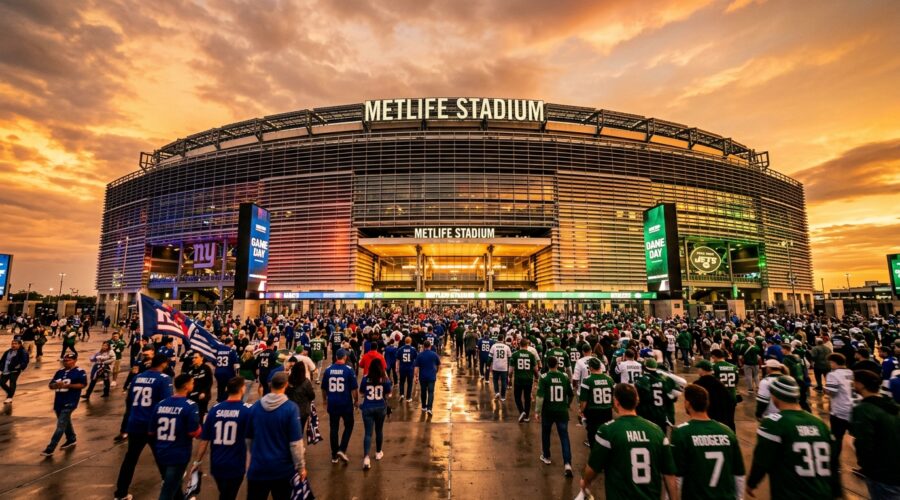
Instead, we get Jacksonville Jaguars at MetLife Stadium, 4:25 PM on CBS, November 22, 2026. Let’s break it down from every angle, because this game has earned it.
The Jacksonville Jaguars Are Built Differently This Year
Start with the number that matters most: plus-125 point differential through ten games. That is 50 points better than the second-ranked 49ers at plus-75. To put that in human terms, Jacksonville has outscored opponents by an average of nearly 14 points per game, and they have done it against a schedule that includes road wins at Baltimore on Sunday Night Football and at Tennessee, plus a neutral-site London thriller that they lost by three to a Houston team that has since collapsed to 4-6 and appears to be doing a voluntary controlled demolition of its season.
Their Simple Rating System score of 11.97 ranks first among all 32 teams, per Pro Football Reference. Their turnover margin is plus-9, also first in the NFL. Their expected win-loss record is 7.3-1.7, meaning even their two losses — at Denver in Week 2 and that London heartbreaker in Week 6 — come with the statistical asterisk that this team probably should not have lost them. Denver is currently 7-2 themselves. The Texans loss was 31-34 against a team that has since fallen apart. When your losses have more context than most teams’ wins, you are doing something right.
Head coach Liam Coen, 40 years old and in his second season, pulled off one of the most remarkable single-year reversals in modern NFL history in 2025: he took a 4-13 roster and turned it into a 13-4 playoff team in his first season at the helm. The 2026 results have been even more emphatic. His philosophy is worth understanding because it explains how Jacksonville operates at a structural level. He calls plays himself — there is no offensive coordinator acting as a buffer — and his core directive to Trevor Lawrence has been to stop playing not to lose. Cut it loose. Play to win.
Lawrence has taken that mandate and run with it in ways that justify the full MVP conversation.
Trevor Lawrence Is Playing the Best Football of His Career
The numbers: 112.8 passer rating, 21 touchdowns, 5 interceptions, 8.7 yards per attempt, 66 percent completion rate. Those are the surface stats, and they are very good. But the more interesting data lives underneath.
Lawrence’s passing points per dropback sits at 0.58, which is the highest figure in the NFL. His average air yards when blitzed is 9.7, also the highest in the NFL. His pressure rate when blitzed is 33.3 percent, the second-lowest in the entire league. These numbers, taken together, describe a quarterback who does not flinch when defenses try to get aggressive with him, who actually throws the ball farther and more effectively when teams send extra rushers, and who converts first downs or touchdowns on more than 41 percent of his blitz-facing snaps.
In Week 10, against Tennessee, he threw for 352 yards and three touchdowns on 10.1 yards per attempt. In that same game, he crossed 20,000 career passing yards, becoming the eighth-youngest quarterback in NFL history to reach that milestone — and he did it on fewer attempts than almost anyone who preceded him at that threshold. He has thrown the fourth-fewest passes ever to reach 20,000 yards, behind Deshaun Watson, Earl Morrall, and Jay Schroeder. Efficiency is the word that keeps coming up with Lawrence in 2026, and it is not an accident. This is a quarterback who has fully grown into the system built around him.
The Week 9 performance at Baltimore deserves its own mention, because it functions as the clearest proof-of-concept game for what this offense is capable of on the biggest stages. The Jaguars went into M&T Bank Stadium on Sunday Night Football and left with a 33-10 win. Lawrence connected with Nate Boerkircher for a 52-yard gain on the opening series. Parker Washington caught a 50-yard touchdown pass to close the first half and extend the lead to 17-3. When a fumble briefly threatened to shift momentum, Jacksonville responded by running the ball down Baltimore’s throat and punching in the final score. It was the kind of game that leaves no ambiguous interpretations.
The Weapons Around Lawrence Are Legitimate
Parker Washington, the former sixth-round pick out of Penn State, has quietly become one of the most efficient per-catch receivers in football. Through ten weeks: 36 receptions, 645 yards, 6 touchdowns, 17.9 yards per reception. He had a career-high 152 yards in Week 10 against Tennessee. At 5-foot-10, he is not the prototype for the position in terms of size, but he has been winning consistently against NFL corners in ways that have forced the league to update its mental model of who he is as a player.
Bhayshul Tuten, the 2025 fourth-round pick, has evolved into a genuine three-down back. His rushing line — 148 carries, 609 yards, 5 rushing touchdowns — is solid but not remarkable. His receiving dimension is what elevates the profile: 18 receptions, 206 yards, 3 receiving touchdowns. Eight total scores. He enters Week 11 with a minor foot and ankle concern but is expected to play, which matters because his ability to run routes out of the backfield creates legitimate conflict for nickel and dime packages that might otherwise focus entirely on Washington and Brian Thomas Jr.
Travis Hunter, the dual-threat 2025 draft sensation, adds a unique layer of defensive game-planning complexity. His presence at receiver forces coaches to account for the possibility that he could appear anywhere on the field — including in the defensive backfield, where he picked off a pass against Houston at Wembley. Nine receptions, 91 yards, one touchdown as a receiver in 2026, but his real value is the schematic headache he creates.
Then there are the two trade-deadline acquisitions making their Jaguars debut in Week 11, having sat out Week 10 to acclimate. Safety Jessie Bates III, acquired from Atlanta, brings 60 tackles, an interception, and 4 pass deflections to a defense that already ranks second in the NFL at 16.0 points allowed per game. Defensive tackle Jordan Davis, acquired by Jacksonville from Philadelphia in a blockbuster November 9 trade, adds 2.5 tackles for loss and 1.5 sacks to an interior that was already functional. Coen’s directive for both players was characteristically direct: know your assignments, be in the right place, and then go cut it loose. Adding NFL-caliber pieces to an already-elite defense is either great resource management or mild overkill, and Jacksonville has earned the right to explore that question.
The Giant In the Room: New York’s Unlikely NFC East Lead
Now for the genuinely surprising side of this matchup.
The New York Giants entered 2026 as +600 longshots to win the NFC East. They were coming off a 4-13 season. They were picking up a new head coach in John Harbaugh, who had just been fired after 18 seasons in Baltimore. Their starting quarterback was Jaxson Dart, an Ole Miss rookie. The Eagles and Cowboys were widely projected as the two clearly superior teams in the division. Everyone treated the Giants as a rebuild project dressed in professional clothing.
They are currently 5-3-1 and leading the NFC East by a full game over Dallas.
The Eagles, the defending Super Bowl champions, are 2-7. They have lost seven consecutive games, the NFL’s longest active losing streak. They average 16.4 points per game, rank 30th in the league in scoring, and their three-and-out rate of 35.7 percent is the worst in football. They are, empirically, the NFL’s worst offense right now. They were also the team that CBS and Fox originally placed into the Week 11 national window as a marquee product. The gap between expectation and reality is so large that it would require its own separate article to fully explore, and frankly that might be the saddest sentence in NFL content right now.
Meanwhile, Harbaugh has quietly reconstructed a contender from scratch. His coaching resume is not easily dismissed: 180 regular-season victories, 13 postseason wins, one Super Bowl ring, the most road playoff wins by any head coach in NFL history. He came to New York specifically because he watched film on Jaxson Dart and was, per Giants GM Joe Schoen, “pleasantly surprised.” When Dart went down with an injury in Week 2 at Los Angeles, Harbaugh pivoted to J.J. McCarthy — the former Michigan national champion who had bounced through the Vikings before landing in New York — and the offense barely flinched because McCarthy’s play style was close enough to Dart’s that offensive coordinator Matt Nagy did not have to rip the playbook apart.
Who Is J.J. McCarthy in 2026, and Why Does It Matter Against Jacksonville?
McCarthy’s five-start stat line: 66 of 104, 63.5 percent completion, 915 yards, 2 touchdowns, 2 interceptions, 90.0 passer rating. His yards per attempt sits at 8.1, which is excellent for a backup turned starter operating under these circumstances. The raw numbers are not spectacular, but the context matters. He has beaten Philadelphia on the road, beaten Washington twice in a division that everyone assumed the Giants would lose, and gone on the road to Houston in overtime to pick up a win that would have looked genuinely improbable in August.
The variable that makes McCarthy genuinely difficult to game-plan against is his legs. He has 15 carries for 85 rushing yards in those five starts, and those numbers undersell his impact because they do not capture the third-and-long scrambles that extend drives at critical moments. The 11-yard scramble on third-and-10 against Philadelphia in Week 8, on the drive that effectively ended the game, was the kind of play that does not appear in a stat box but wins football games. In a matchup where Jacksonville’s secondary will be focused on taking away the deep passing game, McCarthy’s ability to convert chunks with his feet is a genuine and underrated complication.
FTN Fantasy has flagged McCarthy as a “volatile QB2” in Week 11 specifically because Jacksonville allows the fifth-fewest quarterback fantasy points in the NFL at 14.8 per game. That framing is accurate. This is not an offense that is going to carve up the Jaguars through the air with ease, particularly now that Bates and Davis are integrating into a defense that was already operating near the top of the league.
The Giants’ Weapons: Likely, Nabers, and the Backflipping Running Back
Isaiah Likely, the tight end who signed as a free agent to reunite with Harbaugh after three seasons in Baltimore backing up Mark Andrews, has had the kind of breakout year that happens when talent finally gets volume. Through nine games: 55 receptions, 575 yards, 10.5 yards per reception, 7 touchdowns. All three counting stats are career highs. He leads the Giants in touchdown receptions and ranks second on the team in targets, catches, and receiving yards. His 66-yard catch-and-run touchdown against Washington on Thursday Night Football was one of the more spectacular single plays of the NFL season so far. He is currently second among all tight ends in fantasy points per game at 14.3. For a player who spent three years as an expensive depth piece in Baltimore, the production has been genuinely historic.
Malik Nabers, in his second year, has become the volume anchor of this offense. Eighty-five targets, 58 receptions, 692 yards, 11.9 yards per reception, 2 touchdowns. He is not generating the touchdown numbers that would put him in the elite conversation, but his consistent availability and production on a week-to-week basis is what keeps opposing defenses from completely ignoring the perimeter and swarming Likely.
Cam Skattebo functions as Harbaugh’s preferred tool for establishing physicality at the point of attack: 116 carries, 496 yards at 4.3 yards per carry, 4 rushing touchdowns. He returned from injury for the Week 9 Washington game and immediately reclaimed his role as the team’s physical foundation. His back-flip touchdown celebrations have become a MetLife Stadium signature, which is either charming or irritating depending on how you feel about style points in professional football.
The Central Matchup: Lawrence’s Blitz Attack vs. New York’s Deep Coverage Weakness
This is the matchup that will likely decide the game, and the alignment between Jacksonville’s offensive strength and New York’s defensive vulnerability is almost unfairly precise.
The Giants’ pass defense is legitimately good at suppressing volume. They allow fewer than 200 passing yards per game, which puts them in elite company. Their interior defensive line, anchored by DJ Reader and Shelby Harris, presents real problems. Edge rusher Abdul Carter has two sacks and three tackles for loss. Cornerbacks Deonte Banks, Greg Newsome, and Dru Phillips are legitimate starters. On the surface, this looks like a secondary that can slow Lawrence down.
But the deep ball numbers tell a different story. New York allows a 51.7 percent completion rate on passes thrown 10 or more yards downfield, which ranks 22nd in the NFL. Their touchdown rate on deep balls is 9.2 percent, also 22nd. These are the specific numbers that describe a coverage unit that holds up fine in the short-to-intermediate game and has real exposure when quarterbacks challenge it vertically.
Lawrence’s league-high 9.7 average air yards when blitzed means that every time the Giants send an extra rusher, he is looking to throw the ball nearly 10 yards in the air on average — directly at the part of this secondary that has been most vulnerable. His 41.8 percent first-down or touchdown rate against the blitz means those attempts are converting at a rate that should make defensive coordinator Dennard Wilson uncomfortable. If the Giants blitz, Lawrence beats them deep. If they play coverage and give him time, he operates against a secondary that is good but not elite. There is no clean answer to this problem.
Sharp Football Analysis put it plainly: Lawrence’s average air yards when blitzed “creates shot-play opportunities to challenge the area of the field where the Giants have been weakest.” That is an understatement presented in the form of a polite observation.
The Wrinkle Jacksonville Did Not Plan For: Center Is Out
Robert Hainsey, Jacksonville’s starting center, is confirmed out with a knee sprain and is considered week-to-week. Jonah Monheim, a 2024 third-round pick, will start in his place. This is the first meaningful injury caveat attached to an otherwise remarkably healthy Jacksonville roster, and it arrives at an inconvenient time against a Giants front that has been effective at generating interior pressure all season.
BigBlueView’s Chris Pflum noted that the Giants are among the best teams in the NFL at forcing three-and-outs, and that their ability to generate quick pressure becomes particularly relevant here because “Trevor Lawrence has been one of the quarterbacks most affected by pressure in the NFL.” He has been sacked 14 times on the season, an average of 1.6 per game, which is not alarming but is worth tracking against a Giants defensive line that now has an identifiable interior gap to attack.
Liam Coen acknowledged the trench dynamic directly: “This game needs to be, in a lot of ways, won in the trenches.” That is a head coach telegraphing what he already knows — that the story of this game will be written in the interior, not on the perimeter. Walker Little, Ezra Cleveland, Daniel Faalele, and Monheim replacing Hainsey form the offensive line unit that will need to hold up. The fact that Coen is the one calling attention to this, rather than downplaying it, suggests he is spending significant preparation time on a problem he already knows exists.
On the other side of the trench equation, left tackle Andrew Thomas has allowed a sack in each of the Giants’ last three games. That is a one-to-two sack per game trend against an edge pass rush that has been generating pressure all season. If Jacksonville’s edge rushers can keep Andrew Thomas honest, it creates a situation where the interior Hainsey-gap problem becomes a secondary issue rather than the defining one.
The Steelers-Eagles Demotion Is the Actual Punchline
It is worth spending a moment on the displaced game, because understanding why it was replaced illuminates the full extent of the 2026 narrative collapse it represents.
The Pittsburgh Steelers are 6-3 and lost to Cincinnati 38-18 on Sunday Night Football in Week 10. Their offensive EPA per play ranks 20th in the NFL. Their points per game ranks 19th. Their red zone efficiency at 46.2 percent ranks 29th. T.J. Watt is excellent, as T.J. Watt tends to be, but one elite pass rusher cannot mask an offense that ranks in the bottom third of the league by most measures. Pittsburgh’s winning record is real; the resume it was built on is soft. This is a team built to look like a contender in October and reveal itself in January.
The Philadelphia Eagles are the most dramatic collapse of the 2026 season. They were the defending Super Bowl champions. They entered the year with legitimate expectations of a deep postseason run. Through eleven weeks, they have lost seven consecutive games, been outscored by 73 points, and averaged a 35.7 percent three-and-out rate that is the worst in professional football. They are in what the Philadelphia Inquirer has characterized as full “evaluation mode,” which is a polite way of saying that the front office is now trying to figure out what went wrong rather than trying to win games.
The NFL’s flex scheduling procedures state explicitly that the system exists “to promote quality matchups on Sunday nights and give surprise teams a chance to play their way onto primetime.” Moving Jaguars-Giants into the 4:25 ET window is the league’s official written acknowledgment that the narrative hierarchy of the 2026 season has been rewritten. The surprise teams are Jacksonville and New York. The teams that were supposed to matter in November are Pittsburgh and Philadelphia. The flex decision is the institutional admission that the season unfolded in a way nobody saw coming back in May, which is ultimately what makes professional football worth watching in the first place.
Playoff Stakes: Why This Game Has Real Weight
Jacksonville enters Week 11 as the AFC’s third seed at 7-2, trailing the Bills at 8-1 and the Chiefs at 7-2 by tiebreaker. A win over New York keeps them on trajectory for a potential first or second seed in the AFC — and their remaining schedule (at Chicago, home against Pittsburgh, at Houston, at Dallas, home against Washington, home against Indianapolis) is soft enough that they could realistically run the table or close to it. The Bills and Chiefs are not going away, but Jacksonville is in genuine contention for a first-round bye, which matters enormously in a conference where the road to the Super Bowl runs through some historically difficult environments.
For New York, the stakes are equally significant but with a different texture. The Giants are 5-3-1 and have not yet beaten a team currently at or above .500. Week 11 against 7-2 Jacksonville is their first opportunity to do so. Every win on their resume — Dallas, Tennessee, Arizona, Philadelphia, Houston — came against opponents who are now either below .500 or barely at it. That is not an indictment of what the Giants have accomplished; winning consistently against inferior competition is still winning. But the legitimacy question attached to their NFC East lead does not fully go away until they prove they can compete with the best teams in football. A win over Jacksonville answers that question loudly and definitively. A loss to 6-3-1 puts them in a position where Dallas and Washington have a realistic path to running them down in the division.
Their remaining schedule is unforgiving: visits from San Francisco in Week 13, a trip to Seattle in Week 14, and a trip to Detroit in Week 16. If the Giants are going to prove themselves as genuine NFC contenders rather than a soft-schedule mirage, the conversation starts at 4:25 PM on November 22.
The Case For the Giants Pulling the Upset
The expert consensus favors Jacksonville, and that consensus is not wrong. But Harbaugh’s presence alone makes this a game worth watching to the final whistle.
Consider the structural advantages New York carries into Sunday: they are at home at MetLife Stadium, they had extra rest coming off a Thursday night game in Week 10, and their head coach has 196 combined wins and 8 road playoff victories — meaning he has more experience manufacturing victories in hostile environments and high-pressure moments than almost anyone alive. The Hainsey absence creates a genuine interior pressure opportunity, and McCarthy’s legs add a dimension that Jacksonville’s defense cannot simply cover out of existence with pre-snap alignment.
The Giants’ ability to force three-and-outs is real. Their pass defense, despite the deep ball vulnerability, is legitimately strong in the aggregate — sub-200 passing yards per game is a number that most NFL teams cannot manufacture against quality offenses. Isaiah Likely, in particular, presents a matchup problem for a Jacksonville secondary that will need to decide whether to cover him with a linebacker and get beaten over the top or use a safety on him and open up the run lanes for Skattebo.
BigBlueView summed it up with more honesty than most preview takes manage: “I won’t be surprised if John Harbaugh’s team hangs in there and keeps it as a one-score game most of the way. But in the end, until the Giants show me that they can beat a really good team, I can’t pick them to do so.”
That is exactly the right framing. This is not a game where New York is overmatched to the point of irrelevance. This is a game where a 5-3-1 team with legitimate coaching and genuine talent faces the logical ceiling of what it can currently claim to be.
The Bottom Line
The NFL’s flex scheduling decision is, at its core, a statement about which games matter in 2026. And the answer the league gave — Jacksonville over Pittsburgh, Giants over Eagles — is the correct one.
Jacksonville is the best team in professional football by point differential, by SRS, by turnover margin, and by the eye test. Trevor Lawrence is in the middle of the best sustained stretch of his career. Parker Washington has emerged from sixth-round obscurity into one of the most efficient receivers in the sport. The defense, already elite, is about to get better with two quality trade-deadline acquisitions taking the field for the first time. Liam Coen is in the second year of a system that his quarterback now understands by heart, which is a frightening development for every AFC team that has to eventually face this offense in January.
New York is the most compelling surprise story in the NFC, led by a Hall-of-Fame-caliber head coach operating in his first year with an entirely rebuilt roster, a backup quarterback doing more than anyone had a right to expect, and an emerging tight end in Isaiah Likely who is finally getting the opportunity that three years behind Mark Andrews in Baltimore never provided.
The all-time series between these two franchises is tied 4-4, which gives Sunday the kind of clean symmetry that makes for a good television hook. But the actual question being answered at 4:25 PM is not about the historical series. It is about what Jacksonville is, and what New York is capable of becoming.
MetLife Stadium will give us an answer. Bring snacks.