The last time the NHL played an 84-game regular season was 1993-94 — a season that still featured luminaries like Wayne Gretzky, who would not retire until April 1999. More than three decades later, the league is not just adding two games to the calendar — it is engineering a season so dense with marquee moments that it reads less like a schedule and more like a highlight reel written in advance.
The 2026-27 NHL season, born out of a newly ratified four-year Collective Bargaining Agreement between the NHL and NHLPA, runs from September 29, 2026 through April 10, 2027. Across its 1,344 total games, three events stand out not simply as spectacles, but as genuine inflection points for the sport — a Heritage Classic that returns to the frozen heart of Canadian hockey culture, a Winter Classic that completes a 32-franchise odyssey in one of the most visually stunning settings the game has ever seen, and an All-Star Game format so radically reimagined it might actually make you care about the All-Star Game again.
Here is everything you need to know about the moments that will define this season.
The Season Itself Is the Story
Before diving into the marquee events, it is worth appreciating the canvas on which they are painted. The 84-game regular season is not a trivial footnote. It is a structural overhaul driven by competitive fairness — multiple franchises had long complained that the 82-game format produced an imbalanced number of divisional matchups depending on the year. Under the new schedule, every team now plays two home and two road games against each of its seven division rivals, a clean symmetry that eliminates the luck of the draw.
The season opens with an ESPN Tripleheader on September 29, headlined by the Stanley Cup champion Carolina Hurricanes raising their banner against the Florida Panthers. There is also a Sportsnet doubleheader in Canada featuring the Toronto Maple Leafs against the Montreal Canadiens — a game that could mark the NHL debut of Gavin McKenna, the consensus top overall pick and the most anticipated young talent to enter the league in years. And if you think the schedule cools down after that, consider: the NHL Frozen Frenzy on October 13 puts all 32 teams in action simultaneously, NHL Global Series stops visit Helsinki and Düsseldorf, and the Hockey Hall of Fame welcomes Patrice Bergeron, Carey Price, and Pekka Rinne in November. The 84 games are just the container. What is inside them is extraordinary.
Heritage Classic: Winnipeg Reclaims the Outdoor Throne
On Sunday, October 25, 2026, the Winnipeg Jets host the Montreal Canadiens at Princess Auto Stadium — a CFL cathedral that has already proven it knows how to host hockey’s grandest traditions. The 2026 Tim Hortons NHL Heritage Classic, the eighth edition of the series and the 46th NHL outdoor regular-season game overall, kicks off at 6:00 PM MT / 8:00 PM ET on TNT. And while outdoor games have become a reliably beloved part of the NHL calendar, this one carries a weight that most do not.
Let us start with the history. The Heritage Classic was the original. On November 22, 2003, more than 57,000 fans packed Commonwealth Stadium in Edmonton to watch the Montreal Canadiens defeat the Oilers 4-3 in what was, at the time, a one-of-a-kind experiment: an NHL regular-season game played outside. The Winter Classic would not arrive for another five years. The Heritage Classic did not just inspire the outdoor game movement — it invented it.
Winnipeg hosted the Heritage Classic once before, in 2016, when the Jets fell 3-0 to the Edmonton Oilers at what is now Princess Auto Stadium. The Canadiens, meanwhile, have a deep, almost mythological relationship with this event. They won the first one. They have now participated in three Heritage Classics in total — 2003, 2016, and this upcoming edition in Winnipeg — making Montreal one of the most recurring presences in the series’ history. Bringing them back to Winnipeg to face a Jets franchise that has emerged as one of the league’s most competitive teams makes for a matchup with legitimate emotional and on-ice stakes.
The Heritage Classic’s defining character is its unapologetic Canadianness. It is always played at a CFL stadium — those community cathedrals of the prairies — and it always features Canadian franchises. No American teams. No neutral-site gimmicks. Just Canadian hockey, played outside, in October, the way generations of Canadians have always imagined the sport should feel. Tim Hortons returns as title sponsor for the seventh time under a new multiyear NHL deal, maintaining its status as the Official Coffee and Coffee Based Beverages, Tea, Hot Chocolate, Breakfast and Baked Goods partner of the NHL in Canada, with a national marketing presence across league touchpoints throughout the country. The branding fits the event almost too perfectly.
Steve Mayer, the NHL’s President of Content and Events, put it plainly after the announcement: “When Winnipeg hosted the Heritage Classic in 2016, we were blown away by the amazing fan response and how great the venue was. Given the success the Jets have had since we were last there, it’s fitting to bring another outdoor spectacle to Winnipeg. We guarantee the event will feel completely different this time.”
A promise backed by a Jets team that, unlike 2016, arrives as a legitimate contender. The stakes are real. The setting is proven. The history is unmatched.
Winter Classic: The Last Franchise, the Most Poetic Venue
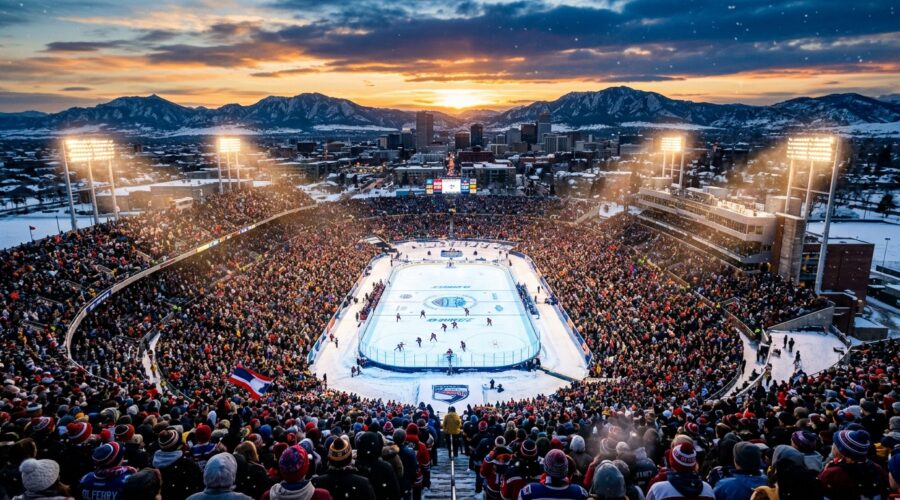
There is something almost narrative about the 2027 Discover NHL Winter Classic. On December 31, 2026 — New Year’s Eve, not the traditional January 1 — the Utah Mammoth host the Colorado Avalanche at Rice-Eccles Stadium in Salt Lake City, Utah. The game tips off at 4:00 PM MT / 6:00 PM ET on TNT. It is the 18th Winter Classic and the 47th NHL outdoor regular-season game overall.
But the number that matters most is 32.
The Utah Mammoth, who entered the NHL as an expansion franchise for the 2024-25 season, will become the last of the NHL’s 32 franchises to play in an outdoor game when they take the ice on December 31. Commissioner Gary Bettman announced the Winter Classic on April 25, 2026, during Utah’s first-round playoff series against the Vegas Golden Knights — a dramatic, almost storybook timing that underlined just how quickly this franchise had embedded itself in the fabric of the league. The Mammoth reached the playoffs in just their second full season. Now, in their third, they host the Winter Classic.
The venue is where the poetic dimension becomes undeniable. Rice-Eccles Stadium, home of the Utah Utes on the University of Utah campus, was the site of the Opening and Closing Ceremonies of the 2002 Winter Olympics. Twenty-five years after the world gathered at that stadium to celebrate winter sport, NHL hockey returns to it. The natural mountain backdrop provides a visual setting unlike anything the Winter Classic has offered before — not the intimacy of Fenway Park, not the industrial grandeur of a football stadium in the Midwest, but the Rocky Mountain West in all its December splendor.
Utah Mammoth owner Ryan Smith, whose tech entrepreneurship and relentless enthusiasm have made him one of the most visible owners in American sports, has framed the Winter Classic weekend as something far larger than a single hockey game. “Our hope is this is a whole weekend that is a version of an All-Star game where we can come in and we can program and activate our state and show our state off,” Smith said. “You can expect a weekend of full programming of events, sports, concerts, and activities that will be pretty special.” A postgame New Year’s Eve concert at the Delta Center is already planned, with events spreading across Salt Lake City throughout the weekend.
Colorado brings the star power. Nathan MacKinnon and Cale Makar headline a franchise that, despite being one of the NHL’s most celebrated brands, had somehow never appeared in a Winter Classic before this announcement. Their last outdoor game was the NHL Outdoors at Lake Tahoe in February 2021. They are Pacific Division rivals with Utah, geographically neighboring teams whose nascent rivalry is now framed by one of the most anticipated outdoor games in recent memory.
The Vegas Golden Knights, meanwhile, will face the Dallas Stars in the Stadium Series — their most recent outdoor appearance being the 2024 Winter Classic on January 1, 2024, a 3-0 loss to the Seattle Kraken at T-Mobile Park in Seattle.
The shift to New Year’s Eve is deliberate and smart. Rather than sharing the cultural bandwidth of January 1 with college football and the general noise of New Year’s Day, the NHL plants its flag on December 31 and owns the holiday entirely. Utah gets a full programming window. The league gets a moment without competition. Everyone wins.
All-Star Weekend: A Revolution on Long Island
The 2027 Honda NHL All-Star Weekend arrives at UBS Arena in Elmont, New York — home of the New York Islanders on Long Island — on February 5 and 6, 2027. It was originally awarded for 2026, but a scheduling conflict with the 2026 Milan Cortina Winter Olympics pushed it back one year. The All-Star Game itself has now been absent for two consecutive seasons: skipped in 2025 for the 4 Nations Face-Off, and skipped in 2026 for Olympic participation. The return, then, carries the pressure of justification — and the NHL has answered that pressure with a format that is genuinely unprecedented.
The All-Star Game will feature five teams competing in a 3-on-3 round-robin international tournament. Team Canada, Team USA, Team Sweden, Team Finland, and Team World — representing all other nations — each carry rosters of 11 players (9 skaters, 2 goaltenders). Each team plays four five-minute round-robin games, with standings determined by wins and ties. The top two teams advance to a 10-minute championship final. The winning team splits $2 million USD.
The projected rosters are a who’s-who of the sport’s greatest talent. Team Canada alone could theoretically field Connor McDavid, Sidney Crosby, Nathan MacKinnon, Connor Bedard, Cale Makar, and Macklin Celebrini on the same bench. Team USA counters with Quinn Hughes, Jack Hughes, and Connor Hellebuyck. Team Finland brings Sebastian Aho and Aleksander Barkov. Team World — which represents international players not from Canada, Finland, Sweden, or the United States, and notably includes Russian players eligible despite ongoing IIHF bans — could showcase Nikita Kucherov, Alex Ovechkin, and other global stars such as German forward Leon Draisaitl (competing under his German nationality) and Czech sniper David Pastrnak, though those two would represent their respective nations in other international contexts rather than appearing on Team World.
This is not a traditional All-Star Game where players coast through meaningless shifts without breaking a sweat. The international structure, the prize money, and the round-robin format create something that at least approximates real competition. It is the All-Star Game as it should have been designed years ago.
The roster selection process blends fan input with league oversight in a sensible way. The NHL and NHLPA nominate 30 players per team. Fans vote for 8 per team during a December 2026 vote. The NHL and NHLPA then jointly select the final 3 spots — one forward, one defenseman, one goaltender — per team. The players, for the most part, will be there because they deserve to be.
The Skills Competition on February 5 is equally reimagined. Ten players — all aged 25 or under, jointly selected by the NHL and NHLPA — compete across eight events: Fastest Skater, Hardest Shot, Passing Challenge, One Timers, Stick Handling, Accuracy Shooting, Shootout, and an Obstacle Course Finale. Each skater competes in four of the first six events. The top four advance to a Shootout against one of four All-Star goaltenders. The top two from the Shootout face off in the Obstacle Course Finale. The Skills champion earns $1 million.
NHLPA Executive Director Marty Walsh framed the All-Star Weekend’s strategic purpose with unusual clarity: “Four Nations was a kind of prelude into the Olympics. This All-Star Weekend can be a prelude to the World Cup of Hockey in the following year.” The 2028 World Cup of Hockey, to be hosted across Calgary, Edmonton, and Prague, looms on the horizon. The 2027 All-Star Game is not a standalone event — it is a chapter in a longer story of international hockey’s resurgence.
Commissioner Bettman, for his part, sounded like a man who knows exactly what he has: “We’re extremely excited to bring this event to New York. We think the format we’ve created will be fun. It’ll be entertaining. It’ll be great for the players and the fans.”
The Rest of the Season Deserves Its Own Headline
In almost any other year, the 2027 Navy Federal Credit Union NHL Stadium Series — the Vegas Golden Knights visiting the Dallas Stars at AT&T Stadium (Jerry World) in Arlington, Texas, on February 20, 2027 — would dominate the outdoor hockey conversation. AT&T Stadium’s capacity exceeds 80,000, which could produce one of the largest crowds in outdoor hockey history. It is only the second outdoor NHL game ever played in Texas. It is, in any reasonable sense of the phrase, a massive deal.
Similarly, the NHL Global Series this season brings real stakes to European ice. The Stanley Cup champion Carolina Hurricanes carry their championship banner to Helsinki in November for a two-game series against the Seattle Kraken. The Chicago Blackhawks and Ottawa Senators follow with two games in Düsseldorf, Germany — only the second and third NHL regular-season games ever played in that country.
The Hockey Hall of Fame Induction Weekend in Toronto (November 7-9) ushers in a class of genuine legends: Patrice Bergeron, Brian Burke, Cindy Curley, Carey Price, Pekka Rinne, and Keith Tkachuk. It is a class worthy of the game’s cathedral.
What This Season Means
The 2026-27 NHL season is a statement. It is the league declaring, with 84 games and more marquee events than any schedule in recent memory, that it is no longer content to be the fourth sport in American markets or an afterthought in the broader sports media landscape. The Heritage Classic connects the sport to its Canadian roots. The Winter Classic plants a flag in a brand-new hockey state. The All-Star Weekend tries, for what feels like the first time in earnest, to be genuinely entertaining.
Three decades ago, the last 84-game season felt like a quirk of labor and logistics. This one feels like ambition. The NHL is building toward something — a 2028 World Cup of Hockey, a generation of star players that rivals any in the sport’s history, and a global audience that is, slowly but unmistakably, paying closer attention.
This season is the runway. Buckle up.