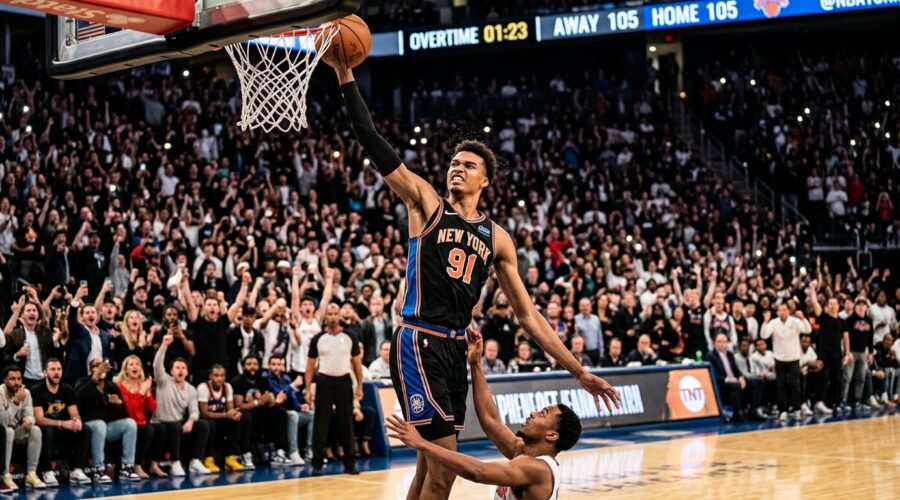
Shai Gilgeous-Alexander had just accepted his second consecutive NBA MVP trophy. The ceremony was still warm in the memory of everyone inside Paycom Center when tip-off arrived for Game 1 of the 2026 Western Conference Finals. For Oklahoma City, the night was supposed to be a coronation — a defending champion flexing its dominance, a 64-win machine rolling past another obstacle on the road to back-to-back titles. Instead, what unfolded over 49 suffocating, double-overtime minutes was something else entirely: the arrival of a player who may never be fully understood until long after we’ve stopped watching him play.
Victor Wembanyama finished the night with 41 points, 24 rebounds, 3 blocks, and 3 assists. The San Antonio Spurs walked out of Oklahoma City with a 122-115 victory and a 1-0 series lead. And basketball quietly crossed a threshold it may not return from.
What Wembanyama Did — and Why It Matters
Numbers this staggering demand context, so here it is: Wembanyama became the youngest player in NBA history — at just 22 years and 134 days old — to post a 40-point, 20-rebound game in the postseason. He surpassed Kareem Abdul-Jabbar to claim that record. He also became just the seventh player in league history to record a 40/20 in a Conference Finals game or later, joining a list that reads like a scripture: Wilt Chamberlain, Bill Russell, Elgin Baylor, Bob Pettit, Kareem Abdul-Jabbar, and Charles Barkley.
Read that list again. There is no modern player on it. Not LeBron. Not Durant. Not Shaq. Not Giannis. Not Jokic. Victor Wembanyama, at 22, in his first Western Conference Finals, belongs to a group of men whose careers ended before most current NBA fans were born.
He did it in double overtime, logged 49 minutes, shot 12-of-13 from the free-throw line, and posted a plus-16 for the night. When Chet Holmgren blocked his would-be game-winner in regulation — a block that was itself a remarkable defensive feat — Wembanyama simply responded in overtime. That detail alone tells you something about the kind of player we are dealing with. The game kept asking him a question, and he kept finding a new answer.
The Spurs also outrebounded the Thunder 61-to-40. Oklahoma City entered this series as the NBA’s top defensive team by rating (107.7). They were swept into a historic rebounding deficit by a 7-foot-4 Frenchman who, it increasingly seems, did not come here to be stopped.
The MVP Trophy and the Quiet Response
Before tip-off, the NBA presented Shai Gilgeous-Alexander with his second consecutive MVP award, making him the 14th player in league history to win back-to-back honors. It was a genuine and deserved moment — SGA averaged 31.1 points, 6.6 assists, and 4.3 rebounds per game this season on a staggering 55.3 percent from the field. He set an NBA record with 140 consecutive games scoring 20 or more points. He became only the third player in league history, alongside Michael Jordan and Wilt Chamberlain, to average 30-plus points on 50-plus percent shooting for four straight seasons.
When Wembanyama was asked afterward whether he had watched SGA receive the trophy, he gave a one-sentence answer: “Yeah, for sure.”
Those three words landed differently in the context of what he had just done on the floor. Some rivalries are declared. Others are demonstrated. This one is being demonstrated in real time.
SGA, for his part, was honest. He shot 7-of-23 from the field for 24 points, and while his 12 assists kept him influential, it was far below the standard he has set for himself and the standard Oklahoma City needs. His postgame comment left no ambiguity: “I had to be better.” He is right. He will be. But the fact that the Thunder, even without their MVP at his best, were still in a double-overtime game speaks to how deeply this franchise has been constructed — and how formidable the challenge ahead is for San Antonio.
The Supporting Cast and Its Contradictions
Jalen Williams returned from a Grade 1 hamstring strain that had kept him out for 25 days and six consecutive playoff games. In that time, Ajay Mitchell had stepped in and averaged 20.4 points, 4.8 rebounds, and 5.8 assists across nine starts, emerging as one of the postseason’s more quietly compelling stories. Williams’ return was supposed to restore the Thunder’s full arsenal. Instead, he went 11-of-25 for 26 points in 37 minutes, ending the night with a minus-3, and the Thunder still lost by seven in regulation before forcing overtime.
The wild card was Alex Caruso. Oklahoma City’s bench reserve scored 31 points — the second-highest scoring output of his career — and nearly single-handedly kept the Thunder alive in the fourth quarter and first overtime. It was a heroic performance, but it was also a warning sign wrapped in a highlight reel: when your comeback is being powered by a 31-year-old bench player rather than your two-time MVP and reigning Finals MVP, the mathematics of sustainability are not on your side.
Meanwhile, San Antonio got 24 points and a franchise-record seven steals from Dylan Harper, a 19-year-old rookie in his first Western Conference Finals. Stephon Castle, 20 years old and the reigning Rookie of the Year, has been averaging 19.9 points and 6.1 assists through the playoffs on 49 percent shooting. This team is doing something unusual: it is young and it is battle-tested, having gone 7-3 through two rounds against Portland and a stubborn Minnesota team that pushed them to six games.
Oklahoma City arrived here having swept eight opponents in a row, averaging roughly 14 points of victory margin in the first two rounds. The Spurs snapped that streak. They also ended a nine-game Thunder postseason winning streak in the process.
The Elephant in the Room: De’Aaron Fox
The most significant variable in this series did not play in Game 1. De’Aaron Fox, San Antonio’s veteran point guard and the most experienced playoff performer on their roster, sat out with right ankle soreness and is listed as day-to-day. In the Minnesota series, Fox averaged 18.8 points and 5.8 assists. He is, in many ways, the connective tissue between Wembanyama’s dominance and the rest of the offense — the player who commands defensive attention off the ball so that Wembanyama does not have to create everything himself.
The Spurs won Game 1 without him. That is remarkable. It is also not necessarily repeatable at this level over a full series. His return — or continued absence — may be the single most consequential factor in whether this series ends in five, six, or seven games.
Luke Kornet, San Antonio’s backup center, is also dealing with left foot soreness, which adds another layer of concern around the team’s frontcourt depth if Wembanyama runs into foul trouble or needs a genuine rest.
History, Stakes, and the Larger Picture
The Oklahoma City Thunder won the 2025 NBA championship. They finished 2025-26 with the league’s best record at 64-18, the league’s best net rating, the league’s best defensive rating, and the league’s best turnover differential. They had the back-to-back MVP in Gilgeous-Alexander, a reigning Finals MVP in Williams, and a DPOY runner-up in Holmgren. They entered this series as 71 percent favorites on prediction markets to reach the Finals.
No team has won back-to-back NBA championships since the Golden State Warriors in 2017 and 2018. Oklahoma City, with all of its construction and discipline, had positioned itself to do something the entire league has failed to accomplish for the better part of a decade.
And then a 22-year-old from Le Chesnay, France, put up 41 and 24 in their building.
The series shifts to San Antonio for Games 3 and 4, where the Spurs are 89-34 in postseason play since 2002-03 — the second-best home playoff record in the NBA over that span, behind only the Boston Celtics. The crowd at Frost Bank Center will not be incidental.
A Rivalry Being Written in Real Time
Some observers have reached for the Magic versus Bird comparison to describe what is developing between Wembanyama and Gilgeous-Alexander. It is an ambitious analogy, but it is not entirely without foundation. Both are 22 and 27 respectively. Both play in the same conference. Both are generational in their respective skills — SGA the most precise scoring guard of his era, Wembanyama a defensive and offensive phenomenon with no obvious historical comparison. And both have now been placed, by circumstance and timing, directly in each other’s path with something real at stake.
Magic and Bird needed years and multiple Finals matchups to become the defining rivalry of an era. This one is two games old.
What Game 1 established is not a prediction — it is a premise. The Thunder are not broken. SGA will be better. Holmgren will be better. Williams will get his legs under him. Oklahoma City has won eight consecutive playoff games and has been the NBA’s best team for two consecutive seasons. They are not a team that wilts under pressure; they are, by every measure, a team built to create it in others.
But a premise has been established: San Antonio can win this series. Not as an upset. Not as a fluke. As a team that went 4-1 against Oklahoma City in the regular season, that has a player who is capable of doing things that have not been done since the sport looked entirely different, and that has already proved it can win on the road in a hostile building on the biggest night of its young players’ careers.
Game 1 is over. The Spurs lead 1-0. Victor Wembanyama is 22 years old. And the Western Conference Finals has just become the most compelling series in the NBA.
The rest is still being written.