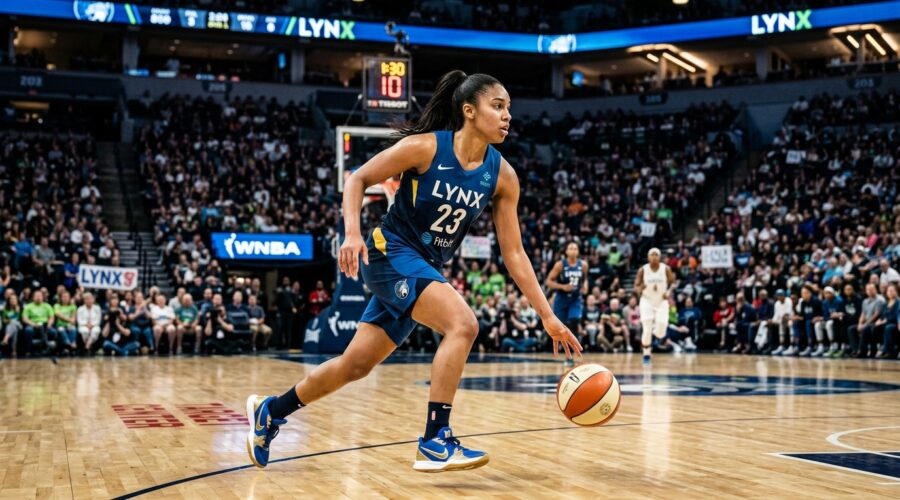
Three games into her professional career, Olivia Miles is not playing like a rookie. She is playing like a point guard who has been studying for this moment her entire life — because, in every meaningful sense, she has been.
The Minnesota Lynx’s #2 overall pick is averaging 16.3 points, 7.0 assists, and 3.7 rebounds per game through her first three WNBA contests while shooting 50.0% from the field and a pristine 92.3% from the free-throw line. Her plus/minus sits at +14. She is currently ranked 4th in the entire WNBA in assists — ahead of every rookie in the league and behind only three of the most seasoned playmakers in the game: Alyssa Thomas, Caitlin Clark, and Veronica Burton.
She is 23 years old. She has played 92 minutes of professional basketball.
The betting markets have already moved. BetMGM opened Miles at +260 preseason — actually worse than #1 overall pick Azzi Fudd’s +250 — and has since installed her as the outright favorite at -105. Polymarket prediction markets give her a 77% implied win probability. And 73% of WNBA general managers picked her to win the 2026 Kia Rookie of the Year award before the season even began. The GM survey, the odds, and the stat sheet are all saying the same thing: the race may already be over, and it has barely started.
But numbers only tell part of the story. To understand why Miles’ start to her WNBA career feels different — genuinely historic, not just impressive — you have to understand the road she took to get here.
The Wave That Almost Stopped Her
On February 26, 2023, Olivia Miles tore her ACL against Louisville. She was a 20-year-old sophomore at Notre Dame, widely regarded as one of the most gifted playmakers in college basketball, and she was averaging 14.3 points, 7.3 rebounds, and 6.9 assists per game. The injury did not just end her season. It erased her next one entirely.
Eighteen months of rehabilitation. An entire NCAA season of watching from the sideline. Miles described the experience with striking honesty: “This injury is like a wave. I always compare it to that, because one day you’re going to feel great and the next day you’re going to come in sore and not being able to move. I’m trying to stay balanced… I feel better than I’ve ever felt.”
When she returned for her senior season at Notre Dame in 2024-25, she was good — 15.4 points, 5.6 rebounds, and 5.8 assists — and was once again projected as a top-two WNBA Draft pick. Then she made the decision that would define her legacy before it even began.
On March 31, 2025, instead of entering the WNBA Draft, Miles transferred to TCU.
It was a move that required patience, confidence, and a clear-eyed understanding of what she still needed to prove — primarily to herself. At TCU in 2025-26, she became something else entirely. She averaged 19.6 points, 7.2 rebounds, and 6.6 assists per game across 38 contests, earned Big 12 Player of the Year honors, made the All-American team for the third time, and helped guide the Horned Frogs to back-to-back Elite Eight appearances. Her assist rate of 35.8% — meaning she assisted on more than a third of every teammate field goal while she was on the court — ranked in the 99th percentile nationally per Her Hoop Stats. She was not just healthy. She was the best version of herself she had ever been.
When the Minnesota Lynx called her name with the second overall pick on April 13, 2026, it was not a consolation for what she had been through. It was confirmation of what she had become.
A Historic Start Hidden Inside a Loss
Miles’ WNBA debut on May 9, 2026 ended in a 91-90 loss to the Atlanta Dream — a painful one-point defeat that masked just how extraordinary her performance had been. She finished with 21 points, eight assists, three rebounds, two steals, and two blocks in 34 minutes, going 6-of-14 from the field and a perfect 8-for-8 from the free-throw line.
The historical footnote buried inside those numbers is staggering: Miles became only the second player in WNBA history to post 20-plus points, eight-plus assists, and 55-plus percent true shooting in a professional debut. The first was Candace Parker in 2008, who set the all-time WNBA debut scoring record with 34 points and went on to win both Rookie of the Year and MVP in the same season — a feat no one has matched since.
Teammate Courtney Williams, a veteran guard who has seen enough professional basketball to know what she was watching, put it plainly after the game: “I mean she a little killer, aye man, I said ‘look let me move out your way.'”
Game Two: Winning When It Counted Most
If Game 1 announced Miles’ arrival, Game 2 on May 12 at Phoenix made the statement that separates genuinely elite players from merely impressive ones. Playing just 26 minutes — truncated by foul trouble that forced her to the bench with her fourth foul in the third quarter — Miles still led the Lynx in assists with seven, added 13 points on 50% shooting, and delivered the game-winning play.
With 25.6 seconds remaining and Minnesota trailing by one, Miles drove into the lane, drew the defense, and found Nia Coffey spotting up in the corner for a go-ahead three. The Lynx won 88-84. Miles had made the defining play of the game in 26 minutes, hampered by foul trouble, on the road.
Head Coach Cheryl Reeve was unimpressed by the idea that 13 points in limited minutes was somehow a step back: “Thirteen, seven and six — if she’s obviously not in foul trouble, it’s probably a little bit better. She’s a handful. You got to figure out what you’re going to do with her.”
The Company She Keeps
After Game 3 — a 90-86 win at Dallas where Miles logged 15 points on 58.3% shooting and six assists — ESPN’s analytics team surfaced a comparison that reframes the entire conversation about her start.
Miles became only the third player in WNBA history to record 10-plus points and five-plus assists in each of her first three career games. The other two players on that list are Sue Bird and Candace Parker.
Let that sit for a moment. Sue Bird, who won four WNBA championships and is widely considered the greatest point guard in the history of the sport. Candace Parker, who won the only combined MVP-Rookie of the Year season in league history and is a Hall of Famer in every sense of the word. These are not just good basketball players. They are two of the most decorated athletes the WNBA has ever produced.
Miles also became the first rookie in WNBA history to post 45-plus points and 20-plus assists across her first three professional games — a statistical standard that no one, across the entire span of the league’s existence, had ever achieved.
Why the GM Survey Matters More Than You Think
The annual WNBA GM survey is easy to dismiss as an informal popularity contest. It is anything but. These are the executives who scout, draft, build, and dismantle rosters for a living. They watch more film on these players than almost anyone alive. When 73% of them agreed — before a single regular-season game had been played — that Olivia Miles would win Rookie of the Year, they were not making an emotional bet. They were making an informed professional assessment.
That 73% figure is all the more striking when you consider who it was stacked against. Azzi Fudd, the #1 overall pick out of UConn, commanded 20% of the vote. Fudd is a generational scorer with a national profile. She had just won a national championship and was going to play alongside Paige Bueckers in Dallas, one of the most marketable backcourts in the sport. And she got 20% of the vote.
The GMs were not being contrarian. They were recognizing something that the statistics have since confirmed: Miles does not just score, she organizes. Her ability to make teammates better — that 35.8% assist rate, that 1.28 assist-to-usage ratio, the vision that Napheesa Collier described as something you simply cannot teach — is the kind of quality that general managers who build winning teams understand on an almost cellular level.
As High Post Hoops summarized the survey results: “Passing leads to scoring which leads to winning.”
The Fudd Problem — and Why the Competition Is Already Fading
To her credit, Azzi Fudd is exactly the player the Dallas Wings believed they were drafting: a gifted, relentless scorer with a clean stroke and a fierce competitive spirit. None of that has changed. What has changed is the context. Fudd is averaging just 5.5 points in 18.5 minutes per game, coming off the bench in a backcourt already occupied by Paige Bueckers (25.3 PPG) and Arike Ogunbowale. She was the first #1 overall pick to debut off the bench since Kelsey Plum in 2017.
This is not a knock on Fudd’s talent. It is simply the reality of her situation. The Rookie of the Year award rewards accumulation — minutes, games, statistics, impact — and Fudd is not getting the minutes or usage to accumulate at a pace that competes with Miles. Her odds have cratered from +250 preseason to +500 as of May 15, 2026. Unless her role changes dramatically in Dallas, she is running out of road.
Flau’jae Johnson of the Seattle Storm, the #8 pick who GM voters gave just 7%, is averaging 11.7 points but shooting a troubling 27.6% from the field with just 1.7 assists per game. The tools are there, but the gap between Johnson’s current numbers and Miles’ current numbers is vast.
The Whalen Standard — and Why It Actually Means Something
When Cheryl Reeve calls Miles “the first real point guard we’ve had since Lindsay Whalen,” she is making the highest possible compliment in the specific dialect of Minnesota Lynx basketball. Whalen won four WNBA championships running Reeve’s motion offense. She was the engine of a dynasty. She is now a point guard coach on Reeve’s staff — and she has reportedly told Reeve that Miles is a better point guard than she was.
That is a former champion, coaching her position, watching a rookie operate in the same system she once ran — and conceding that the rookie is doing it better. If there is a more compelling endorsement available in women’s basketball, it is difficult to imagine what it would look like.
Miles, for her part, responded with the kind of competitive reverence that suggests she understands exactly what standard she is being held to: “I literally was looking up ‘Lindsay Whalen highlights’ the other night to see what kind of dimes you were throwing. Refresh my memory.”
The Collier Factor: A Risk That Might Actually Help Her
The elephant in any analysis of Miles’ early performances is the absence of Napheesa Collier, the Lynx’s star forward who has been sidelined by back-to-back ankle surgeries and is not expected to return until early June. Miles has been operating as the unquestioned offensive initiator of the Minnesota offense since her very first professional game — a level of responsibility and usage that most rookies do not earn until their second or third season, if ever.
The counterintuitive point worth making: this may ultimately help her Rookie of the Year case more than it hurts it. Every statistic Miles has produced, she has produced without the team’s best player. When Collier returns, the Lynx should win more games — and Miles will have already established herself as a league-wide force. The best point guards in WNBA history have consistently elevated when elite finishers play alongside them, not the reverse. Miles having Collier back should not diminish her impact. It should amplify it.
Collier herself has already offered her assessment, watching from the sideline: “She has something you can’t teach, which is, just the vision to see something before it’s about to happen. She knows where people are about to be, before they’re there. And that’s something, like I said, you have to be born with that. And she is.”
The Legitimate Risks Worth Watching
An honest assessment of Miles’ Rookie of the Year candidacy cannot ignore the areas where she has struggled early. Her three-point shooting is genuinely concerning at 20.0% through three games — well below her 35.1% at TCU and her 33.1% career college average. Defenders who are not afraid of her pull-up from deep will have an easier time keying in on her drives, and if that weakness persists into the summer, it could limit the ceilings of some of her shot-creation sets.
Her turnover rate of 2.7 per game also bears watching. The 3.0-to-1 assist-to-turnover ratio is reasonable at this volume, but WNBA defenses will continue to probe her decision-making under pressure, and the best teams in the league will design schemes specifically to force those mistakes.
These are real concerns. They are also concerns that have existed for great point guards at every level of their development. The question is not whether Miles is perfect — she is not. The question is whether anyone else in the 2026 rookie class is equipped to challenge her over a full season. As of right now, the answer is almost certainly no.
More Than Basketball
It would be incomplete to write about Olivia Miles without acknowledging who she is beyond the stat sheet. She graduated from the University of Notre Dame with a degree in political science in 2024. She won the Kay Yow Scholar Athlete of the Year award in 2025. She signed with Unrivaled as part of the league’s “Future is Unrivaled Class of 2025,” establishing herself as one of the marquee commercial faces of the next generation of women’s basketball before she ever played a professional game.
She is exactly the kind of player — articulate, educated, visibly invested in the sport’s growth, and capable of backing it all up on the court — that the WNBA’s expanding audience has been hoping to find. The league is in the middle of a commercial and cultural moment unlike anything it has experienced before, and Miles is arriving precisely when the stage is largest.
The Verdict
Three games is a small sample. Seventy-three percent of general managers, betting markets sitting near even money, historically elite company in a list that includes Sue Bird and Candace Parker, and a single go-ahead game-winning assist delivered in 26 minutes on the road — none of that is conclusive. The WNBA season is long. Injuries happen. Adjustments get made. Roles shift.
But here is what is already true: Olivia Miles arrived at the professional level and immediately played at a standard that, statistically, almost no one in the history of the sport has matched. She did it coming off an ACL tear that cost her an entire season. She did it without the team’s best player. She did it in a system built for the kind of generational passing intelligence that Lindsay Whalen spent a decade perfecting — and by the assessment of Whalen herself, Miles is already doing it better.
The 2026 WNBA Rookie of the Year race is not over. But Olivia Miles is already making it look that way — and the wave, for once, is fully at her back.