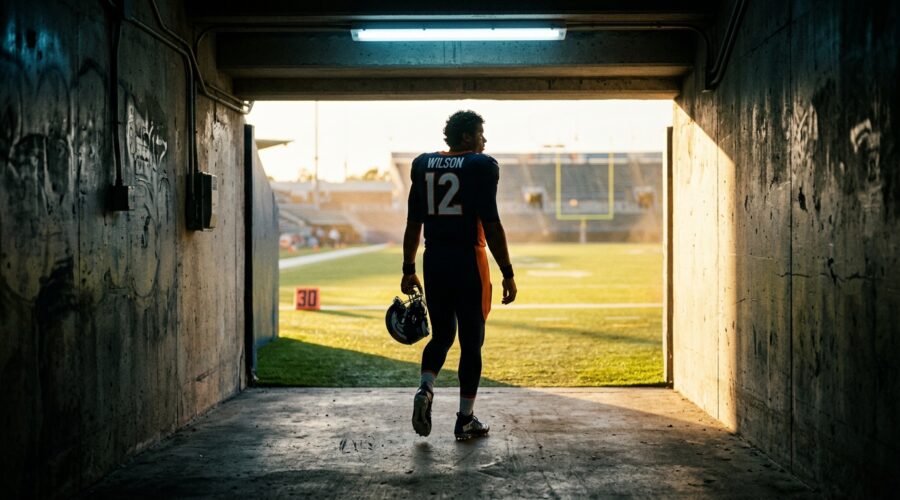
On the afternoon of July 23, 2026, one day before rookies were scheduled to report to training camp in Owings Mills, Maryland, the Baltimore Ravens issued a roster transaction so routine it barely warranted a paragraph. Quarterback Diego Pavia, waived. Reason: to make room for veteran center Ethan Pocic on the 90-man roster.
A veteran lineman for a developmental quarterback. A roster math problem. Nothing to see here.
Except the quarterback they just cut was the 2025 SEC Offensive Player of the Year. A First-Team All-American. The Johnny Unitas Golden Arm Award winner. The man who took a program that had never won ten games in its entire history and dragged it to 10 wins in a single season. The man who beat both Auburn and Alabama in the same year — only the 13th starting quarterback to do so since 2004. The man who struck the Heisman pose at midfield after dismantling LSU.
The man the NFL just keeps telling no.
And if Diego Pavia’s life has proven anything, telling him no is the least effective strategy available.
A Career Built Entirely on Closed Doors
To understand why Pavia’s Ravens release lands differently than a typical training camp cut, you have to understand where he started — and how many times the football establishment told him he was not good enough to move forward.
Pavia grew up in Albuquerque, New Mexico, attended Volcano Vista High School, went undefeated his senior season, and received exactly zero FBS scholarship offers. Zero. The entire Football Bowl Subdivision looked at one of the best high school quarterbacks in New Mexico and collectively shrugged.
So he went to New Mexico Military Institute in Roswell — a junior college — and won a national championship. In the 2021 NJCAA title game, he guided NMMI to a 31–13 victory over Iowa Western, throwing two touchdown passes and scoring another on the ground. Over two years at the JUCO level, he threw for 2,644 yards and 31 touchdowns against just 4 interceptions, while adding 1,107 rushing yards and 15 more scores.
He transferred to New Mexico State, an FBS program still fighting for full conference legitimacy, and became their all-time leader in passing yards, touchdown passes, and quarterback rushing yards. He earned Conference USA Offensive Player of the Year in 2023 and was named MVP of the Quick Lane Bowl after engineering a 24–19 victory over Bowling Green.
Then came Vanderbilt — a school that had been college football’s permanent underdog, historically defined by the size of its losses to SEC giants rather than the quality of its victories. In two seasons under head coach Clark Lea, Pavia transformed the Commodores into something no one had ever seen before. In 2025 alone, he threw for 3,539 yards — a school record — completed 70.6 percent of his passes, led the SEC in touchdowns (29), passer rating (170.4), and yards per attempt (9.4), while adding 862 rushing yards and 10 more scores on the ground. Vanderbilt finished 10–3. The program’s first-ever double-digit win season. In the Southeastern Conference.
By any sane measure of college football production, Diego Pavia was one of the best quarterbacks in the country in 2025. The awards confirmed it. The voters confirmed it — mostly. He finished as Heisman Trophy runner-up on December 13, 2025, behind Indiana’s Fernando Mendoza, who had led the Hoosiers to a 13–0 record and the Big Ten Championship. Mendoza collected 643 first-place votes to Pavia’s 189, and the final margin — 2,362 points to 1,435 — was not particularly close.
Pavia’s response to losing the Heisman became almost as famous as his season. “F— all the voters,” he posted publicly. It was raw, it was unfiltered, and it was the kind of thing that gets replayed in NFL draft rooms for months.
The Draft That Wasn’t
The 2026 NFL Draft was held in Pittsburgh. There were 257 picks across seven rounds. Ten quarterbacks heard their names called, including Garrett Nussmeier, Behren Morton, Athan Kaliakmanis, Taylen Green, and Cole Payton — names that, with all due respect to each of them, did not lead the SEC in any meaningful statistical category in 2025.
Diego Pavia’s name was never called.
He became the first Heisman Trophy finalist to go undrafted since Northern Illinois quarterback Jordan Lynch in 2014. He became the first Heisman runner-up to go undrafted since Jason White in 2005 — a quarterback who, notably, also won a major award (the Davey O’Brien in 2003), finished behind Matt Leinart in the 2004 Heisman voting, and went undrafted in the 2005 NFL Draft. The parallel is uncomfortably precise.
The reasons NFL scouts offered were a familiar cocktail of legitimate concern and institutional bias. His height — listed at 5’10” but measured closer to 5’9″ at the Senior Bowl — was the headline objection. His arm strength was considered below starter-caliber at the pro level. His 4.76-second 40-yard dash undermined the dual-threat narrative his college tape loudly announced. His off-schedule playmaking style, which had made him nearly impossible to defend in the SEC, raised questions about how it would translate against NFL pass rushes and defensive schemes. And then there was the Heisman comment, which scouts and front offices referenced repeatedly as a maturity red flag.
CBS Sports ranked him the No. 377 overall prospect and No. 18 quarterback in the class. Eighteenth. At his position. In a draft where ten quarterbacks were taken.
It is worth sitting with that for a moment. The reigning SEC Offensive Player of the Year, a First-Team All-American who set school records and won major national awards, was considered the eighteenth-best quarterback available in his draft class by at least one major outlet. The system, once again, had a very clear message for Diego Pavia.
Baltimore’s Invitation — and What It Really Meant
After the draft, multiple NFL teams had expressed interest in Pavia as an undrafted free agent, per ESPN’s Adam Schefter. The Baltimore Ravens moved quickest, inviting him to rookie minicamp on a tryout basis before pivoting to something more formal: a three-year UDFA contract signed on April 28, 2026. No signing bonus. No guaranteed money. A projected rookie-year salary of somewhere between $885,000 and $1,005,000 — a significant step down from the approximately $2.5 million in NIL earnings he had reportedly collected in his final season at Vanderbilt.
He also negotiated the deal himself, without an agent. “Ain’t nobody taking my money,” he said. “I’ll tell you that.”
On paper, the opportunity in Baltimore looked genuinely promising. The Ravens’ quarterback room at the time of signing consisted of exactly two players: Lamar Jackson and Tyler Huntley. No third quarterback. Schefter said plainly that it represented a real opening. Head coach Jesse Minter — in his first year leading the franchise after replacing John Harbaugh following Baltimore’s 8–9 2025 season — had a direct personal connection to Pavia through Clark Lea, who had hired Minter as his defensive coordinator at Vanderbilt in 2021. Minter offered Pavia a clean slate. “Show us what you can do,” he said. General manager Eric DeCosta praised Pavia’s “grit.”
There was also a legitimate football concept attached to Pavia’s presence. New Ravens offensive coordinator Declan Doyle had spent four seasons with the New Orleans Saints while Taysom Hill was on the roster — the same Taysom Hill who had redefined what a utility quarterback could look like in a modern NFL offense. Lamar Jackson had missed 3 games in 2025 due to a hamstring injury and posted career lows in carries (67), rushing yards (349), and rushing touchdowns (2). The idea of a hybrid quarterback who could take some of that physical burden while contributing in creative ways was not far-fetched. It was, in fact, the most sensible use case anyone had articulated for Pavia at the professional level.
He wore jersey number 17 through the full offseason program — OTAs in late May, mandatory minicamp in June. Teammates noticed. Adam Randall, a fifth-round running back pick out of Clemson who had played alongside Pavia at the Senior Bowl, described him as “a guy that plays with a chip on his shoulder” with “great energy and attitude.”
But football is a competition, and competitions have outcomes. By the end of mandatory minicamp, Skylar Thompson — a veteran who had spent time with the Miami Dolphins — had shone brightest among the quarterback group. Thompson established himself as the frontrunner for the third-string role behind Jackson and Huntley. Pavia, alongside fellow UDFA Joe Fagnano out of UConn, was left competing for a roster spot that almost certainly did not exist. The Ravens have carried only three quarterbacks on their 53-man roster once in the past five years. The math was always against him.
The Cut, the Context, and the Uncomfortable Truth
Ian Rapoport of NFL Network broke the news at 4:24 PM ET on July 23. The Ravens confirmed it on their official website. The official reason — roster space for center Ethan Pocic, who had passed his physical and signed a one-year deal to replace Tyler Linderbaum (who had departed for the Las Vegas Raiders) — was entirely mundane and entirely true. Pavia was simply the fifth-best quarterback on a team that carries two or three. The depth chart math, as one analyst put it, was decisive.
What was not mundane was the weight of what that transaction represented. A Heisman runner-up, cut before a single preseason snap. The first player of his Heisman pedigree to go undrafted since 2014, now cut before training camp even opened. The post-release landscape laid out his options with uncomfortable clarity: the NFL waiver wire, where any of the 31 remaining teams could claim him within 24 hours; the CFL, where the Winnipeg Blue Bombers hold his negotiating rights; the UFL, which posted a cryptic social media recruitment message within hours of his release; or some version of the Taysom Hill path — a position reinvention so complete it barely resembles quarterbacking anymore.
The UFL’s recruitment post felt equal parts opportunistic and genuine. The CFL parallel to Jason White — his most direct historical predecessor in the “Heisman runner-up, undrafted” lineage — is almost too on the note to ignore. Whether Pavia is willing to follow an unconventional professional trail is an open question.
What is not an open question is whether Diego Pavia is a football player worth watching. Clark Lea, who coached him at Vanderbilt and has seen more of him than almost any professional evaluator, said before the draft: “We may look up in 12 years and he’s still playing football in the NFL. That’s the level of belief I have in Diego.”
What the NFL Still Gets Wrong About Players Like Pavia
There is a version of this story in which the NFL’s evaluation of Diego Pavia is entirely defensible. Height matters at quarterback. Arm strength matters. The transition from college to professional defenses is brutal, and players who succeed against SEC competition do not always — or even often — carry that production forward. The concerns about his off-field comments were not invented. Teams are investing enormous resources in their quarterback rooms and they are entitled to prioritize character alongside talent.
But there is another version of this story, one that is also true, and it goes like this: The NFL passed on a player who led the SEC in completion percentage, passer rating, touchdowns, and yards per attempt. A player who guided a program to its first-ever ten-win season. A player who beat Alabama and Auburn in the same year. A player who, across his full FBS career, accumulated 10,255 passing yards, 3,094 rushing yards, and 119 total touchdowns against increasingly elite competition. The league passed on him because he is roughly an inch shorter than the preferred prototype, because his 40 time was pedestrian, and because he said something impolitic after losing an award to a 13–0 quarterback from a national champion.
Meanwhile, quarterbacks with significantly worse statistical resumes were drafted ahead of him — some in rounds where Pavia was not even considered. The disconnect between production and evaluation, between what Pavia did on a football field and how the league valued that output, is difficult to explain away with height charts and combine measurements alone.
He has been here before. He was here when no FBS program offered him a scholarship out of high school. He was here when he had to win a national championship at a junior college just to earn a transfer to an FBS program. He was here when he became a dominant force at New Mexico State, only to need another transfer to prove himself in the SEC. Every door that closed pushed him toward a bigger stage, and every time he walked onto that bigger stage, he performed.
The Next Chapter Is Not Yet Written
As of the evening of July 23, 2026, Diego Pavia is a free agent in waiting — moving through a 24-hour waiver period, his three-year contract potentially transferable to any team willing to claim him. The Carolina Panthers, among others, have been floated as possible landing spots. The UFL and the Winnipeg Blue Bombers loom as alternatives. The Taysom Hill hybrid conversation has not gone away.
What happens next is genuinely unknown. That is not nothing. For a player who has spent his entire career defying the predictions of the people who were supposed to know better, “genuinely unknown” has historically been a favorable condition.
The Ravens’ official roster move on July 23 was four lines of text on a transactions page. Pocic in, Pavia out. The kind of thing that gets lost in the noise of a training camp news cycle within 48 hours, buried under injury updates and depth chart battles and uniform reveals.
But Diego Pavia has spent his entire career being the kind of thing that gets buried and then resurfaces louder than before. The unrecruited high schooler who won a national championship. The JUCO transfer who dominated the SEC. The undrafted Heisman finalist who signed with one of the NFL’s marquee franchises on a three-year deal he negotiated himself.
The Ravens cut him. The story is not over. If anything, given everything that came before it, the cut is almost certainly just the setup for whatever comes next.
Bet against Diego Pavia at your own risk. History suggests it has not been a winning wager.