For approximately three hours on the night of Friday, August 28, 2026, the Atlanta Dream’s Eastern Conference title hopes hung by the thinnest of threads. Angel Reese — the most dominant rebounder in the WNBA, a generational force who has recorded 22 double-doubles through 37 games this season, and the woman who had just broken the all-time record for double-doubles in a single season — was one league ruling away from sitting out Sunday’s pivotal showdown against the first-place Minnesota Lynx. All because of a boxout.
And then, just like that, it was over. The WNBA rescinded the technical foul. Reese’s count went back to seven. She would play Sunday. Crisis averted.
But the fact that it was ever a crisis at all — that the league needed three hours and an appeal to correct what replays suggested was an ordinary, competitive paint battle — is a story that refuses to disappear beneath the feel-good headline of a rescission. Because this is the second time in three weeks that the WNBA’s most high-profile players have been sent home from a game staring down the barrel of an automatic suspension, only for the league office to walk the call back before morning. And if a pattern is not yet a systemic problem, it is at minimum a systemic warning.
What Happened on the Floor
The Atlanta Dream entered Friday night’s game at Gateway Center Arena riding a 24-13 record and a half-game chase behind the Indiana Fever for Eastern Conference supremacy. The Portland Fire, sitting at 16-23, were not supposed to be the team that complicated that chase. They were anyway.
Portland was dominant from the jump, outscoring Atlanta 28-18 in the first quarter and never relinquishing control. Emily Engstler, in arguably the signature performance of her career, dropped a career-high 25 points on 11-of-14 shooting, adding six rebounds, four steals, and four blocks. She scored 18 of those points in the first half alone, setting a tone that Atlanta’s defense simply could not answer. Portland guard Carla Leite added 26 points including a perfect 4-for-4 from three-point range. The Fire shot 58.5 percent from the field and dominated the paint 50 to 28, exploiting Atlanta’s 19 turnovers for a commanding 101-83 victory.
For Atlanta, Rhyne Howard did everything she could, pouring in 22 points on six three-pointers made. And Angel Reese, as she has done with breathtaking consistency all season, delivered: 16 points, 16 rebounds, and six assists. Her 27th double-double of the season. A number that broke the great Alyssa Thomas’s record for the most double-doubles recorded in a single WNBA season in the league’s history. A number that, under any normal circumstance, would have dominated the post-game conversation entirely.
Instead, the conversation was about what happened with 8:45 remaining in the fourth quarter.
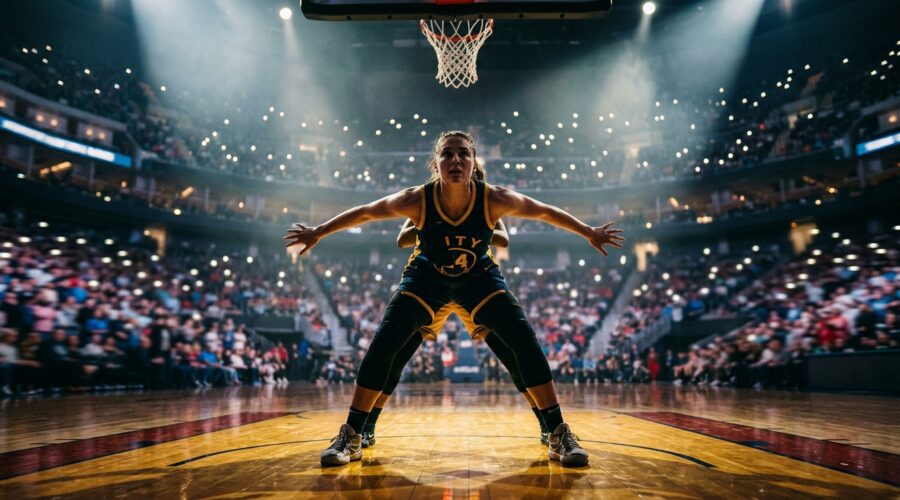
Atlanta trailed by a comfortable margin when Rhyne Howard launched a right-corner three-pointer. In the paint, Portland guard Carla Leite extended both arms backward toward Reese, positioning her body to box out the bigger forward. Reese pushed free from behind. A referee whistled Reese for a technical foul — her eighth of the season — and the implications were immediate and enormous.
Reese walked away from the play, visibly shaken, mouthing the words, “I didn’t do anything.”
She was not wrong.
What the Rules Said — and What They Were About to Do
Under the WNBA’s 2026 collective bargaining agreement, the technical foul landscape was reshaped before the season began. The league introduced an escalating fines structure designed to discourage repeat offenders: technical fouls one through three carry a $500 fine each; fouls four through seven escalate to $1,000 per offense; and the eighth technical foul triggers a $1,500 fine plus an automatic one-game suspension, with every two subsequent technical fouls adding another suspension on top.
The rule is clean and uncomplicated. Eight technicals, you sit. No discretion. No appeal process running fast enough to save you before the next tip-off — at least not in theory. Reese had entered Friday’s game sitting at exactly seven technical fouls on the season. The Leite play, as called, was her eighth. Had the ruling stood, she would have been required to sit out Sunday’s game against the 31-8 Minnesota Lynx — a game Atlanta desperately needed to win to keep pace with Indiana for the Eastern Conference’s top seed. The Dream were also already missing Brionna Jones, ruled out with a leg injury. The prospect of facing Napheesa Collier, Olivia Miles, Kayla McBride, and Courtney Williams without both Jones and Reese was, to put it plainly, nightmarish.
Head coach Karl Smesko did not try to hide his skepticism in his post-game remarks. “From my vantage point, it didn’t look like something that was tech-worthy,” he said. “She’s been really good. She went a long time without getting a technical. She was doing a great job.” He confirmed the team would appeal. “Hopefully, this is something that will be rescinded, and we’ll have Angel’s services for the Minnesota game.”
He got his wish — but the timeline matters.
The Rescission: Relief With an Asterisk
Within approximately three hours of the final buzzer, ESPN’s Alexa Philippou confirmed the reversal. The WNBA had reviewed the play and determined the technical foul was not warranted. The league classified the incident as a standard basketball boxout battle — the kind of physical contact that occurs dozens of times in every single professional game — and overturned the call. Reese’s technical foul count returned to seven. She would be available Sunday against Minnesota.
The relief in Atlanta was palpable and understandable. But the relief should not crowd out the discomfort.
Because if the league can review footage in three hours and determine the call was wrong, the question that follows is unavoidable: how was the call made in the first place? The WNBA’s own rule book contains a clause that reads, “Assessment of a technical foul shall be avoided whenever and wherever possible.” That standard, applied in real time on August 28, produced an 8th technical foul for Angel Reese during a standard paint battle. The league’s own post-game review said it was wrong. The referee’s real-time judgment said otherwise. That gap — between what happened on the floor and what the footage showed — is exactly the kind of gap that erodes trust in officiating, regardless of which direction it falls.
Caitlin Clark, Twenty Days Earlier
To understand why this rescission landed with such force on the broader WNBA conversation, it is necessary to back up exactly twenty days to August 8, 2026.
Indiana Fever beat the Chicago Sky 90-86 that night. Caitlin Clark was spectacular. But in the third quarter, Clark was bumped out of bounds by Natasha Cloud, stumbled, and made incidental contact with a referee while fighting to stay on her feet. A technical foul was called — her eighth of the season. Fever head coach Stephanie White earned her own technical arguing the call immediately: “That’s a bad call. Incidental contact when you’re flying out of control.”
Clark, measured in her post-game comments, said she had already reviewed the tape: “It wasn’t anything intentional or anything. So I hope it gets rescinded. And nothing was said.”
Within approximately two hours of that game ending, the WNBA rescinded the technical foul. Clark’s count reset to seven. She played Tuesday, August 11, against the New York Liberty.
The parallel between the Clark rescission and the Reese rescission is not coincidental or incidental. It is the league, in back-to-back high-profile instances within three weeks of each other, correcting its own referees after the fact. Both of the WNBA’s most scrutinized and talked-about players. Both facing automatic suspensions. Both cleared by the league office hours after their respective games. Both incidents occurring when the stakes were high enough that missing even one game carried genuine playoff implications.
The symmetry is striking. So is the question it raises: if these were both obvious enough to reverse after a simple video review, why did they require an appeal at all?
A Season of Officiating Under the Microscope
The 2026 WNBA season has been, by almost any measure, one of the most scrutinized officiating environments in the league’s thirty-year history. The elevated technical foul totals across the league — Clark and Reese leading the way at seven apiece, with Natasha Cloud at six, Kahleah Copper at six, Alyssa Thomas at five, and several others in the four range — reflect in part a more physical, intense style of play as the league’s talent pool deepens. But they also reflect something more complicated: a refereeing workforce that has struggled to keep pace with the game’s growing speed, physicality, and public profile.
The Alyssa Thomas incident earlier in the season crystallized the problem most starkly. In a moment that was captured clearly on multiple camera angles, Thomas struck Caitlin Clark in the throat during a loose-ball play. Officials on the floor declined to call a flagrant foul in real time. The league later upgraded the play to a Flagrant 2 upon delayed video review and suspended Thomas for one game. Clark, who had repeatedly and publicly called for better protection for players in the league, did not mince words: “It’s kind of been a discussion for three years now, and I think we really need to do a better job protecting the people in this league.”
That incident — in which the officiating machinery failed in the moment and required correction after the fact — set the tone for how the league’s credibility with its own players and fans would be measured throughout the summer. The Clark and Reese rescissions are part of that same continuum: not isolated errors, but recurring demonstrations that the real-time officiating often requires post-game correction for it to be right.
The league has invested significantly in recent years in growing its profile, its broadcast presence, and its commercial partnerships. The referees have not always grown at the same rate. Caitlin Clark’s repeated, public calls for full-time professional officiating have not been widely disputed even by those who disagree with her on nearly everything else. The back-to-back rescissions of August 2026 add urgency to that argument in a way that is hard to dismiss.
Angel Reese’s Historic Season — the Story That Should Be Dominating
Strip away the technical foul drama, and what Angel Reese has accomplished in the 2026 WNBA season is genuinely historic in a way that deserves to be told without qualification or caveat.
Twenty-four years old, in her first season with the Atlanta Dream following a trade from the Chicago Sky before the season began, Reese has been the most complete version of herself she has ever been on a basketball court. She leads the entire WNBA in rebounding at 12.0 per game. She is averaging 16.3 points, 2.7 assists, 1.8 steals, and 0.7 blocks. She is shooting 44.1 percent from the field and 73.8 percent from the free throw line across 36 games, and her team-level impact registers in a plus/minus of plus-223 on the season — the kind of number that speaks to how fundamentally different Atlanta is when she is on the floor.
And then there is the double-doubles record. Alyssa Thomas set the WNBA single-season record for double-doubles with the Connecticut Sun in 2023 with 28, a mark that stood as one of the most remarkable individual-season achievements in league history. Thomas — one of the most complete and statistically unprecedented players the WNBA has ever produced — was considered the gold standard for consistent dominance at both ends of the box score.
On the night of August 28, in a game her team lost by 18 points, Angel Reese broke that record with her 27th double-double of the season — surpassing Thomas’s 28-game mark set over the full 2023 campaign, with five games still remaining in the regular season. The record, which now belongs to her alone, has room to grow further still.
That milestone should have been the headline. It nearly wasn’t, because a referee made a call that the league spent three hours deciding was incorrect. Reese’s composure under those circumstances — having just delivered a record-breaking double-double, knowing the technical foul could cost her the most important remaining game of Atlanta’s regular season, and still walking away from the incident rather than escalating — was itself a testament to how much she has grown. She went approximately seven weeks between her seventh technical foul on July 9 against the Seattle Storm and the August 28 incident against Portland. Seven weeks, during one of the most intense stretches of a playoff chase, without a technical foul. That is not a coincidence. That is discipline, hard-won and consciously maintained.
The Dream’s coaching staff recognized it. Smesko’s post-game comments about Reese’s composure were not boilerplate deflection — they were a genuine acknowledgment that she had done everything asked of her. The technical, in his view and ultimately in the league’s view, was not on her.
The Stakes Going Forward
With the rescission confirmed and Reese cleared to play, Atlanta’s attention turned immediately to Sunday and the Minnesota Lynx — 31-8, first place in the Western Conference, and one of the most formidable rosters in the WNBA. Napheesa Collier. Olivia Miles. Kayla McBride. Courtney Williams. This was not a game Atlanta could afford to play shorthanded. With Brionna Jones already ruled out due to a leg injury, Reese’s availability was not merely important — it was the organizational difference between competing and surviving.
Beyond Sunday, the broader stakes for Reese’s season are significant on multiple levels. The outright double-doubles record is already hers, with five games left to extend it further. Her selection to the U.S. national team for the upcoming FIBA World Cup break means that her individual reputation and her disciplinary record carry weight beyond the WNBA regular season — national team availability and eligibility are rarely entirely disconnected from a player’s public standing with league and federation decision-makers. And with the Atlanta Dream still in a genuine fight for the Eastern Conference’s top seed — sitting a half-game behind the Indiana Fever at 24-14 — every game from here through the end of the regular season is a game that matters in the most concrete possible way.
Reese has been in this position before. In 2025, her 8th technical foul was not rescinded. She served the suspension, missed the game, and moved on. She did not get the benefit of a league review that overturned the call. The fact that she absorbed that experience, came back, refined her approach, went seven weeks without a technical at the most critical juncture of a title chase, and still found herself the subject of a questionable call in the fourth quarter of a blowout loss — and handled it the way she did — says something real about who she is as a professional in 2026.
What the League Must Reckon With
Angel Reese will play Sunday against Minnesota. Caitlin Clark played on August 11 against the Liberty. The outcomes the league office avoided — suspending two of its brightest stars over calls that video review determined were incorrect — are outcomes it should be grateful it avoided. But gratitude and accountability are not the same thing.
The WNBA is in its 30th season. It has never been more visible, more commercially viable, or more genuinely exciting as a product. The players it has right now — Reese, Clark, Collier, Miles, A’ja Wilson, Breanna Stewart, and the wave of extraordinary talent behind them — are players capable of carrying the league into a new era. The officiating infrastructure has to be capable of keeping up.
Two rescissions in three weeks, each one preventing a potentially unjust one-game suspension for one of the league’s most marketable players, is not a coincidence to be explained away. It is a data point that confirms what players, coaches, and fans have been saying with increasing volume throughout 2026: the referees are working too hard with too little institutional support, and the real-time decisions they are asked to make in fast, physical, high-stakes games are sometimes beyond what the current system can reliably produce.
The escalating fines structure introduced before 2026 was a step toward accountability. Full-time officiating — a change Clark has pushed for publicly and persistently — would be a larger one. Video review protocols that catch errors in real time rather than three hours later in a league office would be larger still. None of these are revolutionary ideas. All of them are overdue.
Angel Reese broke the greatest double-double record in WNBA history on August 28, 2026. The story, by rights, should end there — with a 24-year-old standing alone at the top of one of the game’s most demanding statistical categories, five games left to extend the record further, and a playoff chase burning at full heat around her. Instead, it ends with relief: relief that the league got it right, eventually, and a lingering, uncomfortable question about what it would take to get it right the first time.