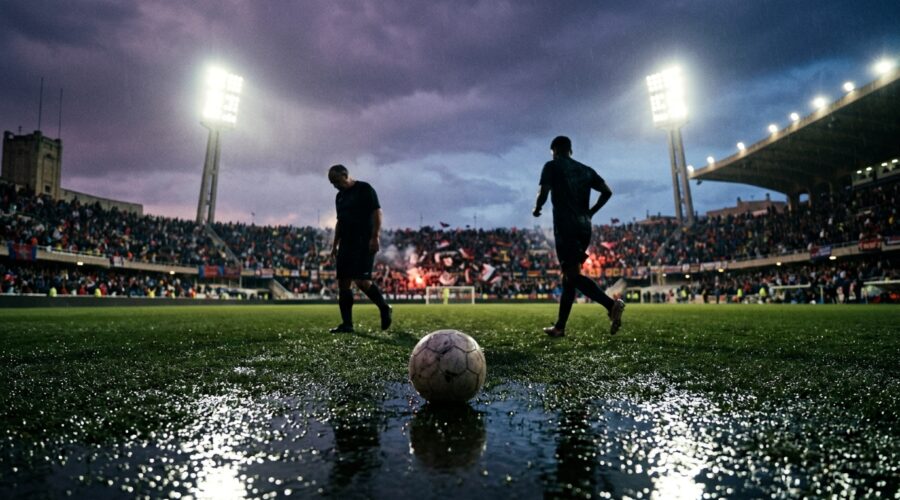
Nations League MD4 Preview: Croatia vs. Spain, France vs. Belgium — and USMNT Faces the Neighbours Again
Three months ago, Ferran Torres buried a left-footed volley past Emiliano Martínez in the 106th minute at MetLife Stadium, and Spanish football tilted into a kind of serene, almost embarrassing dominance. The World Cup was theirs. The European Championship was already theirs. The unbeaten run now stands at forty-one matches and counting. And somewhere on that rain-soaked turf in East Rutherford, a nineteen-year-old from Barcelona’s La Masia academy walked over to Lionel Messi, placed a hand on his shoulder, and said: “Thank you for everything you gave football.” The passing of the torch, performed on a pitch, in public, by a teenager who had not yet been born when Messi first touched a ball for Argentina’s senior side.
This week, European football returns from its brief post-World Cup stupor and the UEFA Nations League resumes for Matchday 4. It is not the grandest competition in the calendar. But the fixtures it has thrown up — a broken Croatia hosting the world champions in Split, a wounded France under Zinedine Zidane facing a resurgent Belgium without their two finest players — carry a weight and a story that the competition itself rarely earns. Across the Atlantic, meanwhile, a USMNT bristling with teenagers and tactical purpose hosts a Canada side that has quietly become the most awkward opponent in CONCACAF. The post-World Cup reset, it turns out, is not a rest. It is a reckoning.
Lamine Yamal and the Art of Starting Early
Before we get to the fixtures themselves, we should pause to appreciate what Lamine Yamal has done in the opening three matchdays of this Nations League cycle, because it is, in the most literal statistical sense, extraordinary.
Matchday 1, September 26: Yamal scores against England at Wembley inside sixty seconds. Matchday 2, September 29: Yamal scores against Croatia inside two minutes. Matchday 3, October 3: Yamal scores against Czechia inside six minutes. He is the first player in Spain’s 106-year international history to score within the opening two minutes of two consecutive internationals. Four goals and multiple assists across three matches, at venues that included Wembley. He is nineteen years old.
There is a particular cruelty to watching Yamal play that those on the receiving end must find almost philosophical in its unfairness. He does not ease into matches. He does not need a few touches to find his rhythm, a second half to assert himself, a warm-up period of fifteen minutes where the opposition adjusts. He arrives at kickoff already at full tilt, cuts inside from the right onto that left foot with the unhurried certainty of a man who has already seen the shot before he’s hit it, and by the time the crowd has properly settled, the scoreboard has moved. It is a form of ambush disguised as football.
His tally for Spain entering Matchday 4: seven goals in thirty-three appearances. He turned nineteen in February. His debut came at sixteen years and fifty-seven days. His greatest hits include the youngest goalscorer in European Championship history — that curling equaliser from the edge of the French box in the Euro 2024 semifinal — followed by a World Cup winner’s medal and an embrace with Messi that will be printed on the wall of at least one Spanish sports bar until the 2030 finals roll around. None of it seems to have slowed him down.
Croatia vs. Spain: Stadion Poljud, Split — October 6
The Stadion Poljud in Split is one of European football’s genuinely beautiful grounds — a concrete bowl crouched into a hillside above the Adriatic, designed by Boris Magaš and unveiled in 1979, named for the field of kisses. On Tuesday evening it will house thirty-four thousand Croatians who will desperately, loyally, perhaps a little desperately again, try to summon something from a national team that has just recorded the worst result in its independent history.
Seven. Goals. To England. Behind closed doors.
The closed-doors element — a UEFA disciplinary sanction imposed for crowd conduct — added its own particular grimness to an October 3rd evening that Croatia’s players will spend several years trying to forget. Croatia had already lost 4-1 to Spain four days earlier. The seven goals conceded to England were not a statistical aberration or a quirk of xG. Luka Modric, at forty-one years of age and now on 204 international caps, emerged from that dressing room and said something that no man of his stature says lightly: “I’ve been here for twenty years and I have to say that for the first time I feel ashamed after a game. You can lose, they are better, but to lose in this way and ruin your reputation like this — this is unacceptable.”
That is not a man in the grip of mild disappointment. That is a man confronting the end of something that has sustained him and his country for two decades, and finding that it ended not with grace but with a 6.75 expected goals conceded in an empty stadium to a side that barely needed to extend themselves.
Slaven Bilić, back in charge of Croatia for the first time in fourteen years and clearly under no illusions about what he has inherited, framed the task with blunt clarity: only the players and the manager, he said, can drag the program back from this. He is right. He is also going to face Lamine Yamal on Tuesday.
Spain’s recent head-to-head record against Croatia is less a rivalry than a tutorial. Since that 2021 Euro thriller — 5-3, the one with Pedri and the interplay and the tactical shellacking, Croatia clawing back to 3-3 before Spain’s extra-time surge — Spain have beaten Croatia 3-0 in the Euro 2024 group stage and 4-1 just last week in Seville, where Yamal scored twice, the second a curling, contemptuous thing in the fifty-seventh minute that suggested he was almost bored. The last time Croatia defeated Spain in competitive football, it was a 2-1 victory in the UEFA Euro 2016 Group Stage on June 21, 2016. An entire generation of Spanish players has since grown up, won a European Championship, and won a World Cup since that night.
Spain have their own injury concerns — goalkeeper Joan García departed with a knee problem, Pedro Porro withdrew from camp entirely, and Eric García hobbled off before kick-off in the England match — but the depth of this squad has long since made individual absences feel like editorial choices rather than emergencies. Unai Simón takes his place between the sticks. Pau Cubarsí, still only eighteen, and Aymeric Laporte provide the defensive spine. Rodri — World Cup Golden Ball winner, conducting the tempo with the composure of a man who genuinely cannot understand why anyone bothers pressing — anchors the middle. Pedri floats. Nico Williams and Yamal provide the width. Luis de la Fuente does not need to reinvent the shape; he merely has to avoid getting anyone else injured.
Croatia’s probable lineup — Livakovic in goal, Gvardiol and Sutalo in the back four, Kovacic and Modric in midfield — has talent enough for a creditable performance and perhaps a goal. Dion Beljo scored Croatia’s lone reply in Seville. Ivan Perisic, at thirty-seven, contributed one assist in the opening Matchday against Czechia. There is pride here, and Modric’s public shame will not have gone unnoticed in that dressing room. A home crowd, too — a proper one this time, roaring their team through the Adriatic evening air — can tighten a defensive block and make a stadium feel like something more than a training exercise.
But Spain’s forty-one-match unbeaten run is not the product of fortune. It is the product of a system that has been deliberately, patiently, and brilliantly constructed, and it does not wilt because the opposition are proud and the stadium is loud. Croatia need a result. Spain need barely even try, and yet will be completely ruthless anyway. That is the situation as it stands, and the mathematics of goodwill cannot change it.
France vs. Belgium: Stade de France — October 5
The more interesting match of the window, tactically speaking, kicks off twenty-four hours earlier at the Stade de France, where Zinedine Zidane’s France — already nine games into the Zidane era and still finding its precise identity — host a Belgium side that is leaner, younger, more purposeful, and desperately missing the two players most responsible for its first-half surge of six points.
Let us begin with the absences, because they are defining. For France: Kylian Mbappé, who scored the opener against Turkey on September 25 and then crumpled to the turf clutching his left knee, is out for approximately two weeks with a hyperextension of the posterior capsule of his left knee. No surgery required, which was the first piece of good news a France camp growing accustomed to complicated Mbappé narratives had received in some time. He was injured in Zidane’s very first match as manager — a moment that combined triumph and omen in the concentrated way only football can arrange. He returns to Real Madrid for treatment, under José Mourinho’s oversight, in circumstances that do not require further elaboration.
Also absent for France is Dayot Upamecano, serving a suspension after collecting a second yellow card against Italy — in a match that ended 1-1, with Michael Olise’s stunning volley cancelled out by Alessandro Bastoni after a lapse in concentration from Lucas da Cunha, the Como midfielder who was pressed into error midway inside his own half. France also finished that match with ten men. Seven points from four possible wins, a home draw, an away win, and a captain already in the treatment room: Zidane’s opening window has been eventful in the way that only managing France can be eventful.
What it has also revealed, however, is that when Mbappé is absent, France do not collapse. They adapt, and the man doing the adapting most eloquently is Michael Olise of Bayern Munich. Four goals and one assist in four Bundesliga appearances for Bayern this season. One goal and significant involvement in three French national team appearances, including that sublime 88th-minute winner in Brussels that settled Matchday 2 and kept France top of Group A1. Olise has the kind of movement and technical range that makes defenders genuinely unhappy, and he is the axis around which Zidane is building this particular iteration of Les Bleus — supported by the precocious Désiré Doué and the ever-available Ousmane Dembélé in a front three that lacks Mbappé’s finishing blade but compensates with variety and creativity.
Belgium arrive with momentum and minus half their engine room. Kevin De Bruyne — yes, the Kevin De Bruyne, who scored twice against Turkey in Matchday 3 to confirm that he has somehow extended his peak another season at Napoli — is suspended. Youri Tielemans is also suspended. Leandro Trossard carries a heel injury. Mark van Bommel’s youthful, pressing-based Belgium without De Bruyne is a different animal to Belgium with him: the precision drops, the set-piece threat diminishes, and the transitions that their system depends on become less decisive without his weight of pass. Charles De Ketelaere carries the creative burden. Diego Moreira, three goals in five Serie A matches at AC Milan this season, provides the left-sided threat. Mika Godts scored against Turkey. They are a team of exciting parts, capably assembled, playing without their most important piece.
Van Bommel, asked about facing a man whose name adorns a specific dribbling manoeuvre in the global football lexicon, handled it with the warmth of a former professional meeting a greater one: “If a dribbling move is named after you, then you must have done pretty well.” It was well judged. Zidane, for his part, arrives at the Stade de France for the second time as manager — his home debut against Italy was greeted by the crowd chanting his name with the fervour of a congregation — and will need to make the “smart changes” he publicly promised without disrupting the structural solidity that has kept France top of the group.
The match-up of systems is genuinely intriguing. Belgium want to press, win the ball high, and create transition opportunities. France, without Mbappé’s directness, prefer patient possession and the late incision — Olise’s goal in Brussels was exactly this: a ball worked patiently to the right, space manufactured by movement, and then a finish of controlled violence into the far corner. If Zidane can establish midfield control through Manu Koné and Rabiot, and if Rayan Cherki is given license to move between the lines against a Belgium midfield deprived of its two regulars, France ought to have enough. Ought to.
France have won five of their last six meetings with Belgium, and the home record under Zidane at the Stade de France is already building towards something formidable. But Belgium, for all their absences, are not Italy at the Euros. They are fast, aggressive, and liberated from the weight of a golden generation that spent a decade promising more than it delivered. Without De Bruyne and Tielemans, they may well be faster than they are with them.
USMNT vs. Canada: Allianz Field, St. Paul — October 6
And then there is the matter on the other side of the Atlantic, which the American football public continues to approach with the specific anxiety reserved for neighbours who have become, without much warning, genuinely good at something you thought was your territory.
Canada have won their last two meetings with the USMNT — 2-1 in Kansas City in September 2024, then 2-1 again in the CONCACAF Nations League third-place match at SoFi Stadium in March 2025, the latter ending with Jesse Marsch controversially sent off, Jonathan David winning it in the second half, and Canada collecting bronze while the United States finished fourth. It was, for the hosts of the World Cup, an uncomfortable way to conclude the cycle.
The USMNT, under Mauricio Pochettino and his freshly signed four-year contract, went three-for-three in the opening fall window — 4-1 over Peru, 4-2 over Chile, 3-0 over Mexico — with a depth and a verve that suggested the embarrassing 4-1 Round of 16 exit to Belgium at the World Cup is already generating productive internal fury rather than organizational drift. Cavan Sullivan, seventeen years old and representing the Philadelphia Union, became the youngest goalscorer in USMNT history. Julian Hall, eighteen, scored his third international goal of the window. Pochettino is blending veterans with teenagers in a way that has produced results, if not yet the big-occasion test that a Matchday against Canada will provide.
Allianz Field in St. Paul is, numerically speaking, the USMNT’s most comfortable venue: three matches played, three shutout wins, a combined score of 11-0 for the men’s side. These are the kinds of statistics that live happily in the press release until the one occasion they do not. Jonathan David will arrive as the most direct challenge to that particular piece of institutional complacency.
David — now at Atlético Madrid, his career having traced its arc through some of Europe’s more demanding atmospheres — has forty-three international goals for Canada. He is CONCACAF’s most dangerous forward, perhaps its finest outright striker since the position existed in the region. He drops deep, links play, presses from the front with genuine menace, and finishes with the clinical economy of a man who has spent years surrounded by elite defenders and knows precisely where the margins are. Alphonso Davies, if fit enough to play a meaningful role, provides the width and the pace on the left that gives every centre-back in his eyeline reason for concern.
Jesse Marsch, the American coaching Canada — a subplot that retains its irony regardless of how many times you rehearse it — built this group through physical intensity, structural clarity, and the kind of competitive coherence that makes Canada genuinely awkward rather than merely competitive. They beat Chile 1-0 and Peru 2-0 in their fall window. They had twenty-one shots in the Chile match. They are organised, direct, and led by a striker who has a habit of being decisive in the late minutes against this particular opponent.
At least the forty-second official meeting between these sides, and the overall USMNT record stands at 17 wins, 12 losses, 13 draws. The last two belong to Canada. The capacity at Allianz Field is just over nineteen thousand, and it will be sold out and loud and thoroughly American, and none of that will intimidate a Canada side that just won at SoFi Stadium. The home record at this specific venue is not a guarantee. It is an invitation to be ruined. Pochettino will know this. He tends to.
The Bigger Picture: What the Post-World Cup Window Reveals
What the autumn of 2026 is clarifying, for anyone paying close enough attention, is which programs genuinely reset and which ones merely tell themselves they are resetting while hoping the old names can carry them another cycle.
Spain are not resetting. Spain are accelerating. Their forty-one-match unbeaten run is built on a generation — Yamal, Cubarsí, Pedri, Rodri, the two Williams brothers — who are not at their peak yet. The thought should disturb everyone competing between now and 2030.
France are resetting with borrowed grandeur. Zidane’s name guarantees a crowd and a cultural moment, but the hard work is structural: integrating Olise, Doué, and Cherki into a system capable of winning without its captain, finding a defensive partnership that holds shape without Upamecano, and managing the perpetual Mbappé situation — now including an injury timeline that has handed Real Madrid’s treatment room an outsized role in French international football preparations. Zidane has the vision. Whether the squad has the collective consistency to realise it is the question the Nations League is supposed to answer.
Belgium, without Hazard, Alderweireld, Vertonghen — the gilded fossils of a golden generation that collected nothing — are, paradoxically, more interesting than they were in their supposed prime. Van Bommel’s team does not carry the weight of expectation. It carries the lightness of reconstruction, which is, if managed correctly, a considerable tactical advantage.
Croatia carry something heavier still: the weight of the end. Modric cannot go on indefinitely, and the seven goals conceded to England were not a performance that can be attributed to one bad night, one poor tactical decision, one lapse of concentration. They were the result of a generational gap that no amount of competitive pride can paper over. The players who come next will have to be built — genuinely built — from the foundations up. That is not a Nations League project. That is a decade’s work.
And for Canada and the USMNT, the post-World Cup window presents a simpler, more urgent question: who, in the CONCACAF rivalry that now defines the region’s competitive ceiling, is actually ahead? Canada have the head-to-head momentum, the tactical cohesion, and the striker who turns draws into wins. The USMNT have the teenager scoring historic goals, the manager with a global pedigree, and Allianz Field’s unbroken record. Something, eventually, has to give.
Final Thoughts
Football after a World Cup always carries a peculiar melancholy — the sense that the peak has passed, that the great narratives have resolved themselves, and that what follows is merely administrative. But the fixtures this week argue otherwise. A broken Modric trying to find one more performance of dignity against a Spain side led by the player who has replaced Messi as football’s central phenomenon. A France manager whose name is a dribbling move trying to win his first home match without his injured captain. A Canadian striker walking into a stadium that has never seen his country succeed on American soil — and doing it two wins in a row.
The great cycle begins again. Lamine Yamal will probably score inside the first ten minutes. Somewhere in Split, a forty-one-year-old midfielder will run onto the pitch at Stadion Poljud and try to feel something other than shame. And at Allianz Field in Minnesota, Jonathan David will wait, very patiently, for the moment the back four loses its shape.
These things matter. They always do. The spreadsheet can wait.