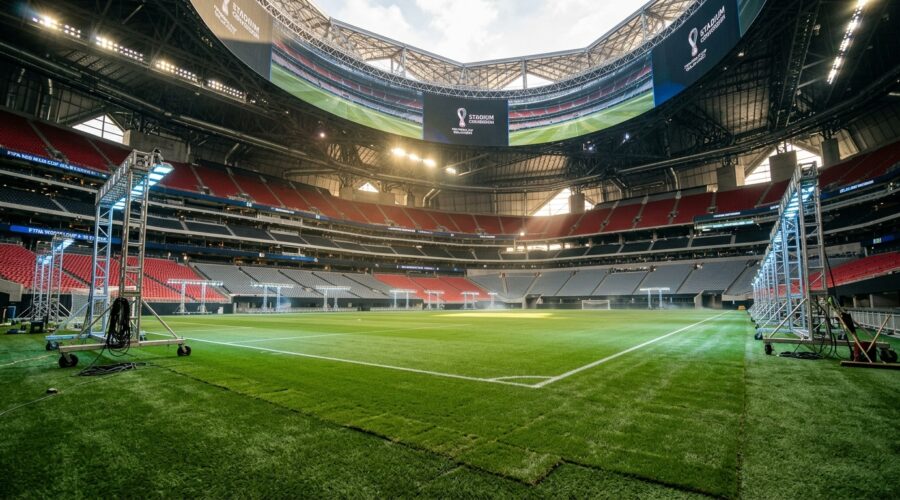
For one summer, MetLife Stadium stopped being “DeathLife.”
The nickname — coined by Odell Beckham Jr. and earned through a grim catalog of torn Achilles tendons, shredded ACLs, and careers derailed on its unyielding synthetic surface — was temporarily retired when workers laid pristine natural grass over the East Rutherford, New Jersey stadium ahead of the 2026 FIFA World Cup. On July 19, 2026, Spain and Argentina played the World Cup Final on that grass. The world watched. And NFL players watched too, with a burning question they are no longer willing to keep quiet about.
If you can grow real grass inside a domed stadium for soccer, why won’t you do it for us?
That question has detonated into the most emotionally charged labor flashpoint the NFL has seen in years — and this time, the players have proof that the excuses are finished.
The Proof of Concept the League Cannot Dismiss
The 2026 FIFA World Cup was jointly hosted by the United States, Canada, and Mexico across 16 venues. All 12 of the United States venues were NFL stadiums. FIFA has a non-negotiable rule: every World Cup match must be played on natural grass. That meant eight NFL stadiums that normally use artificial turf — including MetLife, AT&T Stadium in Arlington, SoFi Stadium in Los Angeles, Mercedes-Benz Stadium in Atlanta, Gillette Stadium, NRG Stadium, and Lumen Field — had to be converted.
This was not a small undertaking. FIFA invested more than $5 million in a dedicated grass research program led by Dr. John Sorochan of the University of Tennessee and Dr. Trey Rogers of Michigan State University — the same duo who helped solve the grass problem for the 1994 World Cup. Their team ran more than 170 tests, deployed robotic cleat simulators and ball-launching machines, developed a hybrid surface made of approximately 95% natural grass stitched with synthetic fibers for structural support, and engineered specialized LED grow-light systems to replicate natural sunlight in domed venues — the precise obstacle that NFL owners have long cited as justification for maintaining artificial turf.
It worked. The pitches held up across all 104 World Cup matches in the summer heat. And when the tournament ended, crews immediately began tearing the grass back out — to reinstall the synthetic surfaces before NFL training camps opened in late July.
That image — workers ripping up living grass from NFL playing fields — became the inciting symbol of a movement.
“It’s No Longer a Question of Capability”
The NFL Players Association had been watching all of this unfold with a strategy in mind. On June 10, 2026 — the day before the World Cup kicked off — the union issued a statement that was pointed, deliberate, and impossible to misread:
“The temporary installation of natural grass fields for the World Cup is a choice by certain NFL team owners to do for soccer players what they refuse to do for NFL players. It’s no longer a question of capability: the technology exists, the expertise exists and the resources exist to install the high-level grass fields that our players overwhelmingly prefer. We have seen the meaningful investments made to meet the standard for international athletes and global events. NFL players — who regularly compete on these fields, help fund these stadiums and whose work makes the league what it is today — deserve the same commitment to quality grass fields.”
Then, on July 17 and 18 — as grass removal crews were setting up equipment at SoFi, Gillette, and other venues — the NFLPA launched the #WorthTheCost campaign on social media. Dozens of players flooded X with the hashtag. Caleb Williams posted a photo of MetLife’s temporary grass and asked simply, “Why can’t we have this too?” Laremy Tunsil wrote, “If stadiums can make grass work for the World Cup, they can make it work for NFL players.” George Kittle, who had already gone viral weeks earlier for posting about the grass at SoFi during the group stage, issued a formal statement: “At this point, it comes down to the NFL making it a priority and choosing to invest in us as players, because our bodies are our business, which they get to capitalize on.”
Jonathan Taylor, Tucker Kraft, Cam Heyward, Breece Hall, Patrick Queen, Dion Dawkins, Zaire Franklin, and dozens more added their voices. Franklin’s post cut to the bone: “The cost of doing nothing is paid for by players’ bodies. Make grass mandatory.”
Former Cowboys head coach Jason Garrett, appearing on the Up and Adams Show with Kay Adams on June 18, issued what amounted to a public dare to the league: “If the World Cup players demand that they’re not going to play unless they’re playing on grass, why can’t the NFL — arguably the greatest league in the world — why can’t the players make that same demand?”
DeathLife: The Stadium That Made the Case
No single venue crystallizes the stakes of this debate more vividly than MetLife Stadium. Since 2020, the East Rutherford facility has seen at least 16 serious injuries, many of them non-contact lower extremity events that players, coaches, and medical professionals have linked to the field surface. Aaron Rodgers tore his Achilles on his fourth play as a Jet. Jaelan Phillips tore his Achilles at MetLife in the same 2023 season. Nick Bosa, Solomon Thomas, Malik Nabers, and Mykel Williams all suffered torn ACLs on that field. The NFLPA’s 2026 Report Cards gave MetLife Stadium an F-minus for its playing surface — the worst possible grade.
When Malik Nabers, the Giants’ second-year receiver, went down in late September 2025 on a non-contact play, Odell Beckham Jr. — who coined the nickname “DeathLife” — returned to social media with fury: “DeathLife has taken too many talented players away from the game… GET RID OF THE TURF.” Packers head coach Matt LaFleur, whose running back Josh Jacobs suffered a knee contusion at MetLife in November 2025, publicly called out the “hard surface” as a contributing factor. Even Jalen Carter, the Eagles’ defensive tackle, chose not to play a Week 6 game at MetLife while nursing a minor ankle injury — the surface itself had become a factor in roster decisions.
Devin McCourty, the former Patriots safety turned NBC Sports analyst, framed the moment with the kind of raw directness that resonates because it is simply true: “It’s the most disrespectful thing as a player when you see them pouring all this dirt and putting this grass surface on top of your field because the field’s not adequate enough for these soccer players. And you know you’re about to go back and play on this field time and time again, watch guys get hurt on it.”
The Numbers Are Not Subtle
The injury data underpinning the players’ position has accumulated for more than a decade and points consistently in one direction. NFLPA data from 2012 through 2018 showed players suffered a 28% higher rate of non-contact lower extremity injuries on artificial turf than on natural grass, a 32% higher rate of non-contact knee injuries, and a staggering 69% higher rate of non-contact foot and ankle injuries. A study covering the 2020 through 2023 seasons found 91 knee ligament tears occurring on turf compared to 58 on grass. Games on turf averaged 2.8 injuries per game versus 2.5 on grass.
The physics behind these numbers is not complicated. Natural grass compresses and releases under cleat pressure, dispersing stress across the surface before it reaches injury-inducing thresholds. Artificial turf resists that compression and instead transfers force back into the joints — exactly the mechanism that leads to non-contact ACL tears and Achilles ruptures on planting, cutting, and drive movements. A 2022 systematic review of 53 studies published between 1972 and 2020 confirmed that elite football players are more likely to sustain knee injuries on artificial turf and that foot and ankle injuries are disproportionately concentrated there.
The NFL’s official counter-position, stated publicly by Chief Medical Officer Dr. Allen Sills, is that 2025 season data showed 0.43 injuries per 100 plays on artificial turf versus 0.42 on grass — a difference so marginal the league characterizes it as statistically insignificant. The league further notes that some individual grass fields have recorded higher injury rates than some turf fields in certain years, and that modern third-generation turf systems have narrowed the historical gap.
The NFLPA’s rebuttal is methodological: the NFL’s figures aggregate all injury types across all situations. When you isolate non-contact lower extremity injuries — the category most directly linked to surface mechanics — the turf disadvantage reasserts itself consistently across every dataset examined. As JC Tretter, the former NFL center elected NFLPA Executive Director in March 2026, put it bluntly: “I don’t think ‘good news, grass has gotten less safe, it’s now as impactful as turf’ is a great winning message to our players.”
The Chemical Question No One Wants to Answer
Beyond the biomechanics of injury, a slower and more insidious concern has been building in the background. Artificial turf is manufactured using PFAS — per- and polyfluoroalkyl substances — a class of approximately 15,000 synthetic chemicals used to give the fibers and backing their water and heat resistance. PFAS do not break down in the environment or in the human body. They accumulate. They have been linked to cancer, liver disease, thyroid disruption, decreased immune function, fertility problems, and cardiovascular disease.
A 2024 study published by The Guardian found that athletes playing on artificial turf are likely coated with meaningfully higher PFAS levels after play than before, with the chemicals entering the body through skin contact, inhalation, ingestion, and open wounds. The Ecology Center in Michigan found PFAS markers in synthetic grass blades. California attempted to pass a PFAS turf ban, though Governor Gavin Newsom vetoed it. Several other states have moved forward with restrictions.
For NFL players — large men who spend their careers diving, sliding, and bleeding on these surfaces — the long-term implications are not abstract. Former players have drawn attention to clusters of rare cancers among athletes whose careers were spent predominantly on turf. The question of what a decade of full-contact play on a PFAS-coated surface does to the human body remains, inconveniently, open.
What the Owners Say, and What They Won’t Say
The obstacles to a league-wide grass mandate are real, even if NFL players argue they are not insurmountable. NFL stadiums routinely host 150 or more events per year — concerts, Monster Jam, college football games, boxing matches — that would quickly destroy natural grass surfaces. Domed and retractable-roof venues present genuine horticultural challenges, requiring dedicated LED grow-light systems, specialized root zones, and climate controls. According to Sportico’s reporting based on conversations with NFL teams, grass sod field installation costs range from $300,000 to $500,000, with additional infrastructure costs — including grow lights, hydronic heating, aeration systems, staff, and fertilizer — adding approximately $1 million annually on top of that.
Stadium owners have been reluctant to say the quiet part loudly: artificial turf is not just more durable, it is more profitable. As Garrett put it on the Up and Adams Show: “Let’s face it: It’s a money-making operation, not only for AT&T Stadium but for stadiums all across the National Football League.” Jermaine Eluemunor, who spent a decade as an NFL offensive lineman and played home games at MetLife, told NBC News: “The NFL as a whole is one of the most profitable businesses in the world, and so you would think that us as players would have a say in the fields that we get to play on.”
The NFL and NFLPA did jointly announce a new field surface accreditation program in December 2025, requiring all NFL surfaces to meet new quality standards using a red-yellow-green compliance framework by the 2028 season. The NFLPA called it “a step in the right direction.” Critics, including many players, noted the program’s critical limitation: it does not mandate natural grass. Teams may choose from accredited natural grass, hybrid, or artificial turf options. Since most turf surfaces are replaced every two to three years anyway, the practical effect of the 2028 deadline is minimal. The program addressed surface quality without touching the surface type question at all.
The Science That Changed Everything
What the World Cup did — and what no amount of union lobbying or player advocacy had been able to do before it — was eliminate the foundational excuse. For years, when players demanded grass in domed stadiums, owners pointed to the genuine engineering difficulty of growing natural grass without adequate sunlight, in climate-controlled environments, on a schedule crowded with non-football events. It could not be done, they said. Or if it could, the cost was prohibitive.
Then FIFA spent $5 million to prove that it not only could be done but had been done — successfully, at scale, inside the exact buildings where NFL players suit up every fall Sunday. Dr. Trey Rogers, one of the lead researchers who made it happen, stated plainly after the World Cup installations: “I don’t think we’re far away from permanent grass in NFL domed stadiums. And some of our work that FIFA has sponsored allowed us to really kind of peek over the fence beyond what was necessary for the World Cup. It’s going to take a commitment.”
A commitment. That is the operative phrase. Not a breakthrough. Not a miracle of engineering. A commitment.
Tretter has made clear that the NFLPA intends to hold the league to exactly that standard in CBA negotiations. The current collective bargaining agreement expires in March 2031. The next round of talks is expected to begin in earnest over the next two to three years, and Tretter has explicitly stated that the World Cup has killed the “it can’t be done” argument for good. “The idea that ‘we’re going to host these events that means we have to put a worse surface on there for you and you don’t actually get any of that money for those events we’re hosting’ isn’t a great thing for the players either,” he said. “And that is what we have to evaluate for the next deal.”
What This Moment Actually Is
The #WorthTheCost campaign is not simply a social media moment. It is the opening move of a labor negotiation. The NFLPA, led by a new executive director who played the game and felt these surfaces under his cleats, has found its most powerful argument in an unexpected place: a global soccer tournament that temporarily turned NFL stadiums into laboratories proving that natural grass is not a luxury, not an engineering fantasy, but a choice.
92% of NFL players prefer natural grass. That figure has been consistent across multiple years of NFLPA polling. The players are not divided on this. They are not uncertain. They have watched teammates’ seasons — and in some cases, careers — end on surfaces they were told were acceptable. They have seen those same surfaces covered in dirt and sod and living grass for an international soccer tournament. And then they have watched workers tear that grass out to reinstall the synthetic material before training camps.
The 2026 NFLPA Report Cards tell a stark story. On February 12, 2026, an arbitrator ruled that the NFLPA’s publication of the report cards violated the CBA and ordered the union to refrain from publicly releasing future report cards. The 2026 report cards were subsequently leaked in March 2026 — and what they showed was damning: a median grade of B+ for natural grass fields and a D for artificial turf. The Baltimore Ravens, Denver Broncos, and Philadelphia Eagles — all grass stadiums — received top marks. MetLife and the Tennessee Titans’ Nissan Stadium received F-minus grades.
The gap between what players experience on grass and what they endure on turf is not a matter of preference or sentiment. It is documented in injury data spanning more than a decade, in biomechanical research, and now in the lived experience of playing a summer of World Cup soccer on pristine natural surfaces inside the same buildings that will send NFL players out onto synthetic ones in August.
For the first time, the players do not just have data. They have precedent. They have images of those fields. They have the moment when MetLife — “DeathLife” — was briefly, beautifully, something else entirely.
The grass is gone now. The turf is back. But the argument is different, and everyone involved knows it. The next CBA negotiation — with the current agreement expiring in March 2031 — will settle whether NFL players are, in fact, worth the cost. Given what the World Cup proved this summer, the union’s answer is no longer a demand. It is a demonstration.