There are days at a World Cup that feel like housekeeping — results that confirm what the groups already knew, eliminations that were quietly inevitable. And then there are days like June 20, 2026, which managed to squeeze genuine history, a stunning demolition, a late German resurrection, and the most grimly efficient defensive performance of the tournament into the space of a single matchday. Thirteen goals across five games, two nations sent home, and a record that had stood since the first Brazil golden age finally, quietly, broken. Not a bad afternoon’s work.
Brazil Find Their Voice — and a Footnote
The question hanging over Brazil since their opening 1-1 draw with Morocco was whether Carlo Ancelotti’s system had the teeth to match its reputation. Facing Haiti at Lincoln Financial Field in Philadelphia, they produced the answer, though with characteristic Brazilian complexity — ruthless in front of goal, slightly anxious at the back, and unable to finish the match with the squad they started it with.
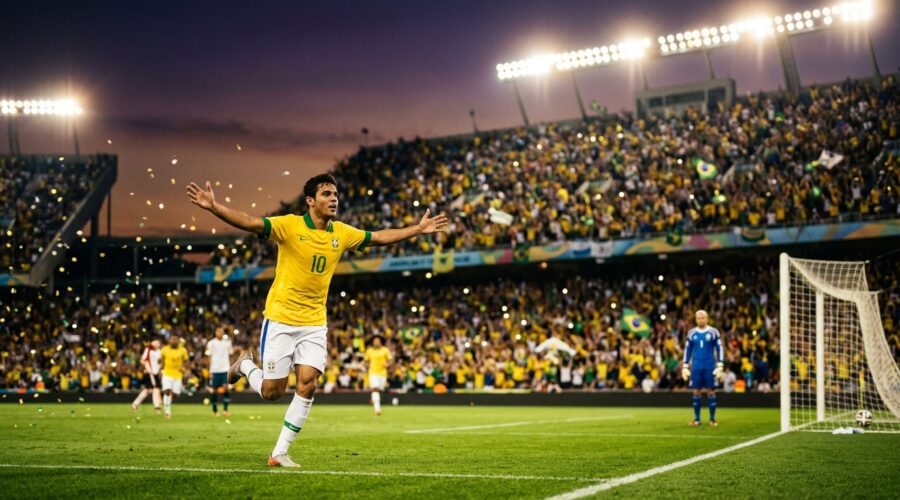
Matheus Cunha, deployed in a free role behind Vinicius Junior, was the story. His first goal arrived in the 23rd minute — a sharp rebound after Johny Placide had parried a Vinicius drive — and it landed in the books with rather more weight than a routine tap-in usually carries. That goal pushed Brazil to 238 World Cup goals, one behind Germany’s all-time record of 239 — a record Germany claimed when they dismantled Curaçao 7-1 on June 15. Cunha’s second, in the 36th minute, was the better of the two: a Vinicius through ball, an instant first-time finish, the kind of instinctive striker’s goal that only looks simple when you are the person playing it.
Vinicius added the third himself, sliding beneath Placide after collecting a Paquetá pass, before collecting the official Player of the Match award — somewhat generously, given Cunha’s evening. The man from Bournemouth, Rayan, came on for the injured Raphinha at the 40-minute mark and gave the crowd something to talk about in the way only fearless nineteen-year-olds can. He is one to watch in the Brazil vs Scotland match in Miami.
The Raphinha injury is the asterisk on an otherwise composed evening. Brazil face Morocco next, with Raphinha’s availability uncertain, and a fit Morocco side defending set-pieces with considerable menace. Ancelotti will be filing that thought somewhere uncomfortable.
Haiti, for their part, were not disgraced. Placide made multiple acrobatic saves — denied a Ricardo Adé header from a corner, kept the scoreline respectable until the final quarter — and played with a composure that belied their position. They become the first nation eliminated from this World Cup, and their presence here, their second-ever tournament, was worth every minute. They were just, on this evidence, caught a division short.
As for the record itself — Germany’s 239 goals carry a certain irony that requires no explanation to anyone who was alive in July 2014 and remembers the peculiar silence of a Brazilian summer evening. Brazil, now on 238, trail by a single goal. The gap has never felt smaller, or more loaded.
Paraguay’s Finest Hour (With Ten Men)
You would struggle to design a more dramatically inconvenient sending-off than Miguel Almirón’s red card in the 45th minute plus three at Levi’s Stadium. Paraguay had already secured what should have been the match’s defining moment — Matías Galarza’s goal at 64 seconds, the fastest strike of this tournament, a crisp finish that left Turkey’s goalkeeper with barely time to set his feet — and were comfortably seeing out the first half. Then Almirón went, the dressing-room door had barely closed, and suddenly Paraguay needed to defend an entire second half a man down against a side that had now become, through simple desperation, considerably more dangerous.
They did it. Goalkeeper Orlando Gill was outstanding — composed, commanding, the kind of goalkeeper whose calm communicates itself to the defenders in front of him. Turkey, for all their frantic pressure, could not find a way through. Hakan Çalhanoğlu struck a free kick that hit both the crossbar and the post in the same movement, which is the sort of thing that happens to sides whose luck has entirely abandoned them. According to reports, Turkey registered 32 shots across their two group games without scoring once. Thirty-two. There is a particular kind of football hell reserved for teams who cannot convert possession and pressure into goals, and Vincenzo Montella’s side found it with impressive thoroughness.
They are eliminated, goalless, 180 minutes of World Cup football having produced nothing but increasingly creative ways to miss. It is a cruel game. Paraguay, nine men and a goalkeeper against the tide, advance to Matchday 3 to face Australia for second place in Group D. They will face that one without Almirón, but having demonstrated a defensive organisation that suggests they are capable of making it deeply inconvenient for anyone.
The Dutch Put On a Show — Then File a Grievance
The peculiar, bittersweet arithmetic of the Netherlands’ relationship with the World Cup acquired another dimension at NRG Stadium in Houston. Brian Brobbey, recalled to the starting lineup in a selection call that looked aggressive at kick-off and inevitable in retrospect, put Ronald Koeman’s side two goals clear inside 17 minutes. His first, in the fourth minute — a clinical first-time finish from Gakpo’s low cross — was followed by an almost carbon-copy second in the 16th. Two goals in thirteen minutes of football. The third-fastest opening double at a World Cup since 1986, behind Podolski against Sweden in 2006 at 11 minutes and 35 seconds, and Ronaldo Nazário against Costa Rica in 2002 at 12 minutes and 16 seconds. Good company.
Sweden, who had entered this match in second place in Group F — the Netherlands led with four points to Sweden’s three following their earlier results — found themselves staring at a deficit from which they never genuinely recovered. Cody Gakpo, introduced at half-time as a substitute but very much the second act’s protagonist, scored twice — the second, a fierce drive into the bottom corner in the 54th minute, confirmed as the 100th goal of the 2026 World Cup. Crysencio Summerville swept home a fifth in the 90th minute, and Anthony Elanga’s consolation in the 58th — a neat clipped finish from an Alexander Isak through ball — gave Sweden a goal to carry home but little else.
Final score: 5-1. It was the kind of display that makes tournament previews look prescient and rival coaches take notes.
And then the statistic, delivered with the gentle cruelty of a well-timed aside: the Netherlands became the eighth nation to score 100 or more World Cup goals — the first to reach that milestone during this tournament — joining Germany (239), Brazil (238), Argentina (152), France (136), Italy (128), Spain (108), and England (104). They are the only side in that group who have never won the tournament. Three finals, three defeats, a century of goals, and a trophy cabinet that remains conspicuously underused. Clarence Seedorf said afterwards that they are here to go all the way. The Dutch always are. That is rather the point.
Group F now sits with the Netherlands and Japan locked on four points apiece after Japan’s comfortable 4-0 win over Tunisia on the same evening. The second phase of this group will be decided between those two sides, and it promises considerably more tactical sophistication than the evening’s scorelines suggest.
Germany’s Second Act: The Undav Principle
Julian Nagelsmann made three simultaneous substitutions around the hour mark at BMO Field in Toronto, and one of them changed the match, the group standings, and the Golden Boot conversation in the space of thirty minutes. Deniz Undav, who had scored twice and assisted twice in Germany’s 7-1 dismantling of Curaçao on Matchday 1, came on with Germany trailing 1-0 to an Ivory Coast side that had, to be entirely fair, outplayed the world’s second-ranked side for the best part of an hour.
Franck Kessié’s 30th-minute goal — a loose ball slotted into the far left corner after Germany’s defence had failed to clear — was thoroughly deserved. The Ivorians were more compact, more urgent, and considerably better organised than Germany’s first match had suggested they needed to be. Two German goals had been correctly disallowed before that point. The situation, at half-time, looked genuinely uncomfortable for Nagelsmann.
Undav equalised in the 68th minute and won it in the 90th plus four. The Germany substitute had now accumulated three goals and two assists across 56 total minutes of World Cup football — a goal involvement every eleven minutes, which is the sort of statistic that makes you wonder whether Nagelsmann’s squad-rotation strategy is either accidental genius or the most carefully constructed illusion in tournament football. The BBC noted he was tying Roger Milla’s 1990 record for most goal involvements by a substitute at a World Cup since 1966. That is not a comparison made lightly.
Germany qualify for the Round of 32 with six points and a goal difference of plus-eight. They have scored nine goals in two games and conceded just once, and their most effective player has started neither of those games. The structural question for every remaining opponent is not just how to stop Germany — it is how to stop a Germany side that may be hiding its most dangerous piece until you are already behind.
Elsewhere, the absence of Ivory Coast striker Elye Wahi — reportedly unable to enter Canada due to a legal dispute connected to an alleged betting investigation — cast a shadow over what had otherwise been a composed Ivorian performance. These are matters for the relevant authorities. What is football-relevant is that Ivory Coast, three points, still very much alive, face Curaçao in Matchday 3 knowing a win keeps them in serious contention for the last sixteen.
Ecuador and Curaçao: A Game Best Forgotten
There will not be much written about the 0-0 at Arrowhead Stadium in Kansas City, and that is the most honest thing to say about it. Ecuador and Curaçao played the kind of match that happens when two sides simultaneously calculate that a draw is survivable and then proceed to manufacture exactly that, without quite meaning to. Eloy Room in the Curaçao goal made several saves of note. Moisés Caicedo worked hard in midfield, as Moisés Caicedo always does. Enner Valencia was muted. The match was muted. Both sides sit on one point and must win their final group games, against Germany and Ivory Coast respectively, to have any realistic prospect of progression.
Given what we saw from Germany in Toronto, Ecuador’s task borders on Sisyphean. One chooses not to elaborate further.
The Bigger Picture
After June 20, the Golden Boot race has three men joint-level on three goals: Deniz Undav, Lionel Messi, and Jonathan David. The first has played 56 minutes. The second needs no introduction. The third represents a Canadian football movement that deserves an essay of its own.
Two nations are eliminated — Haiti and Turkey — and both departures carry distinct flavours. Haiti leave having given the tournament a moment of genuine celebration simply by being here; their dignity throughout was considerable. Turkey leave having threatened constantly and delivered nothing, which is its own kind of football tragedy, the sort that comes without obvious resolution or lessons that can be easily applied.
Brazil and Germany are already through. The Netherlands and Japan are level at the top of Group F, Sweden and Ivory Coast are fighting for second places in their respective groups, and Paraguay still have something to play for in a Group D where the USA sit alone at the top — six points from two victories, with a final group game against Turkey on June 25 still to play before qualification is officially confirmed.
Matchday 3 approaches: Brazil versus Scotland in Miami on June 24, Germany versus Ecuador at MetLife on June 25, and the Group F decider between Netherlands and Japan in Kansas City. The group stage is tightening in the way group stages always do — the slack shaken out, the genuine questions beginning to form. Who stops Germany’s bench? Can Brazil cope without Raphinha? Will the Netherlands’ century of goals finally end in the thing they have chased across three finals and fifty years of near-misses?
June 20 gave us no definitive answers. It gave us thirteen goals, two exits, a broken record, and a twenty-nine-year-old substitute who cannot stop scoring. That will do for a Saturday.