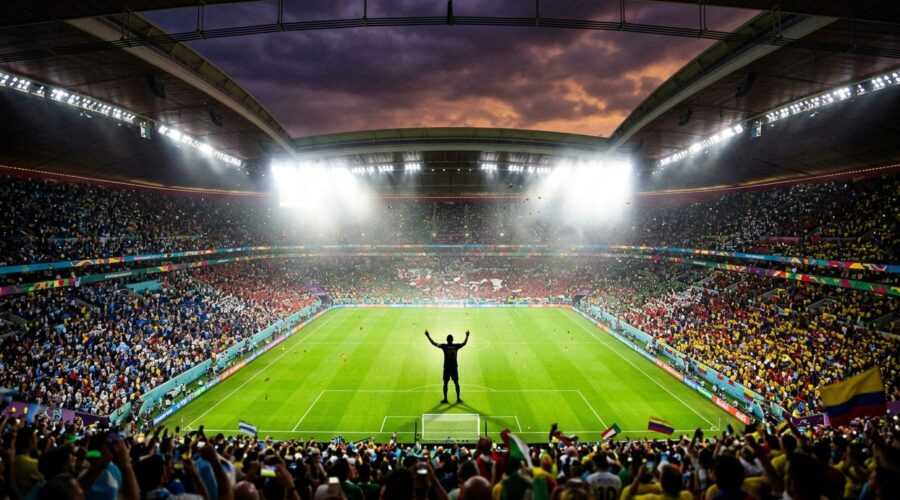
There are days at the World Cup that feel, in the moment, like the ones you will describe to people who weren’t there. July 3rd, 2026 was one of those days. Three matches across three venues, from the cool Pacific air of BC Place in Vancouver to the baking dome of AT&T Stadium in Arlington to the sweat-soaked theatre of Hard Rock Stadium in Miami Gardens — and across all three, football offered up records broken, histories made, tactical blueprints executed, and at least one goal so improbable it seemed borrowed from another sport entirely. There was also, it should be noted, an almost comical accumulation of own goals, which tells you something about the tournament’s slightly chaotic soul.
By the time Diney Borges deflected a Cristian Romero header into his own net at the 111th minute in Miami, the day had already delivered more than any reasonable football fan deserves in a single sitting. Let us work through it methodically, because each story deserves its proper telling.
Switzerland 2–0 Algeria | BC Place, Vancouver
There is a particular kind of satisfaction in watching a team do exactly what they said they would do, and then watching the opposition have no answer for it. Murat Yakin’s Switzerland arrived at this match with 44% of the ball and left it having comprehensively dismantled an Algerian side that should, in theory, have been more than equipped to punish such apparent passivity. They were not. They rarely are against a properly organised Swiss block, which is the point Yakin has been making since he took over, and which his critics have never quite absorbed.
Breel Embolo settled the nerves — and the match’s tactical argument — inside ten minutes. A counter-attack, a composed finish, and that slightly deflating sensation for Algeria of conceding the precise goal their coach had told them to prevent. The nature of the strike against the run of play mattered enormously. Algeria had begun brightly, pressing with ambition and something approaching authority, and then the Swiss absorbed it, turned it, and punished them before Algeria’s momentum had converted into anything tangible. A sucker-punch by any useful definition of the phrase.
Dan Ndoye added the second sixty seconds into the second half — the most psychologically catastrophic moment to concede a goal, when the opposition have barely resumed their positions and the referee’s first whistle is still fading. Algeria never recovered. Vladimir Petkovic, the man who built a version of this Swiss side between 2014 and 2021, now found himself watching it dismantle his own Algerian rearguard. There is a wry irony there that the football gods appeared to savour.
The name worth remembering from Vancouver is Johan Manzambi. Twenty years old, two goals and two assists across the group stage, and a performance in the buildup play against Algeria that confirmed he belongs at this level without any further qualification required. The Swiss have a habit of producing technically accomplished midfielders who combine intelligence with efficiency, and Manzambi fits the lineage rather neatly.
Riyad Mahrez, thirty-five years old and twice a scorer in the group stage, was kept quiet with the methodical precision of a team that had studied the problem carefully and deployed the correct solution. Switzerland’s xG read 1.43 to Algeria’s 0.69 — a reflection not of dominance in possession but of the superior quality of the spaces their counter-attacking system produced. This is their third consecutive Round of 16, achieved now with the certainty of a side that knows precisely what it is doing. Colombia await on Tuesday, and they will be made very aware of that certainty.
Australia 1–1 Egypt (Egypt win 4–2 on Penalties) | AT&T Stadium, Arlington
The word historic is deployed with such industrial frequency in football commentary that it has been almost entirely stripped of meaning. And yet there is no other word for what Egypt achieved in Arlington on Thursday afternoon. In four World Cup appearances spanning ninety-two years — 1934, 1990, 2018, and now 2026 — Egypt had never won a knockout match. Not once. On July 3rd, 2026, that changed: Egypt defeated Australia 4–2 on penalties in the Round of 16, their first-ever World Cup knockout victory. The Pharaohs, who in 1934 became the first African, Arab, and Middle Eastern nation to play at a World Cup, had left each successive tournament in the first knockout round with nothing but the experience itself. Until Mohamed Salah chipped a Panenka into the top of the net and Hossam Abdelmaguid slotted home the fourth, and the AT&T Stadium’s covered dome echoed with something that sounded an awful lot like ninety years of waiting being released at once.
The match itself was rather more complicated than the final scoreline suggests. Emam Ashour’s header at the far post after thirteen minutes was the first knockout-stage goal ever scored by an Egyptian player — a genuinely historic moment that illustrates the scale of what had been absent across all those previous tournaments. Abdel Rahman Fawzi, the name most associated with Egypt’s 1934 World Cup adventure, scored in that edition’s opening round against Hungary, but that match was not a knockout fixture in the modern sense. Ashour’s header was the real landmark. Egypt had the lead, and for considerable stretches of the first half, they looked capable of extending it.
Australia’s equaliser came in the ugliest possible fashion. A free kick deflected off Mohamed Hany and into Egypt’s net in the 55th minute — the tournament’s 13th own goal overall, a new World Cup record for most own goals in a single tournament, surpassing the twelve recorded at Russia 2018. Multiple nations contributed to that tally across the competition; this was not Australia’s doing alone, though the deflection that levelled the score was certainly theirs. That figure speaks to something about the tournament’s broader defensive disorganisation that deserves harder analysis than it will probably receive in the immediate aftermath of this elimination.
Patrick Beach was, for long stretches of the remaining ninety minutes and extra time, the reason the match remained level. His save from Ramy Rabia’s header in the dying moments of extra time was the kind of stop that wins post-match awards and earns goalkeepers cult status in their home countries. It was a magnificent piece of goalkeeping. What happened next was, depending on your tolerance for managerial eccentricity, either a brave gamble or an inexplicable act of self-sabotage.
Australia’s coaching staff withdrew Beach and replaced him with Mathew Ryan immediately before the penalty shootout. Ryan, an experienced international with Premier League history, saved none of Egypt’s four penalties. Harry Souttar blazed Australia’s first kick over the bar with the kind of follow-through that suggested he was aiming for a different postcode. Lucas Herrington — eighteen years old, Colorado Rapids, reportedly linked with Barcelona, which now seems a slightly optimistic proposition — missed the third. Egypt converted all four, with their captain, playing on a hamstring injury that had been visible for the better part of an hour, choosing his moment to float a chip over Ryan’s dive that was equal parts audacity and technique.
Mohamed Salah, it must be said, had no business playing 120 minutes of World Cup football in that condition. He had no business dictating play from deep in extra time, or composing himself over a penalty in the 120th minute with his team’s World Cup survival balanced on the spot. He did all of it. He is one goal away from the Egyptian international record of 69, held by the nation’s coach Hossam Hassan, which when it happens will be a poetic footnote worthy of its own story. For now, Egypt face Argentina on Tuesday in Atlanta. The bracket, it is fair to say, has not been kind.
Australia leave the 2026 World Cup having still never scored a knockout goal from open play. They are 0–3 all time in knockout matches. The goalkeeper debate will run for years. The team deserved better than that tally suggests, and worse than their coaching staff allowed them to achieve.
Argentina 3–2 Cape Verde Islands (AET) | Hard Rock Stadium, Miami Gardens
The defending champions of the world, ranked first on earth, were taken to extra time by a nation of approximately 560,000 people making their debut at the tournament, and were only spared the most seismic upset in the history of the competition by a deflection off a defender’s shin in the 111th minute. That is the architecture of what happened in Miami. Everything else — and there is so much else — exists in the surrounding structure of those facts.
Lionel Messi’s 29th-minute goal was his 6th of the 2026 tournament and added to a World Cup goals tally he had already been building through the competition — earlier in the tournament, a brace against Austria had taken him to 18 total World Cup goals, surpassing Marta’s all-time record of 17 across both men’s and women’s competitions. He extended his record of scoring in eight consecutive World Cup matches. He made his 28th World Cup appearance, the all-time record for men’s football. He leads the Golden Boot standings with seven goals from four games. The statistics, at this point, have become something beyond statistics. They are simply the language of a career that has no adequate comparison.
And then Cape Verde equalised in the 59th minute, and suddenly none of the records particularly mattered.
Deroy Duarte’s low finish, set up by Ryan Mendes, was composed and clean and struck past Emiliano Martínez with a certainty that suggested Cape Verde had not arrived at this tournament simply to participate. These are players who drew with Spain, drew with Uruguay, drew with Saudi Arabia in the group stage, and qualified as Group H runners-up. The Blue Sharks were not here for the photograph. They were here because their coach, Bubista, had built something genuinely competitive from a diaspora spread across a dozen European leagues, assembled with an eye for collective organisation that a nation ranked 67th in the world has no right to be deploying this effectively.
Lisandro Martínez put Argentina ahead again in the 92nd minute of extra time after Alexis Mac Allister flicked on a Messi corner kick, and Martínez slotted his shot under the crossbar — and the logical assumption was that the matter was settled. It was not. Eight minutes later, in the 103rd minute, Sidny Lopes Cabral — who had already given Argentina trouble — received a pass from Yannick Semedo on the left flank and struck a curling right-footed shot into the far top corner that carried an xG value of 0.03. One of the six lowest-probability goals of the entire 2026 tournament. Cabral ran into the stands to celebrate. He can be forgiven the indulgence. It was one of the finest goals scored at any World Cup in living memory, and it came in a knockout match, from a debutant nation, against the world champions, in extra time. The football gods were clearly in an extravagant mood.
Penalties appeared to be arriving. For nine minutes, they appeared inevitable. Then Messi won a corner in the 111th minute, Cristian Romero attacked it with his head, and Diney Borges — in the cruellest possible act of misfortune for a player who had been heroic — deflected the ball into his own net. Argentina 3–2. The match was over. Cape Verde’s World Cup was over.
Vózinha deserves an essay of his own. The Cape Verde goalkeeper made eight saves across the match, five of them directly denying Lionel Messi — a remarkable individual performance in a knockout fixture against the world champions. For context, Rais M’Bolhi’s 11 saves against Germany in the 2014 Round of 16 remain the benchmark for an African goalkeeper in this stage of the competition, and Vózinha did not surpass that record — but the quality and consequence of his stops across 120 minutes demands its own recognition. He was the best goalkeeper on the pitch by some distance. He was beaten by a deflection from his own teammate. In another universe, he has a very different Thursday evening.
Argentina have now won twelve World Cup matches in extra time, tying Germany for the all-time record. They did not look like a team capable of winning twelve friendly matches in extra time last night. They survived because Emiliano Martínez made two critical saves in the final ten minutes, because Messi’s corner delivery found the right trajectory, and because football, even at the highest level, contains an irreducible element of randomness that no amount of tactical preparation can fully eliminate. Cape Verde will understand this better than most.
The Day’s Wider Reckoning
Three own goals shaped three matches — Mohamed Hany’s deflection for Australia, Diney Borges’s deflection for Cape Verde, and the tournament’s thirteenth overall own goal, which remains a record that will not be challenged in this edition. The 2026 World Cup has now produced 53 set-piece goals — more than any tournament since 1966 — and the pattern running through the day’s three matches reflects that broader theme. Corners and free kicks are not incidental details in this tournament. They are the central tactical argument, and the teams that have organised their set-piece delivery, their attacking runs, and their defensive shape around these moments are consistently the ones advancing.
On Tuesday, Egypt face Argentina in Atlanta. It is an extraordinary proposition — a nation playing in the aftermath of its first-ever knockout win, against the defending world champions, who required extra time to eliminate a debutant. Mohamed Salah against a back four that just spent 120 minutes being repeatedly threatened by a team ranked 67th in the world. Switzerland face Colombia in Vancouver, a match that will test whether Yakin’s disciplined counter-attacking blueprint can absorb an opponent with considerably more attacking variety than Algeria possessed.
July 3rd gave us records that will not be broken, exits that will be mourned with genuine affection, and at least one goal — that curling, arcing, utterly unreasonable strike from Sidny Lopes Cabral — that will be played on highlight reels long after anyone still remembers the final score. That, in the end, is what these days are for. Not the spreadsheets. Not the xG. The moments when football does something no one asked it to do, and everyone is grateful that it did.