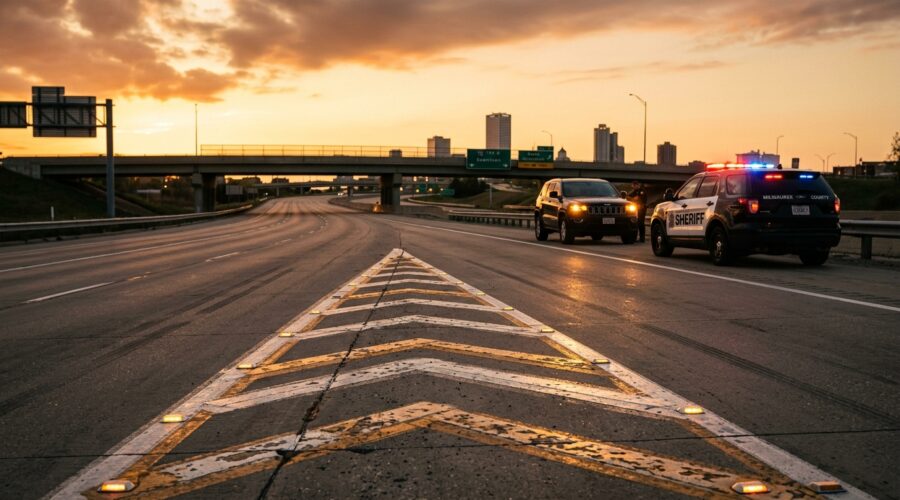
On July 23, 2026, at approximately 5:30 PM Central Time on a high-rise bridge over Interstate 43 in Milwaukee, Wisconsin, a Milwaukee County Sheriff’s deputy pulled over a black Jeep for an unsafe pass through a gore area. Inside the Jeep was Tony Romo — 46 years old, former Dallas Cowboys quarterback, nine-year CBS Sports veteran, holder of the largest broadcasting contract in the history of American television, and, by his own account, a man on his way to visit grandma and grandpa.
It is, as a sentence, almost too much to process.
Eight days, one viral bodycam video, and one terse CBS press release later, the most consequential story in NFL media in years had fully detonated. Romo was placed on indefinite leave. J.J. Watt was promoted to the network’s lead broadcast team alongside Jim Nantz. And a $72 million contractual timebomb, one that a top sports media executive had already called “the worst contract in media history” at the time it was signed, was suddenly, urgently, everyone’s problem.
Let’s break all of it down. Because there is a lot to break down.
The Arrest, Play-by-Play
Romo had spent July 20–23 competing in the Wisconsin Amateur Championship golf tournament in West Bend — a detail that is both charming and somewhat devastating once you learn he tied for 73rd place. He was driving southbound on I-43 when a deputy observed him execute an unsafe pass through a gore area, which, for those of us who needed Romo to define it during the traffic stop (he asked), is the triangular painted pavement that separates highway traffic from on-ramp entry lanes. You are not supposed to drive through it. Romo drove through it.
The deputy pulled him over at 5:30 PM. By 6:15 PM, Romo was in handcuffs. By 9:45 PM, he was booked on OWI, 1st offense. By 11:00 PM, he was released. The whole arc, from gore area to freedom, took roughly five and a half hours.
The arrest-detention report, and then the bodycam footage released by the Milwaukee County Sheriff’s Office on July 28, filled in the details. The deputy noted red, glassy eyes and an odor of alcoholic beverage. A search of Romo’s backpack found shooters — those miniature liquor bottles that exist primarily at airport gift shops and gas stations and, apparently, golf tournament backpacks. An open container was found on the passenger side during the vehicle inventory before towing. Romo initially told deputies he hadn’t been drinking, then acknowledged having one Corona. He performed poorly on standardized field sobriety tests. When asked about prior head injuries, he laughed and acknowledged having accumulated some over the years, but clarified that none had occurred recently, which, given the circumstances, landed as one of the more unintentionally funny lines in the footage.
He also, mid-sobriety test, asked if he could do a stretching exercise, citing two back surgeries. You cannot make this up. The man is a competitor.
When the deputy requested a preliminary breath test, Romo declined with what will surely become the most-quoted line of his broadcasting career: “Oh no. We’re not doing that. I’ve heard from multiple lawyers, ‘Don’t ever do that.'” Which is technically sound legal advice. It is also, when delivered on a highway shoulder in Milwaukee with shooters in your backpack, not a great look.
He received four citations in total: OWI 1st offense (a civil forfeiture under Wisconsin law, not a criminal misdemeanor — the fine is $150–$300 plus a $435 surcharge, which is a parking ticket for someone with $18 million per year in contractual income), an open container violation, an unsafe passing citation, and a fourth citation for refusing the breathalyzer post-arrest. His court date is September 21, 2026. He is not required to appear in person, which is convenient because that date falls during NFL Week 2.
Eight Days of Silence, Then One Very Deliberate Sentence
CBS declined to comment for eight full days after the arrest. Colin Cowherd, citing sources at Fox Sports, reported that for the first two days, nobody from CBS even contacted Romo directly. Whether that is accurate or simply the most efficient way to characterize what happened depends on who you ask, but the perception it created was damaging in its own right: the network appeared to be distancing itself from a man it still owed $72 million.
On July 31, CBS broke its silence with a single sentence: “Tony Romo is on leave from his role at CBS Sports until further notice.”
That is seventeen words. For context, the Declaration of Independence is 1,320 words. CBS used seventeen. The brevity was not accidental. Every additional word would have been a potential legal liability, a moral position staked out, or an invitation to a follow-up question the network was not prepared to answer. Seventeen words is what you say when your lawyers have read every sentence and deleted everything except the load-bearing minimum.
Simultaneously, CBS announced that J.J. Watt would join Jim Nantz and Tracy Wolfson as the lead NFL broadcast team for the 2026 season. The arrest and the promotion were announced in the same breath, which — even if logistically unavoidable — is the kind of juxtaposition that generates its own narrative gravity.
The $72 Million Question Nobody Can Fully Answer
Here is where this story stops being a colorful off-season anecdote and starts being genuinely complicated.
In February 2020, Tony Romo signed a 10-year, $180 million contract extension with CBS — roughly $18 million per year — making him the highest-paid NFL analyst in television history. The deal was signed under competitive pressure: ESPN was aggressively pursuing Romo for Monday Night Football, and he used that leverage to extract maximum value from a CBS front office that badly wanted to retain him. By any reasonable measure, the leverage was real and the strategy was smart.
Six years later, the deal sits at approximately $72 million and four years remaining. It has been called “the worst contract in media history” by a top sports media executive, a verdict that Andrew Marchand of The Athletic revisited in August 2026 with renewed conviction. CBS finds itself in the position of owing enormous money to a broadcaster whose performance had reportedly been declining for multiple seasons, who just generated one of the most viral arrest videos in recent memory, and whose contract a new corporate regime — David Ellison’s Paramount Skydance, which acquired CBS post-deal — has no particular emotional attachment to.
The morals clause is, in theory, CBS’s off-ramp. Standard in high-profile broadcast agreements, morals clauses allow employers to discipline or terminate employees whose behavior damages company reputation or brings public embarrassment — covering conduct both on and off the job. The language is typically broad: public disrepute, scandal, ridicule, behavior that reflects unfavorably on the network. An OWI arrest with viral bodycam footage showing mini liquor bottles and a refused breathalyzer would seem to be in the neighborhood of what these clauses are designed to cover.
But here is the problem: it is not that clean. Mike Florio of ProFootballTalk laid out the core tension precisely. If CBS invokes the morals clause and terminates for cause, Romo’s legal team would almost certainly challenge it with a consistency defense — arguing that CBS has not invoked morals clauses in comparable situations with other broadcasters, which would suggest the clause is being used as legal pretext to escape a financially regretted contract rather than as a genuine conduct concern. That is a coherent argument. Courts and arbitrators have historically been skeptical of contract terminations that happen to align with a party’s financial interest in exiting the deal.
There is also a “nothing to lose” dynamic that Florio raised: if CBS owes Romo $72 million to walk away cleanly, why not invoke the clause and try to pay him nothing? If they lose arbitration, they still pay the $72 million. The asymmetry of outcomes makes aggressive legal strategy rational even if it is not guaranteed to succeed.
Most analysts, including Marchand, expect a settlement — some negotiated buyout figure below $72 million that allows both sides to avoid a prolonged, public, expensive arbitration. That is the most likely ending. But “most likely” and “certain” are different things, and the gap between them represents a legal story that could run parallel to the entire 2026 NFL season.
Romo’s Broadcast Trajectory: The Context Everyone Was Already Discussing
Before any of this happened, Tony Romo’s broadcast career was already a more complicated story than his contract implied.
When Romo joined CBS in 2017, the praise was immediate and legitimate. He had a genuinely rare ability — calling plays before the snap, walking viewers through quarterback decision trees in real time, explaining coverages in language that felt like football, not broadcast protocol. It was a differentiated product. He became, for several seasons, the gold standard for analytical color commentary.
But the “play prediction” brand is uniquely difficult to sustain. The novelty fades. Defenders adapt. Play-callers become less predictable. The thing that made you special in Year 1 becomes the thing critics scrutinize in Year 7. Multiple insiders had reported declining broadcast quality in Romo’s recent seasons, and the Romo-Nantz pairing drew more criticism than praise in end-of-season media assessments for 2025. The Awful Announcing rankings — a benchmark most serious media observers treat as credible — had the Eagle-Watt No. 2 pairing cracking the top five, while Romo-Nantz was drawing increasing heat.
Bobby Burack of OutKick offered the most pointed analogy: “Think of it like a struggling starting quarterback who gets injured. If the backup plays better, history shows the better player often keeps the job, regardless of the guaranteed contract.”
That framing is both useful and darkly ironic. Tony Romo, the man who lost his starting job in Dallas to Dak Prescott in 2016 despite still being under contract, may be about to experience a structurally identical situation in the broadcast booth, nine years later, in a different medium, with considerably more money involved.
J.J. Watt: The Backup Who Was Always Going to Start Eventually
If you were going to design a succession plan for Tony Romo at CBS, J.J. Watt is the blueprint.
Three-time NFL Defensive Player of the Year. Five first-team All-Pro selections. Walter Payton NFL Man of the Year. Certain Hall of Famer. Houston Texans franchise icon. The jersey number is retired. The cultural credibility is enormous. And by every account from people who have worked with him in broadcasting, the work ethic has transferred entirely from the field to the booth.
Watt joined CBS in June 2023 as a studio analyst on The NFL Today. In March 2025, CBS moved him to the booth alongside Ian Eagle on the No. 2 broadcast team. His 2025 debut season — starting with the Pittsburgh Steelers versus New York Jets in Week 1 — was widely considered a success, earning enough praise to land the Eagle-Watt pairing in the top five of Awful Announcing’s annual announcer rankings. He also joined the Manning Cast for the Houston Texans wild-card game against the Steelers, which, given the audience those alternate broadcasts command, functioned as a high-visibility audition for exactly the role he is now stepping into.
Ian Eagle’s endorsement in January 2026 deserves to be quoted directly because it is specific in a way that generic praise is not: “He is as good a dude as you think he would be, but despite all the accomplishment, despite the accolades, despite the fact that he’s going to the Hall of Fame… he is as humble a person as I’ve been around, and I think that’s what makes him so good on the air.” Eagle specifically highlighted Watt’s curiosity and willingness to study the craft — an implicit contrast to broadcasters who assume their on-field credibility will transfer automatically, without the analytical work to back it up.
Watt himself, speaking on the Ross Tucker Football Podcast on July 28 — the same day the Romo bodycam footage went viral, in a timing coincidence that feels almost scripted — framed his approach in terms that anyone who watched him play would immediately recognize: “I also had plenty that I learned and now can’t wait to implement in Year 2. It’s not dissimilar to being a player where you go back, you study what you did well and what you didn’t do well and you have so much more you want to work on.”
His first game alongside Nantz is scheduled for September 13, 2026 — Minnesota Vikings versus Green Bay Packers, an NFC North divisional matchup on a Sunday afternoon. It is, objectively, an appropriate stage.
The Broader Stakes: What This Story Is Really About
Three industry-wide questions are embedded in this situation that will outlast the Romo-CBS resolution, whatever form that resolution takes.
First, the sustainability of the “play prediction” broadcast brand. Romo built his early CBS reputation on a specific differentiator. That differentiator faded. The broader question is whether any broadcaster can sustain a novelty-dependent brand over a decade-long contract, or whether the economics of these deals structurally outpace the shelf life of the quality that justified them.
Second, the unprecedented scale of broadcast contracts and the risks they create. At $18 million per year, Romo was earning more than most starting NFL quarterbacks. The financial leverage that created that number — ESPN competing aggressively, CBS panicking, Romo’s team negotiating ruthlessly — was real and rational in 2020. But leverage is asymmetric. It generates resentment on the paying side that compounds over time, and as Cowherd noted, that resentment appears to have shaped CBS’s cold, delayed response to the arrest rather than any genuine ambiguity about what it should do.
Third, morals clauses in the viral social media era. These clauses were designed for a world where incidents faded. A DUI in 2003 generated a news cycle, maybe a few weeks of coverage, and then largely disappeared from public consciousness. A 45-minute bodycam video released in 2026 gets cut into clips, meme-formatted, embedded in podcasts, and lives on YouTube indefinitely. The reputational calculus has fundamentally changed, and contract language written before smartphones needs to be interpreted in an environment their authors did not anticipate.
And sitting quietly in the background of all of this: CBS is broadcasting Super Bowl LXII on February 13, 2028. That had been the natural horizon for evaluating Tony Romo’s future at the network — a multi-year timeline that his arrest has compressed into a matter of months. Would CBS really want to walk into its decade-defining broadcast carrying $72 million in unresolved litigation and a broadcaster whose reinstatement path is, to use Andrew Marchand’s precise phrasing, “not impossible, but going to take some work”? That is a question David Ellison’s new corporate leadership at Paramount Skydance gets to answer, without the institutional loyalty to legacy deals that might have complicated the calculus under previous ownership.
Jerry Jones Had to Weigh In, Obviously
Dallas Cowboys owner Jerry Jones offered public support for Romo in the aftermath, saying: “I love him. I love what he’s about. I love his character. I love his love of sport. And he’s a very, very unique talent. And the real question is — and I don’t even have to ask what the answer is: Do you think Tony Romo knows how to get up when he gets knocked down? He had a life of that. And absolutely, that’s one of his greatest attributes, is that he can handle adversity.”
This was a personal loyalty statement, not a professional intervention, and it should be read as such. Jerry Jones’s affection for former players runs deep and is not always a reliable guide to what will actually happen next.
Where This Ends
Tony Romo has not issued a public statement as of this writing. His court date is September 21. He is not required to show up. The irony of a man who spent nine years predicting outcomes before they happened now facing a situation whose outcome is genuinely unpredictable is not lost on anyone who has watched his career closely.
The most likely scenario — settlement, buyout, negotiated exit below $72 million — is the boring one, and it is probably the right one for everyone involved. CBS gets its financial exposure reduced. Romo gets a significant payday to go quietly. J.J. Watt gets to do what he was eventually going to do anyway, just ahead of schedule. Nobody has to sit through an arbitration hearing where exhibit A is a bodycam video of a man asking a deputy to define a gore area.
But “most likely” is not the same as “guaranteed.” And even in the boring scenario, every assumption the sports media industry made about the economics of broadcast talent — the leverage, the contract scales, the morals clause enforceability, the shelf life of analytical differentiation — is being stress-tested in real time, in public, on Interstate 43 in Milwaukee, in a black Jeep headed toward grandma and grandpa’s house.
Tony Romo spent nine years in a broadcast booth predicting what was about to happen before it happened. For the first time in a long time, nobody — including him — knows what comes next.