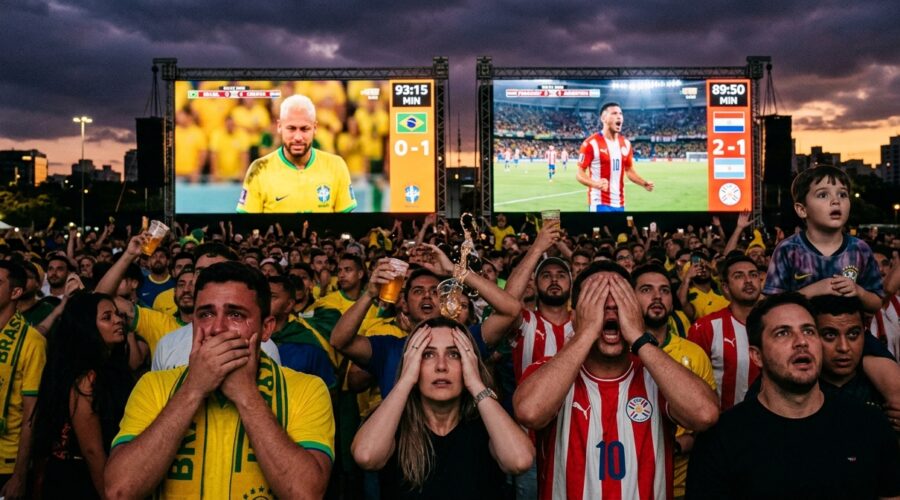
There is a particular kind of football that only a World Cup can produce — the kind where history is not merely being made but visibly unmade, where the comfortable certainties men have carried for decades are stripped away in the space of a penalty kick or a stoppage-time finish at a far post. June 29, 2026 delivered two of those moments inside the same afternoon, on opposite sides of the same continent, and if you were watching both you had the distinct sensation of witnessing the tournament announce itself properly for the first time.
Brazil scraped past Japan with a 90th-minute winner that flattered no one and thrilled everyone. Paraguay eliminated Germany in a penalty shootout — the first penalty shootout Germany have ever lost at a World Cup — sending the four-time champions home from a tournament they should, by most rational assessments, have controlled. On a day when football felt rather than calculated, the favourites survived by their fingernails and the underdogs dined out on German disbelief. Not a bad afternoon’s work.
Brazil 2–1 Japan | Houston Stadium
The Goal That Exposed Everything
You can trace the entire dramatic arc of Brazil’s afternoon back to one moment of staggering carelessness. Danilo, a man who has never quite convinced as the solution to Brazil’s right-sided problems, surrendered possession in midfield with the casual indifference of someone misplacing a set of keys. What followed was anything but casual. Kaishu Sano — already booked for a foul on Vinicius Jr, which tells you something about his temperament and his engine — gathered the ball deep in his own half and simply kept running. Forty yards later, with Casemiro retreating at a pace that suggested mild concern rather than genuine emergency, Sano struck a low, thundering drive that found the bottom corner past Alisson Becker.
It was a goal of the tournament contender. It was also a goal that Brazil’s defensive shape had been silently begging someone to score for twenty-nine minutes. The Seleção went into halftime 1–0 down, with Japan — operating on roughly a third of the ball — having made every touch count in the way that organised, tactically disciplined Asian sides have made a habit of doing at World Cups. The xG numbers told their own story: Brazil 0.7 at the break, Japan 0.53. The numbers suggested a contest. The scoreboard told you who was winning it.
Casemiro’s Arc of Atonement
Carlo Ancelotti is not a man given to panic. He has managed Real Madrid twice and won the Champions League five times — the only head coach in history to do so — making a half-time deficit to Japan at a tournament he was expected to win the sort of problem he files under manageable rather than catastrophic. Whatever adjustments he made in the dressing room — and he was characteristically tight-lipped about the specifics afterwards, offering only that Japan “played very well, very organized” — they produced an immediate structural improvement in how Brazil used the ball around Japan’s defensive block.
The equalizer, when it came in the 56th minute, carried with it a pleasing sense of narrative justice. Bruno Guimarães — quietly the best midfielder at this tournament, a man who has spent the group stage making everyone around him look slightly better than they are — floated a testing delivery into the box, and there was Casemiro, the man who had lost the ball for Japan’s opener, arriving with power and conviction to head Brazil level. It is the kind of redemption arc that football scripts with a generosity it rarely extends to defenders or central midfielders. Casemiro collected his.
Martinelli and the Art of the Super-Sub
Brazil pressed, Japan retreated and organised, and the match settled into the kind of attritional, slightly anxious rhythm that you get when a technically superior side cannot quite break the combinational lock of a team defending for its tournament life. Ancelotti introduced Gabriel Martinelli in the 66th minute, which is either inspired management or the obvious move depending on your level of generosity — and in the 90th minute plus five, it became the only move that mattered.
Guimarães, again, was the architect. His pass slipped Martinelli in behind Japan’s defensive line, the kind of run that the Arsenal winger makes without being asked to, instinctively and at full tilt, and his finish — squeezed past Zion Suzuki at the far post — was clinical enough to end the argument. Brazil 2–1. Into the Round of 16.
Ancelotti, measured as ever, said he was proud of “how the team reacted.” He was right to be, though one suspects he will also have noted that a Brazil side with a tournament xG of 1.8 against Japan was not exactly the Joga Bonito. They are through, they are intact, and they will face Norway or Ivory Coast next. They are also still, in the most diplomatic possible terms, a work in progress.
For Japan, it is another chapter in the most painful running story in Asian football. They have never won a World Cup knockout match — not once in their history, for all the moments they have threatened to rewrite it. Kaishu Sano scored a goal that deserved to win a match. It deserved, in some abstract footballing sense, to win them a tournament. Football, as Julian Nagelsmann would confirm from a different stadium a few hours later, can be very cruel.
Germany 1–1 Paraguay (Paraguay Win 4–3 on Penalties) | Gillette Stadium, Foxborough
The Architecture of a Low Block
Before we discuss what Germany did wrong — and they did several things wrong, some of them structural and some of them simply hapless — it is worth spending a moment on what Paraguay did magnificently right. Gustavo Alfaro set his side up in a compact, deeply organised 5–4–1 that asked Germany a very specific question: can you create big chances from open play against a team that has conceded just over one goal a game in this tournament, has kept two clean sheets, and has absolutely no interest in having the ball? Germany, it turned out, could not.
Seventy-seven percent possession. Seventeen shots. One big chance. Thirty-six touches inside Paraguay’s penalty area across one hundred and twenty minutes. These are not the statistics of a team that was unlucky. These are the statistics of a team that was tactically outwitted by a side ranked forty-one places below them in the world. Julian Nagelsmann, who is a perfectly good football manager in most conditions, has a well-documented vulnerability against low blocks — sides that deny him the space between the lines that Florian Wirtz requires to operate — and Paraguay exploited it with the precision of a team that had studied the blueprint in advance and executed it without deviation.
Enciso’s Header and the Warning Germany Missed
Paraguay’s goal, in the 42nd minute, arrived with the punctual inevitability of a bill arriving after an indulgent dinner. Germany had 79% possession in the first half. They had been the better side by any numerical measure. And then Matías Galarza delivered a corner, Julio Enciso — the Strasbourg forward who has been threatening to produce a moment like this for his entire career — met it with a sharp, flicked header, and Manuel Neuer was beaten. Paraguay went into halftime a goal to the good. The shrug you could feel across the terraces of Foxborough was a very particular kind of shrug: the shrug of people who had watched this exact pattern in the group stage, when Ecuador beat this same Germany side 2–1, and concluded that Nagelsmann had not yet found the answer.
Kai Havertz equalised in the 54th minute — a deft, intelligent header from a Wirtz cross, the sort of technical finish that reminds you why Arsenal paid what they paid — and Germany pushed on into extra time believing, as Germany always believe in these situations, that the shootout was theirs to claim. Their record said as much. Four shootouts at World Cups. Four victories. France in 1982, Mexico in 1986, England in 1990, Argentina in 2006. An unblemished record stretching across four decades and three generations of German footballers, all of whom had passed down the cold-blooded certainty of it like a piece of institutional knowledge.
The VAR Decision That Changed Everything
Then came the moment that will be debated in German football circles for years. Jonathan Tah, in the 102nd minute of extra time, met a set piece with a header that appeared to cross the line. VAR reviewed it. VAR ruled it out for a foul in the build-up. Nagelsmann, who generally maintains the composed exterior of a man who has considered all available outcomes, called it “the wrong decision.” He said football could be “very cruel.” He was not wrong, though he might have also noted that a side creating one big chance from seventeen shots across one hundred and twenty minutes against an outranked opponent is a team that has left its fate in fate’s hands.
And then the same Jonathan Tah — carrying the VAR decision, carrying the weight of Germany’s shootout mythology, carrying all of it — stepped up to take the fourth penalty. He skied it over the bar. José Canale, Paraguay’s Man of the Match, a defensive colossus who had spent the evening making sure Germany’s forwards touched as little grass as possible inside his penalty area, stepped up for Paraguay’s fourth and converted it with the serenity of a man who had been waiting for this moment all his life.
Paraguay win 4–3. Germany go home. History, for the first time in World Cup shootout history, turns its back on the Germans.
What This Means for Both Teams
For Germany, the post-mortem will be long and not entirely comfortable. They topped Group E. They beat Curaçao 7–1 in the tournament’s most misleading scoreline. They had Wirtz in the form of his life and Havertz scoring goals. They also lost to Ecuador in their final group game, created one big chance in one hundred and twenty minutes against Paraguay, and sent a player to take a pivotal penalty who had just had a goal disallowed for a foul and whose head was, visibly, somewhere else entirely. These are not the decisions of a tournament-winning management staff.
For Paraguay, the arc of this tournament is almost too good to be true. They lost 4–1 to the United States. They defeated Turkey 1–0 — Matías Galarza scoring inside the opening minute — and drew 0–0 with Australia, scraping through as one of the best third-placed teams on four points, which is to say they scraped through by the skin of their teeth and the grace of the expanded format that the 48-team World Cup makes possible. They then met Germany and did everything right, for one hundred and twenty minutes, with the discipline of a side that had nothing to lose and everything to organise. In the Round of 16, they face France or Sweden in Philadelphia — Paraguay’s first appearance at that stage since 2010, when they beat Japan in a shootout and lost to Spain in the quarterfinals.
The irony of beating Japan in a 2010 World Cup shootout and then, sixteen years later, eliminating Germany in 2026 with a shootout victory is the kind of coincidence that football generates without apparent effort or design. Alfaro’s side will take it either way.
The Wider Picture: A Tournament Finding Its Shape
Messi leads the Golden Boot with six goals. Vinicius Jr, Mbappé, Haaland, and Dembélé trail on four apiece. Brazil advance. Paraguay advance. Japan and Germany pack their bags. The 48-team World Cup — still finding its rhythm, still generating the occasional sense that the expanded format has diluted the peril of the group stage — has at least delivered a Round of 32 that felt consequential, dramatic, and, in the Germany case, genuinely historic.
June 29, 2026 will be remembered as the day a Brazilian substitute squeezed a winner past a Japanese goalkeeper in stoppage time, and the day a Paraguayan defender skied a penalty over the bar before someone else scored the one that mattered. Football, felt rather than spreadsheet. It had a good day.