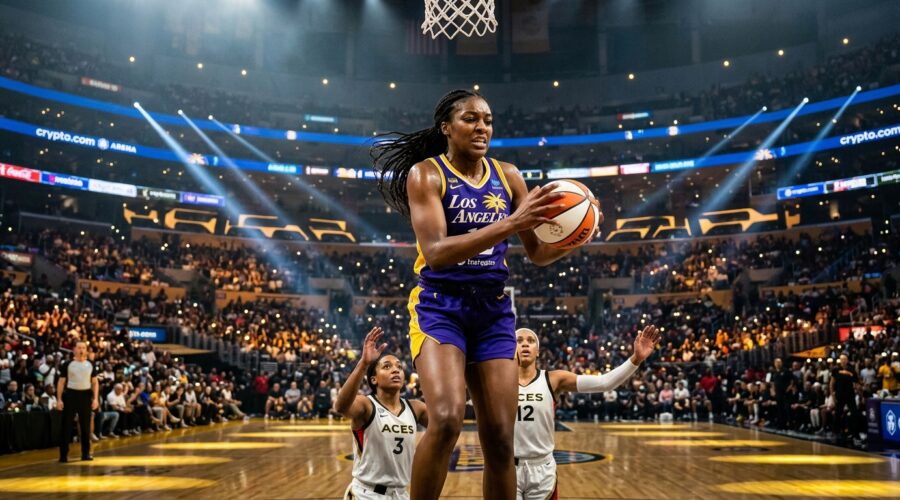
With 13.9 seconds left on the clock in a road game that meant everything and, statistically speaking, had already given her everything, Angel Reese caught a pass, laid it up, and secured her 27th double-double of the season. Then she did something almost absurd: she grabbed a missed free throw in the final seconds, lifting her rebound total on the night to 26. Not a typo. Twenty-six.
In a single Monday night in Los Angeles, on August 24, 2026, the Atlanta Dream’s 24-year-old forward broke not one but two WNBA rebounding records — the kind of records that were supposed to be safe. The kind that survive decades, endure generational turnover, and get dusted off only as footnotes in anniversary roundups. Angel Reese ended both of them before the night was over.
The Records That Fell
The first record had been standing for 23 years. On May 23, 2003, Hall of Famer Chamique Holdsclaw grabbed 24 rebounds for the Washington Mystics in a 74-70 win over the Charlotte Sting. It was a performance so singular that Guinness World Records formally recognized it. Michelle Snow came close with 23 in 2006. Tina Charles matched that number once, in 2011. No one got to 24 again. Until now.
Reese’s 26-rebound night obliterated the mark by two. The top five single-game rebounding performances in WNBA history now read like an Angel Reese monument, with Holdsclaw’s legendary effort sitting alone in second place behind a number that may stand for another generation.
The second record fell in the same contest, almost as a side effect. With each board she grabbed, Reese was quietly surpassing A’ja Wilson’s single-season total of 451 rebounds, set during Wilson’s historically dominant 2024 campaign — a season in which she also averaged 26.9 points per game (a WNBA record), swatted 98 shots, and became the first player in league history to lead the WNBA in total points, rebounds, and blocks simultaneously. Wilson’s 451 was not a soft number. It was the product of one of the most dominant individual seasons in the history of professional basketball. Reese finished August 24 with 458 season rebounds, with six games still remaining on the schedule.
A Night That Almost Didn’t Look Historic
Here is what makes the performance even more remarkable: Angel Reese shot 4-of-14 from the field. A 28.6 percent shooting night. She was, by almost every conventional offensive measure, struggling.
And she still grabbed 26 rebounds.
Reese addressed it herself in the postgame, with the kind of self-awareness that separates elite players from great ones: “Last time I was here, I didn’t miss any shots. Tonight I couldn’t hit anything, so I knew I was going to be able to get them on the rebounding side. I just want to be there for my team. Offensively, defensively, whatever it takes to win.”
That is not a cliche. That is basketball intelligence operating at an extremely high level. When her jumper was not falling, she converted her own misses, and the Sparks’ misses, and the atmosphere inside Crypto.com Arena into history. The Los Angeles Sparks as a team finished the game with 32 total rebounds. Reese alone had 26. The math is almost insulting.
Her full line: 11 points, 26 rebounds (18 defensive, 8 offensive), 3 assists, 3 steals in 38 minutes. The Dream won 78-71 in a game that was tied at halftime before Atlanta’s 26-18 third-quarter dismantled the Sparks and a 9-2 opening to the fourth quarter closed the door. Nneka Ogwumike put up a valiant 27 points and 16 rebounds for Los Angeles, which was essentially the best supporting performance of a night that Reese owned entirely.
The Rebounding Standard She Has Set — Three Times Over
Context matters here, because the sheer volume of records Reese now owns requires some unpacking.
The three highest single-season rebounding averages in WNBA history are: 13.1 rebounds per game (2024), 12.6 rebounds per game (2025), and 12.4 rebounds per game (2026 — with six games remaining). All three belong to Angel Reese. She is the only player in the history of the league to average 12 or more rebounds per game in a single season. She has done it three consecutive times.
Her 2024 rookie season alone reads like a WNBA fever dream. She set the all-time record for consecutive double-doubles at 15, breaking Candace Parker’s mark of 12. She was the fastest player to reach 20 double-doubles in a season. She finished with 446 total rebounds — only for A’ja Wilson to edge her at the wire with 451. She was named to the All-Rookie Team and the All-Star Game in the same year she was learning the professional game.
In 2025, still with the Chicago Sky, she finished second in the WNBA in double-doubles with 947, behind only Alyssa Thomas, who led the league with 31 double-doubles, and posted 12.6 rebounds per game on a team that finished 10-34. The Sky went 1-13 without her during a mid-season injury absence. She was holding together a sinking organization through sheer individual excellence. No playoff appearances in either of her Chicago seasons.
Then came the trade.
From Chicago to Atlanta, and the Lineup That Changed Everything
On April 6, 2026, the Atlanta Dream acquired Angel Reese from the Chicago Sky in exchange for first-round picks in 2027 and 2028, plus 2028 second-round swap rights. At the time, it was a significant haul for a rebuilding Sky organization. In hindsight, Atlanta may have gotten one of the great steals in recent WNBA trade history.
Reese put it plainly: “I wanted to go. Winning is the reason I ran to Atlanta.”
She ran into a roster built for her. The starting lineup of Jordin Canada, Allisha Gray, Rhyne Howard, Naz Hillmon, and Reese entered the August 24 game with a 24-7 record together, along with the best net rating of any five-player unit in the WNBA in 2026 among lineups that had shared the floor for at least 25 games. All three of Gray, Howard, and Reese were named 2026 WNBA All-Stars — the fifth time in franchise history the Dream have had three players named All-Stars in the same season, and the third time in the last four years.
On the night of the record game, Gray scored 20 points and set an Atlanta franchise season record with her 247th made field goal. Rhyne Howard added 18 points and crossed 3,000 career points. The Dream entered the contest 24-13, having already clinched their fourth consecutive playoff berth two days earlier with a win over the Phoenix Mercury — a game in which Reese scored a career-high 31 points.
The four-game West Coast road trip she closed out on August 24 had seen averages of 20.8 points, 15.0 rebounds, 4.3 assists, and 3.5 steals per game. That is a level of production without a clean comparison in the modern WNBA.
The Historical Case That Is Becoming Impossible to Ignore
When a reporter in the postgame accidentally referred to the rebound record as an “NBA record,” Reese’s response went immediately viral: “No, I don’t, because I be setting NBA records too.”
It sounds like bravado. The numbers suggest it is simply accuracy. Her early-career double-double pace, through 75 games in any major professional basketball league over the past 40 years, ranks tied for second — alongside Blake Griffin, with both players posting 57 double-doubles through 75 games — behind only Shaquille O’Neal. She reached 70 career double-doubles in 93 games, shattering the previous WNBA record held by Tina Charles, who needed 118 games to reach the same milestone. The gap between Reese and the rest is not narrow. It is 25 games wide and growing.
Reese is 24 years old.
The statistical case for her as the greatest rebounder in professional basketball history — not just WNBA history, across all professional leagues — is building with every passing game. Three consecutive seasons averaging above 12 rebounds per game in a league that has never seen that once before. The top three single-game performances in WNBA history now include one game featuring her 26 boards. The single-season record she just broke was set by A’ja Wilson in 2024 — a mark Reese had come within five rebounds of as a rookie that same year before surpassing it entirely on August 24.
Tina Charles — the all-time WNBA career rebounds leader and, in a beautiful piece of symmetry, one of Reese’s most important mentors — acknowledged this trajectory in a way that says everything: “I remember last year when I was playing against her and how she was giving me little keys to playing around the basket,” Reese said of Charles. The student is now dismantling the records her teacher spent a career setting.
What Comes Next
Six games remain in the 2026 WNBA regular season. Reese needs just two more double-doubles to break Alyssa Thomas’ single-season record of 28, set in 2023. She has not had a game without a double-digit rebound total all season. That record is not in danger — it is being stalked.
Her season rebounds total will almost certainly climb well past 458 before the regular season ends. The trajectory she is on, if maintained into the postseason and through the FIBA Women’s World Cup in September — her first appearance with the senior United States national team — will generate questions that sports media will struggle to contain within the boundaries of the WNBA.
Atlanta’s starting five is 24-7. The Dream are seeded fourth in the overall WNBA standings, with the Indiana Fever holding the top spot in the Eastern Conference. The first-round playoff exits of the past three seasons, all without Reese, feel like a different era. The organization that traded draft capital for one of the most statistically dominant players in the history of the sport made a decision that looks better with each passing week.
In the locker room after the game Monday night, Dream guard Allisha Gray searched for words and found the most honest ones available: “That’s a talent. I’m just in awe watching her rebound.”
Twenty-six rebounds. Two records. One night. At 24 years old, with a World Cup ahead and a postseason still to be written, Angel Reese is not done adding to what she is building. The only real question left is how far back the record books will need to be rewritten before she is finished.